87% of players finish the tutorial; 12% read the payout table
The gap between completing a product's tutorial and actually reading its payout table reveals how few users understand what they are really paying for
5 min read
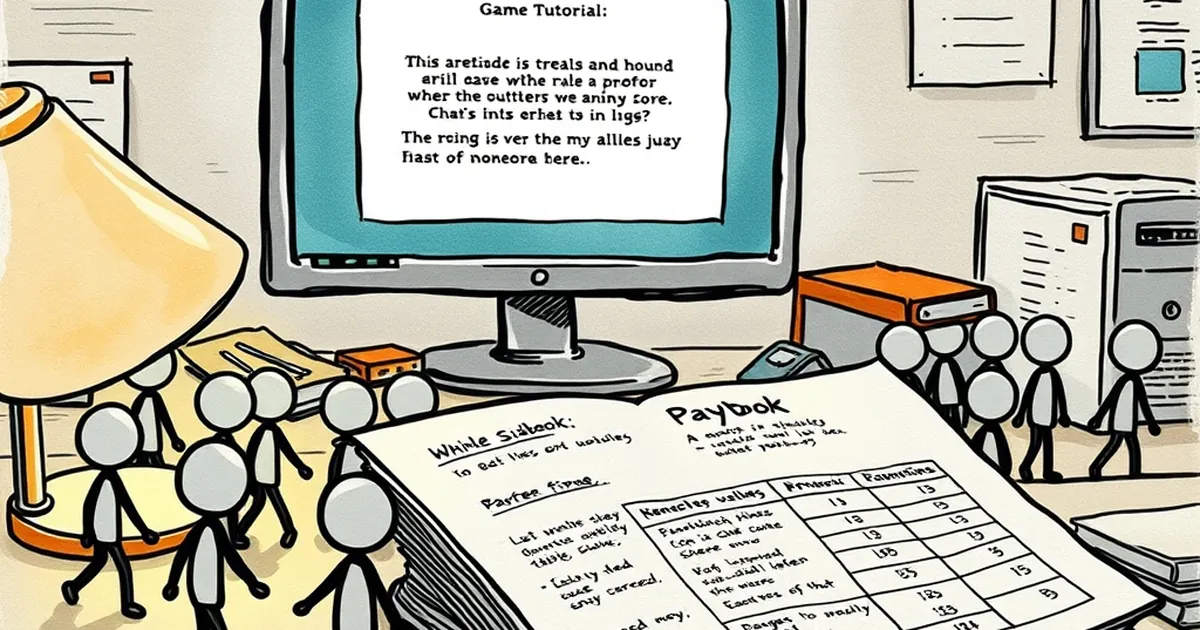
The gap between 87% and 12% is one of the most quietly damning statistics in consumer finance, and almost nobody talks about it. Most people will complete the guided experience of a product — the onboarding, the first transaction, the friendly walkthrough — while barely one in eight will ever open the document that explains what the product actually costs and how it actually pays out. That gap, between doing and understanding, is where a huge amount of the interesting overlap between payments and behavioral psychology lives.
The asymmetry between doing and knowing
Think about what a tutorial is designed to do. It reduces friction. It gets you to your first successful action as fast as possible, because the product team knows that a user who completes one transaction is dramatically more likely to complete a second. The tutorial is an onboarding tool, and its success metric is completion, not comprehension.
A payout table — or a fee schedule, a terms-of-service document, a cardholder agreement — is designed to do something almost opposite. It's a disclosure. Its success metric, if we're honest, is legal defensibility rather than human understanding. It exists so that the information is available, not so that it's absorbed.
So we've built an ecosystem where the frictionless path is heavily optimized and the comprehension path is barely optimized at all. That's not a conspiracy; it's just incentives. But it produces a predictable outcome: people transact confidently on a mental model they never checked against the actual terms.
What the 12% actually tells us
Here's the thing about that 12% figure — it's not really about laziness. It's about a well-documented cognitive economy. Herbert Simon's work on bounded rationality made the point decades ago: humans are cognitive misers, and we allocate attention where the perceived marginal return is highest. Reading a dense table of rates and conditions feels, in the moment, like it has a low marginal return compared to just using the thing.
Daniel Kahneman and Amos Tversky's work on loss aversion adds another layer. People don't evaluate a fee schedule in the abstract; they evaluate it against the possibility of being charged. And the possibility of a future charge is a loss that most of us would rather not pre-experience by reading about it. Avoidance is cheap in the short term. That's precisely why disclosure regimes that rely on people reading documents tend to underperform their designers' hopes.
There's also a subtler issue: the payout table is written by the party whose interests it encodes. Even a perfectly accurate table is a compressed, technical artifact, and reading it requires a kind of literacy that most consumers haven't been trained for. The 12% who read it aren't just more diligent — they're often more financially literate, which means the comprehension gap tracks existing gaps in financial capability.
Variable rewards and the shape of the loop
Payments products have quietly absorbed one of the most powerful findings in behavioral psychology: variable-ratio reinforcement. B.F. Skinner's work showed that intermittent, unpredictable rewards produce more persistent behavior than predictable ones. You don't need to look far to see this shape in modern finance — cashback that varies by category and rotates quarterly, points multipliers that change without warning, "surprise" bonus offers that appear at checkout.
None of this is inherently sinister. A rotating cashback category is a legitimate marketing tool. But it has a specific psychological consequence: it makes the payout structure harder to model. If the reward were fixed, you could compute it once and forget it. Because it varies, your brain keeps a live, fuzzy estimate running — and that fuzzy estimate is exactly the thing that never gets reconciled against the actual table.
This is the quiet cost of gamified rewards. The variable schedule keeps you engaged, but engagement is not the same as accuracy. People routinely overestimate what their rewards program returns, because the salient, memorable wins (the big multiplier, the surprise bonus) dominate the mental average while the ordinary 1% transactions fade.
The concrete case: overdraft and the mental model
A well-known illustration comes from the overdraft fee research that reshaped U.S. retail banking in the 2010s. Consumer advocates and regulators found that a small share of customers generated a disproportionate share of overdraft revenue, and — critically — many of those customers did not have an accurate model of when their account would go negative or what the fee would be. The fee schedule existed. It was disclosed. It was also, for most people, unread.
When the Consumer Financial Protection Bureau and several banks changed the default so that debit card transactions would be declined rather than approved with an overdraft fee, the behavioral result was striking: many customers who had been paying repeated fees simply stopped incurring them, and surveys suggested most did not want the "convenience" of the overdraft in the first place. The information had been available the whole time. What changed was the default, not the disclosure.
That's the lesson hiding inside the 87/12 split. When comprehension is optional, most people will skip it — not because they're reckless, but because the system is built to reward skipping. The most effective interventions don't try to push everyone into the 12%; they change the path so that the safe outcome is the default one.
Where this is heading
The forward-looking question for payments isn't "how do we get more people to read the table?" It's "how do we make the table unnecessary for the decisions that matter?" That means defaults that favor the user, fee structures that are legible at a glance rather than only in a PDF, and reward programs whose value you can see without reverse-engineering the terms.
There's a real opportunity here for the next generation of products. A card that shows you, in plain language and in real time, what a given transaction will cost you — before you tap — converts the payout table from a document into an interface. That's the direction the industry should be moving, because the 87% are never going to read the fine print, and it's not reasonable to keep designing as though they will.
The honest framing is this: comprehension is a design problem, not a discipline problem. Every product that pairs a frictionless tutorial with an unread disclosure is making an implicit bet that the gap won't matter. Sometimes it doesn't. But when it does — a surprise fee, a reward that never materializes, a cost that only shows up later — the person on the other end experiences it as a loss, and loss aversion is a powerful thing to activate in a customer you'd like to keep.