Savings goals hit 100% in 41 days; payday loans in 9 minutes
The gap between patient saving and impulsive payday borrowing reveals how product structure, not willpower, shapes our financial decisions
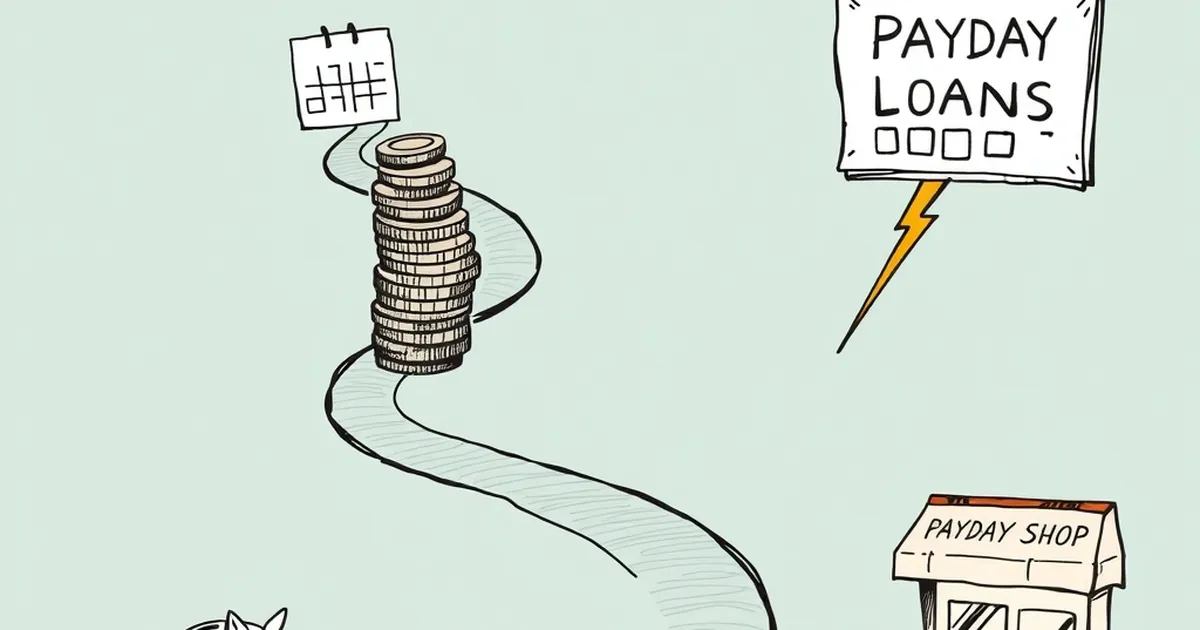
The same person who will spend forty-one days pacing toward a hundred-dollar savings goal can, on a bad Tuesday, apply for a nine-minute payday loan without blinking. That gap — between the patience we show when money is a goal and the impulsiveness we show when money is an emergency — is where behavioral economics stops being academic and starts being personal. What actually changes in those two moments? Not the person. The structure around them.
Two products, two completely different clocks
A savings goal and a payday loan are both financial products, but they're built on opposite assumptions about human attention.
A savings goal — whether it's a bank sub-account, a neobank "vault," or a fintech app's round-up feature — is engineered for delay. You see progress accumulate. You get a small hit of satisfaction each time the number ticks up. The product's entire value proposition is that it makes waiting feel like winning.
A payday loan is engineered for immediacy. The application is short by design. The approval is fast by design. The money arrives before your judgment has time to catch up. Nine minutes isn't a feature that happens to be fast — it's the product.
Both designs are deliberate. And both exploit the same underlying psychology, just pointed in different directions.
The reinforcement schedule hiding in your banking app
Behavioral psychologists have known since B.F. Skinner's work in the 1950s that variable-ratio reinforcement — rewards delivered after an unpredictable number of actions — produces the most persistent behavior. It's why people keep checking their phones. It's also why a savings app that occasionally shows you a surprise bonus, a streak milestone, or an "you're ahead of schedule!" notification keeps you coming back more reliably than one that pays a fixed, predictable interest rate.
This isn't a criticism. It's an observation about why some savings products work and others don't. A flat 4% APY is rational and boring. A round-up feature that occasionally doubles your spare change is irrational and sticky. Guess which one people actually use.
The uncomfortable flip side: the same variable-reinforcement logic makes instant-approval credit feel rewarding. The dopamine hit isn't the money — it's the resolution of uncertainty. You applied. You didn't know. Then: approved. That relief is real, and it's chemically indistinguishable from the relief of any other uncertain outcome resolving in your favor.
Why nine minutes beats forty-one days
Here's the asymmetry that should bother anyone who cares about financial design. Forty-one days of disciplined saving and nine minutes of borrowing are not weighted equally in the moment of decision. They're not even close.
Daniel Kahneman and Amos Tversky's work on loss aversion established that losses feel roughly twice as painful as equivalent gains feel good. A payday loan is framed as a solution to a loss — the rent is due, the car broke, the card was declined. Saving, by contrast, is framed as a gain — but a distant, abstract one. Present bias does the rest. The brain discounts the future at a rate that would embarrass any actuary.
So the nine-minute product wins not because people are reckless, but because it's competing against a forty-one-day product on a playing field tilted entirely toward the present. The person isn't choosing between two equally weighted options. They're choosing between relief now and a number going up later. That's not a fair fight, and pretending it is leads to bad policy and worse product design.
A concrete example worth sitting with
Consider the "save more tomorrow" concept developed by Richard Thaler and Shlomo Benartzi in the early 2000s. The idea was simple: instead of asking people to save more now, you ask them to commit a portion of their next raise to savings. Enrollment jumped dramatically, and — critically — most participants didn't opt out afterward.
The lesson wasn't that people are lazy. It was that the timing of the commitment mattered more than the amount. Move the decision away from the moment of temptation, and behavior changes.
Now apply that to the payday loan. Most borrowers don't wake up wanting a high-cost short-term loan. They arrive there through a sequence of small, reasonable-seeming decisions under pressure. The nine-minute approval doesn't create the pressure — it just refuses to interrupt it.
The overlap nobody wants to talk about
Visa and Mastercard sit at an interesting vantage point here, though not in the way you might expect. Card networks have spent decades building infrastructure that makes transactions frictionless — tap, pay, done. That frictionlessness is a genuine good. It also means the psychological distance between wanting something and paying for it has collapsed to nearly zero.
Meanwhile, the savings side of finance has spent the same decades making saving frictionless too — auto-enrollment, round-ups, sweep accounts. Both directions got faster. The net effect is that money moves constantly, in both directions, with very little conscious deliberation.
The question worth asking isn't whether friction is good or bad. It's where friction should live. A nine-minute payday loan has almost none at the point of decision. A forty-one-day savings goal has plenty — but in the form of waiting, not deliberation. Neither product asks you to think hard in the moment. They ask you to feel something and act.
What risk-taking looks like when the stakes are small
There's a behavioral thread here that connects to competitive play and risk-taking more broadly. People take more risks when the individual stakes feel small and the outcome is fast. A single tap, a single application, a single "yes" — each feels survivable in isolation. The compounding cost only becomes visible in aggregate, months later, when the statements arrive.
This is why framing matters so much. A payday loan presented as "$45 fee on a $400 loan" feels different from "an APR north of 300%." Both are true. One is designed to be processed in nine minutes. The other requires a spreadsheet.
Where this is heading
The most interesting development in payments and banking right now isn't a new card or a new app. It's the slow convergence of saving and borrowing into the same interface. Earned-wage access products, which let workers draw on wages they've already earned, sit precisely on this seam. They're faster than a payday loan and cheaper than most alternatives — but they still live in the same nine-minute decision window.
The design challenge for the next decade is whether we can build products that respect urgency without exploiting it. That means defaults that favor the saver, cooling-off periods that don't feel punitive, and interfaces that make the forty-one-day path as emotionally legible as the nine-minute one.
It's possible. The save-more-tomorrow research proved that small structural changes move behavior more than willpower ever will. The question is whether the industry wants to apply that lesson symmetrically — or only where it's profitable.
If you're building in this space, or just living inside it, the useful habit is unglamorous: notice which clock you're on. Goals run on one. Emergencies run on another. The products that win are the ones that know the difference — and the ones that don't are counting on you not to.