Why your card's fraud check flags a souvenir magnet
A declined €4 souvenir magnet reveals how card fraud systems make fast, uncertain decisions with incomplete data and asymmetric costs
5 min read
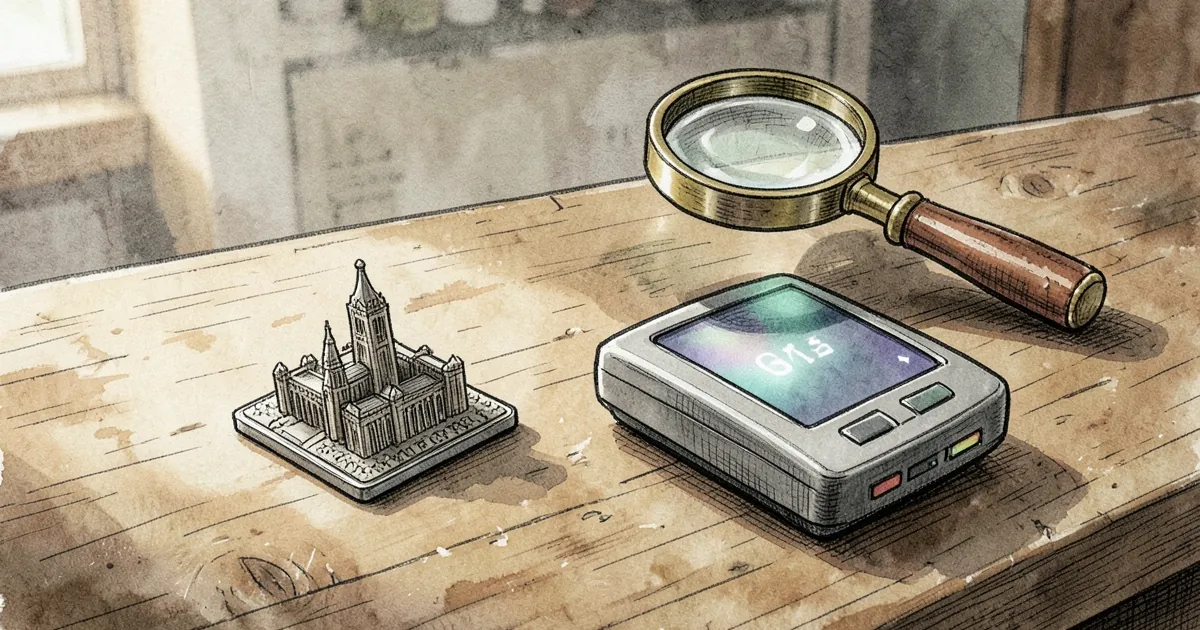
You're standing at a museum gift shop in a city you flew eleven hours to reach, holding a €4 fridge magnet shaped like a local landmark. You tap your card. The terminal thinks for a second, then declines. Your balance is fine. You paid for dinner an hour ago with the same card. So what, exactly, did the fraud system see in a fridge magnet that it didn't see in a restaurant bill?
The answer is that it saw almost nothing it recognized — and a great deal it didn't. Card fraud screening is a decision made under uncertainty, at speed, with incomplete information, and with wildly asymmetric costs. Once you look at it that way, the magnet stops being absurd and starts being predictable.
Every fraud check is a bet with lopsided stakes
A bank's fraud model is not trying to be right. It is trying to be usefully wrong. Approve a fraudulent transaction and you eat the chargeback, the replacement card, the investigation, and a customer who now associates your brand with a loss. Decline a genuine transaction and you annoy someone for ninety seconds.
Those two errors are not priced the same. This is loss aversion in its most operational form — the tendency, documented extensively by Kahneman and Tversky, for losses to weigh more heavily than equivalent gains. A fraud analyst's entire professional life is spent tuning a system so that it accepts a certain volume of false declines because the alternative is a smaller number of much more expensive misses. Your magnet is on the wrong side of that trade.
There's a second layer: the model doesn't know what a magnet is. It knows a merchant category code, a terminal type, a country, a time, an amount, and a device fingerprint. A €4 souvenir purchase at a card-present terminal in a tourist district, on a card issued three thousand miles away, made four minutes after a taxi ride — that pattern is also the pattern of a stolen card being tested before a bigger spend. The system can't tell the difference, so it leans on the base rate.
The souvenir shop is a textbook anomaly
Think about what's unusual in that transaction, from the model's point of view.
You are physically present, which usually helps. But your card's home geography and the terminal's geography disagree. Your spending has shifted abruptly in category — food, transport, then a tiny retail purchase. And the amount is small, which is its own warning sign. Fraudsters test cards with small amounts precisely because small amounts clear more often and confirm the card works before the real theft.
This is why a magnet gets flagged while a hotel bill sails through. Hotels are high-value, but they're also high-friction for fraudsters: they demand ID, they pre-authorize, they have chargeback exposure and staff who look at the card. A gift shop has a queue and a teenager with a terminal. If you want to understand why the same card behaves differently across merchant types, the mechanics of why your card works at a hotel but fails at checkout are the same mechanics at work here, just inverted.
Variable-ratio reinforcement, and why you keep tapping
Here's the part that should interest anyone who thinks about consumer behavior. Your card declines unpredictably. Mostly it works. Occasionally it doesn't. That intermittent pattern is the most durable reinforcement schedule known — variable-ratio, the same structure B.F. Skinner found produced the most persistent responding in his operant conditioning work.
The practical consequence: you don't stop tapping. You tap again, harder, maybe with a different card, maybe with your phone. You might call the number on the back. The unpredictability doesn't teach you to avoid the card; it teaches you to keep probing it, because the next attempt might work. Banks know this. It's why a decline is often followed by an immediate "try again" prompt rather than a hard block.
That same unpredictability is what makes the appeal process so corrosive. A fraud check that resolves in two minutes feels like a hiccup. The dispute that follows a wrongly flagged transaction takes days, and the asymmetry between those two durations is a recurring theme in how these systems fail customers — the two-minute check that clears against the nine-day appeal is the clearest version of it.
What the decision actually looks like from inside
Picture the analyst's dashboard. A model produces a risk score between 0 and 1. A threshold converts that score into approve, challenge, or decline. Move the threshold down and you catch more fraud and annoy more tourists. Move it up and the magnet clears, along with some genuine theft.
Nobody sets that threshold once. It drifts with the fraud rate, the season, the merchant mix, the regulator's mood. During a fraud spike the threshold tightens and your magnet fails. Two weeks later the same purchase clears without a flicker. This is why two people on the same trip, with the same bank, get different outcomes — and why the same person gets different outcomes on different days.
There's also a competitive dimension that rarely gets discussed. Networks and issuers compete on approval rates as much as on fraud rates, because a declined card is a lost transaction and, eventually, a lost customer. That competition pushes thresholds in the opposite direction from the fraud losses. The equilibrium is unstable by design, and it moves under your feet.
The small-amount trap, and what to do about it
If you want fewer magnet moments, work with the system rather than against it.
- Tell the bank you're travelling, if your issuer still offers it. It's crude, but it pre-loads the geography into the model.
- Expect the small purchase to be the risky one. Counterintuitively, a €4 tap in an unfamiliar place is a harder sell than a €200 dinner. If you have a second card, keep it for exactly this.
- Don't retry the same terminal repeatedly. Each attempt is a new event, and rapid repeats can look like card testing — the very pattern the system is trying to catch. A different terminal or a chip-and-PIN read often clears where a contactless tap fails.
- Use the app's confirmation prompt when it appears. A biometric approval is the strongest signal you can send, because it proves presence in a way a tap doesn't.
- If it declines, check whether it's the check or the balance. They look identical at the terminal. The distinction matters, and it's laid out in why a 2:47 AM decline is the check and not the balance — the same logic applies at 2:47 PM in a gift shop.
The forward-looking point is this: as card-present fraud gets harder, the interesting decisions migrate to the margins — tiny amounts, unfamiliar geographies, abrupt category shifts. Those are precisely the cases where a model has the least to go on and the most to lose, and where the human standing at the counter has information the model doesn't. The next generation of fraud systems will be judged less on how much theft they stop and more on whether they can ask you a question instead of silently guessing. Until then, buy the magnet with the card you can afford to have declined, and don't take it personally. It was never about you.