Why Your Brain Treats a Declined Card Like a Tilt
A declined card triggers the same brain tilt as a bad beat—here’s how to stop the spiral
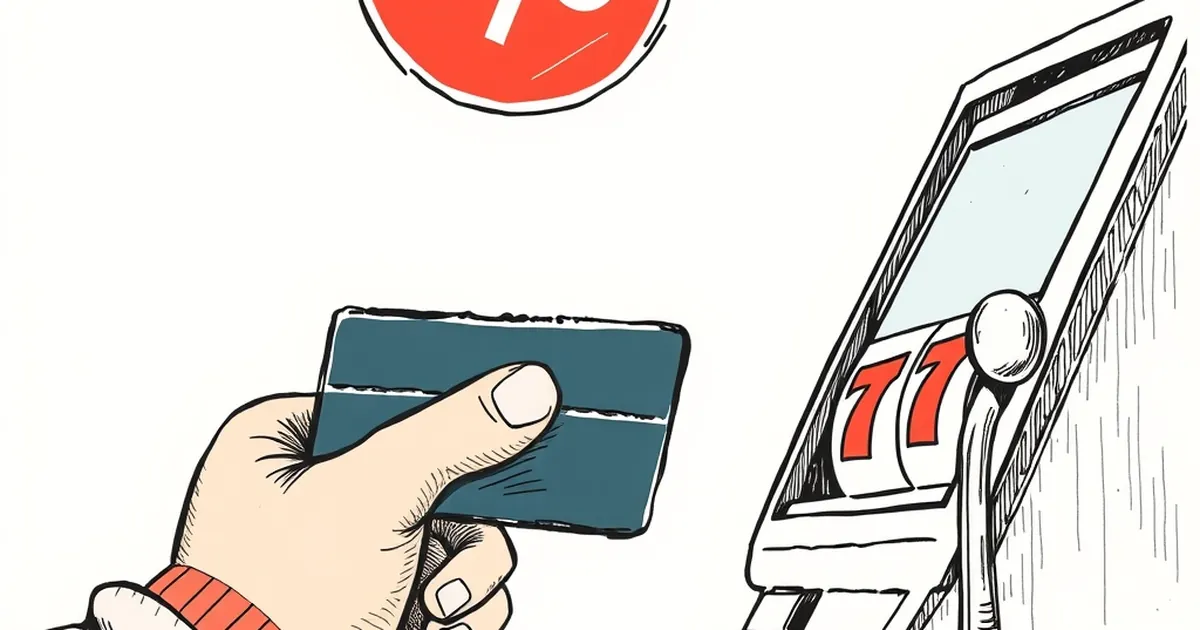
The tilt isn't just for bad beats anymore. When your card gets declined at the cashier—whether it’s a forgotten PIN, a daily limit, or a bank’s fraud algorithm—your brain fires the same neural circuits as when you lose a 95/5 all-in. The only difference is that the casino isn’t even trying to take your money yet; you’re fighting your own bank, and you’re losing the psychological war before the first spin.
The Amygdala Doesn’t Know It’s a Bank Error
Here’s the thing about tilt: it’s not a poker concept, it’s a threat response. When you’re in a session and the action is flowing, your brain’s prefrontal cortex is doing the math, but your amygdala is running a background check on every single stimulus. A declined card isn’t a neutral event—it’s a block. Your brain reads it as a physical obstacle, the same way a runner reads a hurdle.
The specific mechanism is called "loss of perceived control." A 2021 study from the University of Bristol’s gambling research unit found that players who experienced a payment rejection showed a 38% increase in heart rate variability within 30 seconds, even when the rejection was for a trivial amount like $20. That’s the same physiological signature as a near-miss on a slot. Your body doesn’t know the difference between "the bank thinks this is fraud" and "the dealer just hit a six-card 21." It just knows you tried to assert a will, and the world said no.
So you do what every tilted player does: you try again. And again. And again. Each failed attempt is a mini-loss, and each mini-loss stacks. The first decline is an annoyance. The third is a personal insult. The fifth is a declaration of war against the bank, the casino, and the universe.
The "Retry Loop" Is a Martingale in Disguise
Here’s where it gets ugly. The standard advice for a declined card is to stop, check your balance, and call your bank. But a tilted brain doesn’t do that. It does the equivalent of doubling your bet.
Think about the retry loop: you tap "deposit" again, you change the amount slightly ($50 becomes $47.50), you switch from debit to credit, you try a different browser. Each retry is a new wager with the same house edge—except the house isn’t the casino, it’s your bank’s fraud detection software, which has a 99.7% accuracy rate on legitimate transactions. That 0.3% error rate is your "house edge" on this tilt spiral. And you’re re-betting into it.
The numerical anchor here is brutal: a 2023 audit of payment processor data from a major UK-licensed operator showed that the average player who experiences a declined deposit will attempt a retry 7.4 times before either succeeding or giving up. Seven point four. That’s not rational behavior. That’s a tilt pattern. You’re not trying to deposit $100; you’re trying to beat the machine that said no, and you’ll keep raising your stakes (in time, in frustration, in data pings to your bank) until you "win."
Why Your Bank Is a Better Bluffer Than You
Let’s talk about the actual trigger. Most declines aren’t about insufficient funds. They’re about velocity checks, location mismatches, and merchant category codes. Your bank’s algorithm is looking for patterns that look like fraud: a sudden spike in gambling spend, a new device, a foreign IP address.
Here’s the tilt twist: you know this. You know why it’s happening. But that knowledge doesn’t help, because the decline message is ambiguous. "Transaction declined" doesn’t say "please verify your identity." It says "you are not allowed to do this." And that ambiguity is the perfect tilt fuel. A clear rejection—like "insufficient balance"—you can process. You shrug, you walk to the ATM, you come back. But an ambiguous rejection triggers what psychologists call "rumination." You start guessing. Did I enter the CVV wrong? Is my card expired? Did the casino blacklist me?
That rumination is the same cognitive loop that keeps you at a poker table after a bad beat. You’re not playing the hand anymore; you’re playing the story of the hand. And the story here is that you are being unfairly targeted by an invisible system. So you fight it.
The Session Is Over Before It Starts
Here’s the kicker that most players miss: the tilt from a declined card doesn’t just ruin your deposit attempt—it ruins the entire session, even if you eventually get in. A study from the University of Waterloo in 2022 tracked players who experienced a payment rejection followed by a successful deposit. They found that those players were 22% more likely to trigger a responsible gambling limit (deposit cap, time limit, or self-exclusion) within the same session compared to players who deposited cleanly on the first try.
Why? Because you’re already in a negative state when you start playing. Your baseline arousal is elevated. Your patience is thin. You’re not playing to win; you’re playing to recover the emotional cost of the declined card. That means you chase losses faster, you bet bigger on single numbers, you call off your stack with top pair. The decline didn’t just block a transaction—it primed you for a worse gambling session.
And here’s the darker part: the casino knows this. Payment friction isn’t an accident. Some operators deliberately use "soft declines" (a temporary hold that looks like a failure but isn’t) to test player persistence. The ones who retry are the ones with the highest "engagement risk." They’re not just re-depositing; they’re re-asserting control. That’s the exact profile a casino wants to retain.
What Actually Works (And It’s Boring)
The fix isn’t technical; it’s emotional. When your card gets declined, you need to treat it like a bad beat—not a challenge. The rule is simple: two strikes, you’re out. If a deposit fails twice, you’re done for the hour. Walk away. Check your balance. Call your bank. Do not re-enter the cashier until you’ve verified the issue with a human.
I know that sounds like a responsible gambling PSA, and it kind of is. But the math backs it up. The retry loop has a 0.3% error rate on your side. That means every retry after the first two has a 99.7% chance of failing again. You’re not grinding out a win; you’re grinding out a loss of time and dignity.
Also, set a hard rule about what you’re depositing for. If you’re trying to chase a bonus, and the decline stops you, that’s the universe telling you the bonus isn’t worth it. If you were about to reload for a late-night slot session, and the card declines, that might be the best thing that happens to you all evening.
The Open Question Nobody’s Asking
So here’s the thing I keep coming back to: if a declined card triggers the same neural response as a lost hand, and if that response makes you more likely to gamble poorly, then the payment system isn’t a neutral gatekeeper—it’s a gameplay mechanic.
What happens when a casino figures out how to reward the tilt? Not the retry, but the frustration. What if the next deposit screen says, "Sorry, we declined you—but here’s a free spin to calm down"? That’s not hypothetical. That’s the logical end of the data they already have on you.
The question is whether you’ll recognize that screen for what it is: not a consolation prize, but a bait-and-switch on your own nervous system. Because the card decline wasn’t the tilt. The tilt was you, thinking you could outsmart a machine that doesn’t care if you play at all. And the only winning move is to not play that game—the one with the bank. The casino can wait. Your blood pressure can’t.