Poker's time bank refills when you look away
Online poker time banks often pause when the table loses focus, so players who look away can return to the same seconds waiting
5 min read
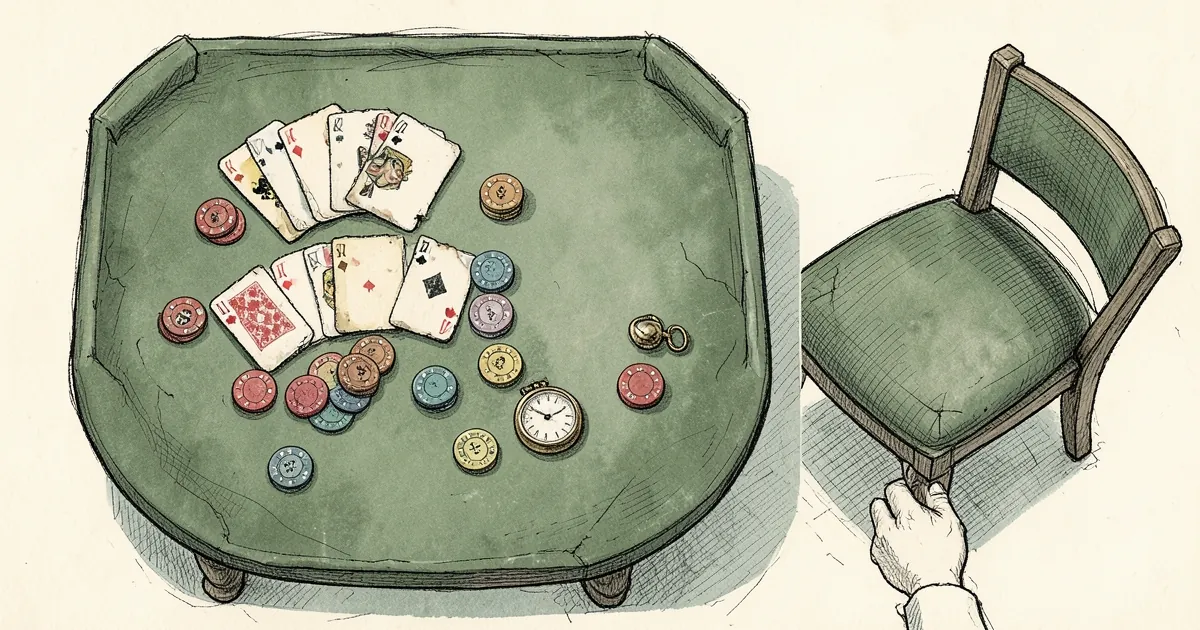
The clock in most online poker rooms stops when you leave the table, and it starts again the moment you come back. That's not a bug report or a rumour from a disgruntled grinder — it's how the time bank is built. Most clients pause the countdown on tab blur or window focus loss, so a player who burns their 15-second bank, flips to another window for a minute, and returns finds the same seconds waiting. The tank clock doesn't run in real time. It runs in your time.
What the time bank actually counts
Time banks are usually described as a fixed budget: 15 seconds, 30 seconds, sometimes a minute per tournament, topped up every orbit or every level. The number in the settings menu is accurate. What isn't obvious is that the number counts active table seconds, not wall-clock seconds. If the client loses focus, the timer handler stops firing, and the budget stays where it was.
That's a design choice, not malice. Poker clients are built to be forgiving of a player who alt-tabs to check a spreadsheet, answer a message, or look up a hand history. Pausing the clock prevents a disconnect or an unexpected pop-up from eating a tournament life. The same logic shows up across the industry in odd corners — deposit pending screens that speed up the moment you look away are the same phenomenon in reverse: the client behaves differently depending on whether the window is in focus.
The catch is that "in focus" is a fuzzy concept. A second monitor, a phone on the desk, a browser tab playing a video — none of these are cheating, and none of them are invisible to the client. Some rooms pause on any blur. Some pause only when the tab is hidden. Some pause on a mouse-leave event but not on keyboard focus loss. The behaviour varies by client version, skin, and operator, which is why two players in the same tournament can disagree about whether the clock "runs out" while they're reading an email.
The 15-second bank that behaves like four minutes
A practical example. A player has a 15-second bank and a 30-second action clock. They use the action clock, then dip into the bank for 10 seconds, then alt-tab to check a message. If the client pauses on blur, those 10 seconds stay in the bank. They come back, use the remaining 5, and the action clock restarts. Across a session of 200 hands, a player who consistently alt-tabs mid-decision can effectively borrow minutes of thinking time that the table clock never records. The math is dull but the effect isn't: the tank clock borrows about four minutes a session once you add up the pauses, and no one in the hand sees it happen.
Why the pause exists, and where it breaks
Pausing on blur is a UX decision that made sense when poker clients were single-window desktop apps and the main risk was a player losing a tournament to a Windows update prompt. The cost is a timing asymmetry that's invisible in the hand history. A player who takes 40 seconds to act looks like a slow player. A player who takes 10 seconds, tabs away for 30, and comes back looks like a fast player — and their hand history records a 10-second decision.
That asymmetry matters more than it sounds. Hand-history tools and tracking software compute timing tells from the action clock, and those tells are one of the few live reads available online. If the clock pauses on blur, the tell is unreliable: the player who "snap-called" may have spent half a minute thinking about it in another window. The same problem shows up in other client-side timing decisions — hand history imports that drop three days of session graph are a different bug with the same root cause: the client's record of what happened doesn't match what actually happened.
What the operator sees
From the operator's side, the pause is mostly invisible. The server receives an action when it receives an action. It doesn't know whether the client was in focus, minimised, or running on a second monitor. Anti-collusion and bot-detection tools work on action timing and bet patterns, and a paused clock distorts both. A bot that never blurs is unaffected. A human who blurs constantly looks faster than they are. The signal gets noisier for everyone.
There's a regulatory angle too, though it's thin. Most licensing regimes require fair and transparent game rules, and a time bank that behaves differently depending on window focus is arguably neither. No regulator I'm aware of has published guidance specifically on timer pausing, and it's unlikely to become a priority while the effect is small and the exploit is unglamorous. But "small and unglamorous" is how most edge cases start.
The phone problem
Mobile clients handle focus differently again. On iOS and Android, backgrounding an app usually suspends the timer, which is correct behaviour — the OS is telling the app it's no longer visible. But some clients treat a notification banner, a control-centre swipe, or a split-screen view as a focus loss, and others don't. A player on a phone who gets a message mid-hand may or may not have their bank paused, depending on the client build and the OS version.
That's a worse problem than the desktop one because mobile players are more likely to be multitasking. The same player who'd never alt-tab on a desktop will glance at a notification on a phone without thinking about it. If the clock pauses, they get free time. If it doesn't, they time out. Either way, the rule isn't the one written in the settings menu.
What a fair clock would look like
A time bank that counts wall-clock seconds is the obvious fix, and it's the one most live poker rooms use: the shot clock runs whether you're looking at the table or not. Online clients could do the same. The reason they don't is that a wall-clock bank punishes players for connection hiccups, browser crashes, and the ordinary distractions of playing at home. The pause is a kindness.
The compromise most rooms settle on is a server-side clock that keeps running but grants a short grace period for reconnects. That's roughly what live-dealer streams do with their shuffle proof — the 1080p stream shows the shuffle, but the audit trail never downloads — the visible layer and the verifiable layer are two different things, and players only see the friendly one.
So the open question isn't whether the pause should exist. It's whether players should be told about it. A line in the table info — "your time bank pauses when the table loses focus" — would cost nothing and change how people play. The fact that almost no room writes it down is the part worth thinking about. If the clock is borrowing your attention, you should at least know the loan terms.