Poker timer banks 15s; the tank clock borrows 4 minutes
A 15-second refillable time bank and a four-minute borrowable tank clock are reshaping poker tournament pacing for live and online MTT players
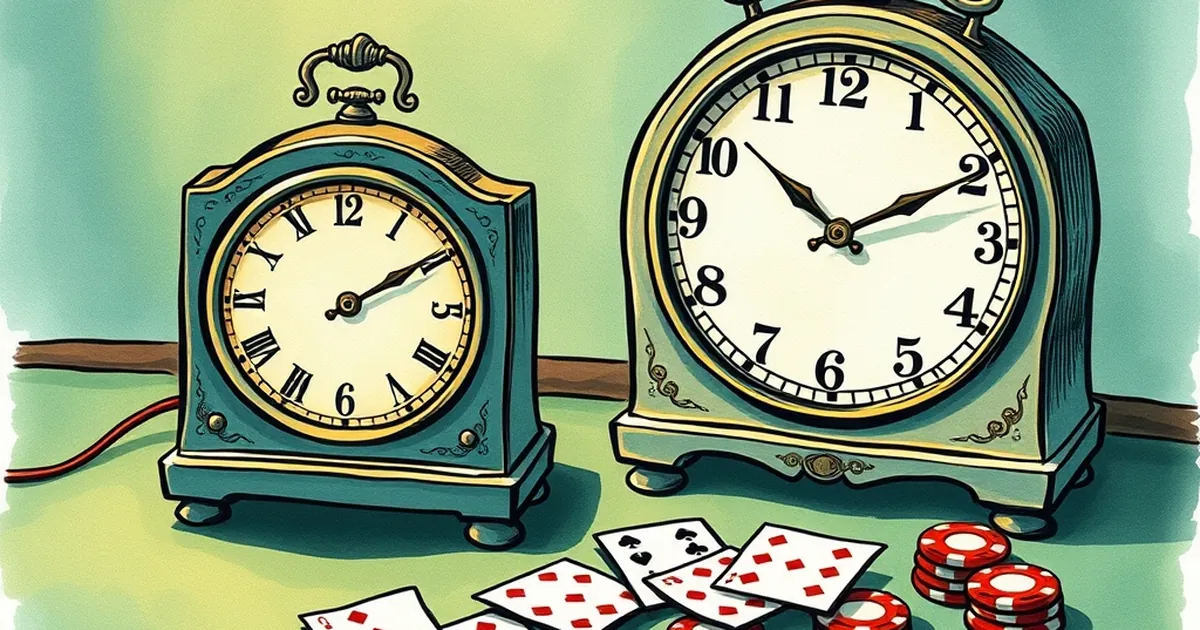
A 15-second time bank per decision, refilled between hands, and a separate tank clock that lets you borrow up to four minutes across a session. That's the structure a growing number of tournament floors and online poker rooms have settled on, and it's a meaningful change from the old model where a fixed clock per decision was the only lever available. The claim in the headline is literal: the bank is small and replenishes, the tank is large and doesn't.
If you play live tournaments or grind online MTTs, you've probably already felt the difference without naming it. The short bank keeps the game moving. The bigger tank exists because sometimes a hand genuinely deserves more than 15 seconds, and forcing a snap decision on a river shove with your tournament life at stake is bad for the game, not just for you.
Why two clocks instead of one
The single-clock model has a known failure mode. Set the clock at 30 seconds and slow players bleed the field dry; set it at 20 and everyone who faces a tough spot feels rushed into a mistake they'll resent. There's no single number that works for both the player who needs three seconds and the player who needs ninety.
Splitting the clock into a bank and a tank solves that by separating the routine decision from the exceptional one. Most spots take a few seconds. The bank covers them and refills, so the fast player never accumulates credit they can't use and the slow player never runs dry on hands that don't matter. The tank is the reserve you dip into when the pot is enormous and the decision actually warrants the time.
The numbers matter here. A 15-second bank refilled every hand is roughly the median decision time in most tournament formats, which means the average player never touches their tank at all. The tank only gets spent by players in genuinely difficult spots — and because it's finite, spending it has a cost.
The bank refills; the tank doesn't
This is the part people get wrong when they first encounter the format. The 15 seconds comes back. Use 14 of them on a tough flop and you're back to 15 on the next hand. The four-minute tank does not come back. Once it's gone, you're playing on the bank alone for the rest of the level, or the rest of the tournament, depending on how the room structures it.
Some venues reset the tank at each break or each level; others make it a tournament-long resource. That distinction changes strategy more than the raw numbers suggest. A four-minute tank that resets every two hours is a completely different animal from four minutes for the whole event.
What four minutes actually buys you
Four minutes sounds generous until you do the arithmetic. In a live tournament you might face a genuinely hard decision — a multi-way river with a polarized range, a bubble spot where ICM does strange things to your calling range — maybe six or eight times in a deep run. Spend 30 seconds on each and you've used three to four minutes without trying.
Online, the math is harsher because you see more hands. A fast MTT structure can put you in 200+ decisions an hour across multiple tables, and while most are trivial, the tank gets tested more often. Rooms that run this format online typically tie the tank to the tournament rather than the table, which means multitabling players have to budget it consciously.
The practical upshot: treat the tank as a resource with an opportunity cost, not a safety net. Burning 90 seconds on a marginal call you were always going to make is the poker equivalent of leaving value on the table.
When to spend it
The spots that justify tank time tend to share a feature: the decision is close, the pot is large, and getting it wrong ends your tournament or costs you a significant chunk of chips. A coin-flip all-in on the bubble with a short stack doesn't need four minutes — the math is the math. A river decision where you're weighing a thin value bet against a check-raise, with 40 big blinds behind and a pay jump two spots away, does.
There's also a meta-game argument for spending the tank visibly. Opponents notice who tanks and who snap-calls, and a player who never uses their tank reads as either very fast or very predictable. Neither is ideal.
The 15-second bank and the pace-of-play problem
Tournament directors have been fighting slow play for two decades. The old solutions — clock calling, penalty cards, and in extreme cases disqualification — are blunt instruments that create bad feeling and slow the game down further while a floorperson walks over.
A 15-second bank is a structural fix rather than an enforcement one. It sets an expectation, and because the bank refills, nobody can argue they're being rushed on a routine hand. The tank absorbs the legitimate exceptions. In rooms that have adopted it, the effect on hands-per-hour is usually noticeable within a level or two, though published figures are scarce and venue-specific.
The number that matters for the broader ecosystem is the one the World Series of Poker introduced when it moved to a 30-second shot clock with time-bank chips in its main event — a format that has since been copied and tightened across the industry. The direction of travel is clear: shorter default clocks, more structured exceptions.
Where the format gets awkward
The bank-and-tank model assumes a dealer or a machine tracking time accurately. Live, that means a dedicated clock, a dealer trained to enforce it, and a floor staff willing to back the dealer up when a player argues. Rooms that run the format half-heartedly — a clock on the table but no real enforcement — end up with the worst of both worlds: the appearance of speed and none of the benefit.
Online, the awkwardness is different. Multitabling players juggling six tables can't always give a 15-second bank their full attention, and a tank that's tied to the tournament rather than the table can vanish faster than expected. Some rooms have responded by scaling the bank with the number of tables, which is sensible but adds a layer of complexity most players won't bother to learn.
The strategic adjustment most players miss
The obvious adjustment is to hoard the tank. The less obvious one is that the short bank changes how you should think about your entire decision process.
With 15 seconds, you can't run a full range analysis at the table. You need to have done that work away from the table so that the in-hand decision is recognition, not computation. Players who arrive at the felt relying on deep in-hand thinking will find the bank forces errors they wouldn't otherwise make — not because they're slow, but because their process depends on time they no longer have.
The tank doesn't fix that. It's a patch for the genuinely hard spots, not a substitute for preparation. If anything, the format rewards players who've already solved the common situations and can spend their tank on the rare ones.
There's a related effect on table image. A player who consistently uses 10 to 14 seconds of the bank on every decision looks deliberate. A player who snaps in three seconds looks either confident or careless, and opponents will adjust accordingly. The clock is information now, in a way it wasn't when everyone had the same 30 seconds and used it however they liked.
What the clock is really doing
The bank-and-tank structure is a quiet admission that the old model was solving the wrong problem. It treated time as a per-hand allowance when it's actually a per-session resource, and it punished the patient player and the fast player equally.
Whether the specific numbers — 15 seconds, four minutes — are the right calibration is an open question. A 15-second bank may be tight for live play with physical chips and a dealer to read, and four minutes may be too generous for a fast online structure where the tank gets tested twice as often. Rooms are already experimenting with variants: shorter tanks that reset per level, longer banks for final tables, and hybrid models that give the tank a small automatic top-up at each break.
The interesting question isn't whether the format spreads — it probably will, because it solves a real problem — but whether players adapt their preparation to match. A clock that rewards pre-solved decisions and punishes in-hand computation is a different game from the one most people learned, and the players who notice that first will have an edge that has nothing to do with their cards.