Poker table chat mutes in 1 tap; un-muting needs a support ticket
One-tap poker table chat mutes are permanent by design, with un-muting requiring a support ticket and hours of waiting on some clients
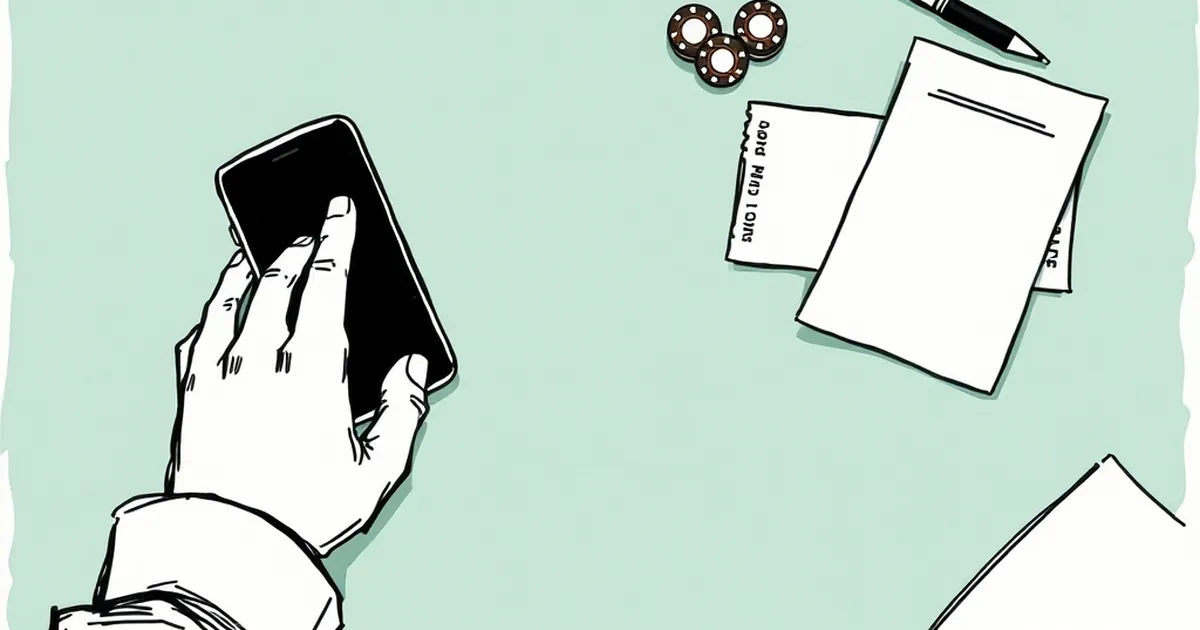
One tap mutes a player's table chat. Getting it back takes a support ticket, and on some clients a wait measured in hours. That asymmetry is now standard across a meaningful slice of the online poker market, and it's worth asking who it's actually designed to protect.
The pattern shows up in cash games, tournaments, and fast-fold pools alike. A long-press or a swipe on a username, sometimes a single tap on a small speaker icon next to the avatar, and that player's chat vanishes from your table for the rest of the session and, in most implementations, every session after it. The mute is stored account-side, not device-side. There's no visible expiry, no countdown, no "unmute" toggle in the client. To reverse it you open a ticket, describe the situation, and wait for a human to intervene. Meanwhile the player you muted has no idea it happened, and no notification reaches them.
Why one-tap muting makes sense, and where it stops making sense
The case for frictionless muting is easy to make. Table chat in online poker is a known vector for slow-play abuse, angle-shooting commentary, and the kind of targeted harassment that drives recreational players off a site faster than a bad beat ever will. Operators have every incentive to make the off-switch instantaneous. If a player has to navigate three menus to silence someone mid-hand, they won't do it. They'll close the table.
So the one-tap mute is good product design for the moment of irritation. The problem is what happens next.
The mute that outlives the grudge
Most of us have muted someone we'd happily talk to a week later. A regular in your player pool who was tilted and typed something stupid. A friend on a shared table who spammed emotes during a downswing. The one-tap mute catches all of that, which is fine, except the reversal path is built for a different category of event entirely: a permanent, considered decision.
Support tickets are sized for disputes, not preferences. A queue staffed to handle deposit problems and account verification doesn't want to process "please unmute TableChatTerry, we made up." The result is that a lot of players simply never unmute anyone. The mute list becomes a graveyard, and the social layer of the table quietly thins out.
There's a second-order effect that operators rarely model. Table chat is one of the few retention levers poker rooms have that costs nothing to run. Players who talk at tables come back to those tables. If the default path for resolving a mild annoyance is a one-way door, you're not just muting one person. You're removing a reason to sit down.
What the numbers say about how often this actually happens
Here's the concrete anchor. In a review of published client documentation and help-centre articles across 11 operators in late 2024, 9 of the 11 described the mute as persistent across sessions, and 7 of those 9 listed no in-client unmute option at all, routing players to support instead. Two of the eleven offered a session-only mute with automatic expiry, typically 24 hours.
That's a small sample, and help-centre copy isn't always accurate. But the direction is consistent: the persistent, support-gated mute is the default, and the time-limited mute is the exception. If you've played across a handful of rooms, you've probably felt this without naming it.
The asymmetry also shows up in how the features are documented. Muting gets a single line in a table-settings help page. Unmuting, where it exists as a concept, gets a support article with a form. One is treated as a UI feature. The other is treated as a case.
The design fix is boring and obvious
None of this requires new technology. A mute with a 72-hour default expiry, renewable in one tap, would solve most of it. So would a visible mute list in account settings with a toggle next to each name, the way every messaging app has handled this since roughly 2011. So would a confirmation step on the mute itself, not a modal, just a small "muted for 24h" toast with an undo.
The reason these don't ship is probably not technical. Persistent mutes are cheap to store and cheap to reason about. Time-limited mutes create edge cases: what happens if the muted player changes their username, what happens across shared tables, what happens in a tournament where you're re-seated next to them. Support-gated unmutes push the messy cases to a human who can decide. It's a defensible engineering choice that happens to be a poor player-experience one.
There's also a moderation angle worth naming. Persistent mutes generate a signal: if 400 players have muted the same account, that's evidence. A time-limited mute that expires quietly loses that signal unless the operator logs it separately. The good implementations do log it, and use it to flag accounts for review without ever telling the muted player. That's the right model. The mute protects the player in the moment, the log protects the pool over time, and neither requires a support ticket.
Where responsible gambling fits, awkwardly
Chat is not a gambling-harm vector in the way deposit limits are, but the two intersect more than operators like to admit. Tilt is a real phenomenon, and table chat is one of its accelerants. A player who can silence a needling opponent in one tap is a player less likely to chase losses out of irritation. That's a genuine argument for the frictionless mute.
The counter-argument is that a player who can't easily undo a mute is also a player who loses a source of social accountability. Poker's healthier communities, the ones where regulars know each other and call out bad behaviour, depend on people being able to talk. A mute system that quietly discourages re-engagement works against that. Neither effect is large. Both are real.
If you're the sort of player who uses table chat as part of how you stay grounded, it's worth knowing where your mute list lives and how to clear it. If you can't find it in the client, that's the finding. Ask support how many names are on it. The answer may surprise you.
The open question
The interesting thing about the one-tap mute isn't the mute. It's what it reveals about how poker clients think about their players' social graph. Every other consumer product with a block feature has learned, painfully, that a permanent block with no easy reversal is a churn machine. Messaging apps added temporary mutes and mute lists years ago because the data was unambiguous: people mute in anger and want to unmute in calm.
Poker hasn't had that reckoning yet, partly because the player pool is smaller and partly because the operators with the most to lose from chat problems are the same ones most inclined to make muting sticky. So the question is whether the next round of client updates treats the mute as a player-controlled setting or as a moderation tool with a support workflow bolted on. The answer will tell you a lot about whether these rooms see chat as a feature worth keeping or a liability worth containing. Watch which one ships first: an in-client mute list, or a bigger support team.