Points expire at 90 days; the streak bonus dies at 14
Why a 14-day streak cliff feels far more urgent than points quietly decaying over 90 days, and what that gap means for rewards design
5 min read
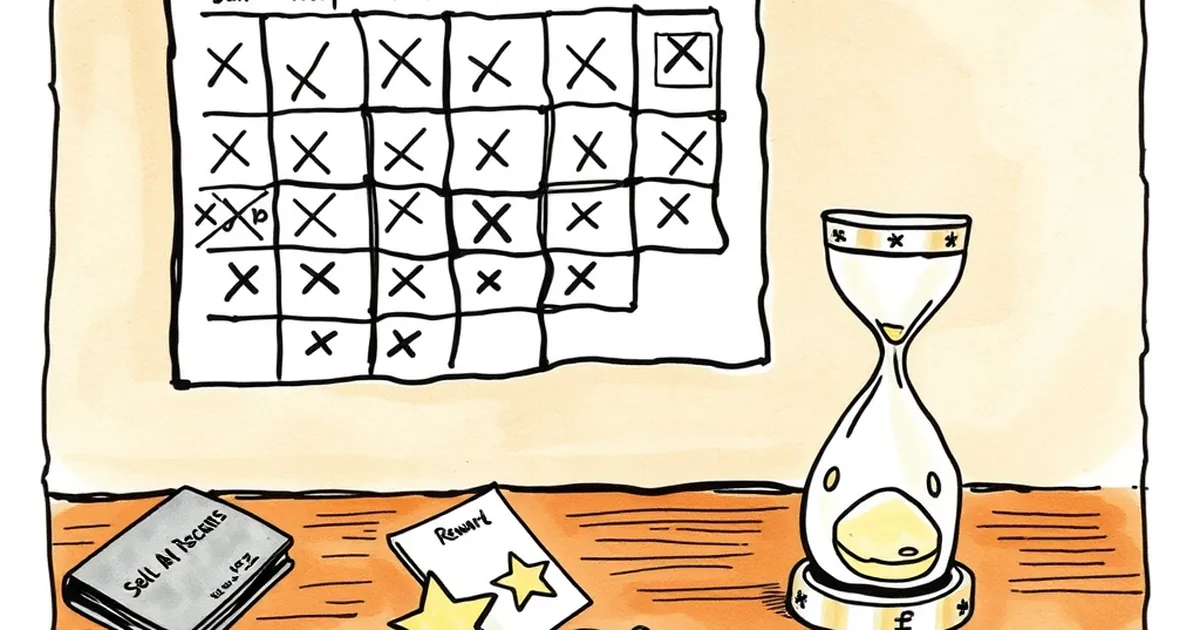
Two deadlines sit inside almost every rewards programme, and they are not the same kind of deadline at all. One is a slow decay — points that quietly vanish at 90 days unless you spend them. The other is a cliff — a streak bonus that pays out only if you keep a behaviour alive for 14 consecutive days, and resets to zero the moment you miss one. Card issuers, neobanks, and wallet providers increasingly run both mechanics side by side, often on the same customer. So the interesting question isn't whether either works. It's why the cliff feels so much more urgent than the decay, even when the decay is worth more money.
Two clocks, two completely different psychologies
A 90-day expiry is a deadline you can forget about for eleven weeks. It's a background process. The 14-day streak is a foreground process — it demands a decision every single day, and every day it survives it becomes more expensive to abandon.
That asymmetry is the whole design. The points balance is a stock; the streak is a flow. Stocks are abstract, easy to defer, and easy to mentally write off ("I'll never hit the good redemption tier anyway"). Flows are concrete and immediate, because you have to actively do something today to keep them alive.
There's a well-documented wrinkle here that works against the slow clock. Humans discount future value steeply — a benefit three months out is worth far less to us in the moment than the same benefit tomorrow. A 90-day expiry therefore has to be large in absolute terms before it registers as a motivator. A 14-day streak, by contrast, is always within the discounting horizon. It's never far away enough to ignore.
The streak is a variable-ratio machine wearing a calendar costume
B.F. Skinner's work on reinforcement schedules is the standard reference for a reason: variable-ratio reinforcement — rewards delivered after an unpredictable number of responses — produces the most persistent behaviour and the greatest resistance to extinction. Streak mechanics borrow that persistence without borrowing the randomness, at least on the surface. Day 14 is fixed. You know exactly when the bonus lands.
But look at what surrounds the fixed payout. The bonus amount often varies by tier, by spend, by category, by whether you also hit a secondary threshold. The streak is the skeleton; the reward structure draped over it is frequently variable. That combination — a predictable daily obligation attached to an unpredictably sized payoff — is unusually sticky.
The behavioural economist's caution is that streaks also manufacture a specific kind of commitment cost. Once you're on day 11, quitting on day 12 doesn't just forfeit the bonus; it forfeits the eleven days you already invested. That's sunk-cost reasoning, and it's a well-known bias rather than a rational calculation. The eleven days are gone either way. The streak makes them feel recoverable only through continuation.
Loss aversion does the heavy lifting on both clocks — but differently
Kahneman and Tversky's central finding — that losses loom larger than equivalent gains — explains why both mechanics work, and why they produce different customer emotions.
With points expiry, the framing is prospective loss: "you will lose 4,000 points." With a streak, the framing is retrospective loss: "you will lose a 13-day run." The second is more painful because the thing being lost is partly an identity — the person who doesn't break streaks — rather than a quantity. Card programmes have learned that a broken streak generates more support tickets and more churn than an expired balance, even when the expired balance was worth more.
This is where the two mechanics start to interfere with each other. A customer who is grinding a 14-day streak is making daily, low-value transactions to keep the run alive. Those transactions don't necessarily advance the 90-day points goal efficiently — they may even nudge the customer toward spending patterns that maximise streak survival rather than redemption value. Two loss-averse systems running in parallel on one person can produce behaviour that serves neither goal particularly well.
A concrete illustration
Consider a mid-tier travel card that offers a 5,000-point signup balance expiring at 90 days, plus a 14-day streak bonus of 500 bonus points per completed run. A customer who completes six streaks earns 3,000 points — more than half the signup balance — through behaviour that requires daily attention. Meanwhile the 5,000-point balance, worth roughly twice as much, sits untouched because it never demands a decision. The smaller, more frequent, more urgent reward dominates the customer's attention. That's not a flaw in the customer; it's a predictable output of how the two deadlines are built.
Issuers that have tested removing the streak report a short-term dip in daily active transactions and a longer-term improvement in redemption rates — customers stop micro-optimising and start planning. The streak was driving engagement, not value.
What this means for the next generation of reward design
The forward-looking question for anyone building or buying a rewards product is whether these two clocks should coexist at all, and if so, how they should be sequenced.
A few directions are already visible in the market. First, collapsing the two into a single mechanic — a points balance with a rolling expiry that accelerates if the customer goes dormant — removes the interference while keeping the urgency. Second, making the streak payout deterministic and large enough to be worth the daily cost, rather than variable and small, reduces the sense of being played. Third, and most interestingly, some programmes are experimenting with forgiveness mechanics: a streak that survives one missed day per month. That preserves the commitment cost while removing the extinction event that drives the angriest support calls.
The underlying principle is that a deadline should map to a decision the customer can actually make well. A 90-day expiry asks "when will you redeem?" — a planning question. A 14-day streak asks "will you act today?" — an attention question. Most people are decent at the first and poor at the second, which is precisely why the second gets used. Whether that's a fair trade depends on whether the streak bonus is genuinely worth the daily attention it extracts, or whether it's extracting attention to subsidise a payout the customer would never have chosen.
The next twelve months of product decisions in cards and wallets will turn on that judgement. The mechanics are cheap to build and hard to unwind. The programmes that get it right will be the ones that treat the streak as a feature with a real cost — to the customer's attention and to the programme's credibility — rather than a free engagement lever.