Loyalty points feel like wages once cash value prints on the receipt
Printing a cash value next to loyalty points turns an abstract score into money you haven't spent yet, reshaping how people behave and how rewards are designed
5 min read
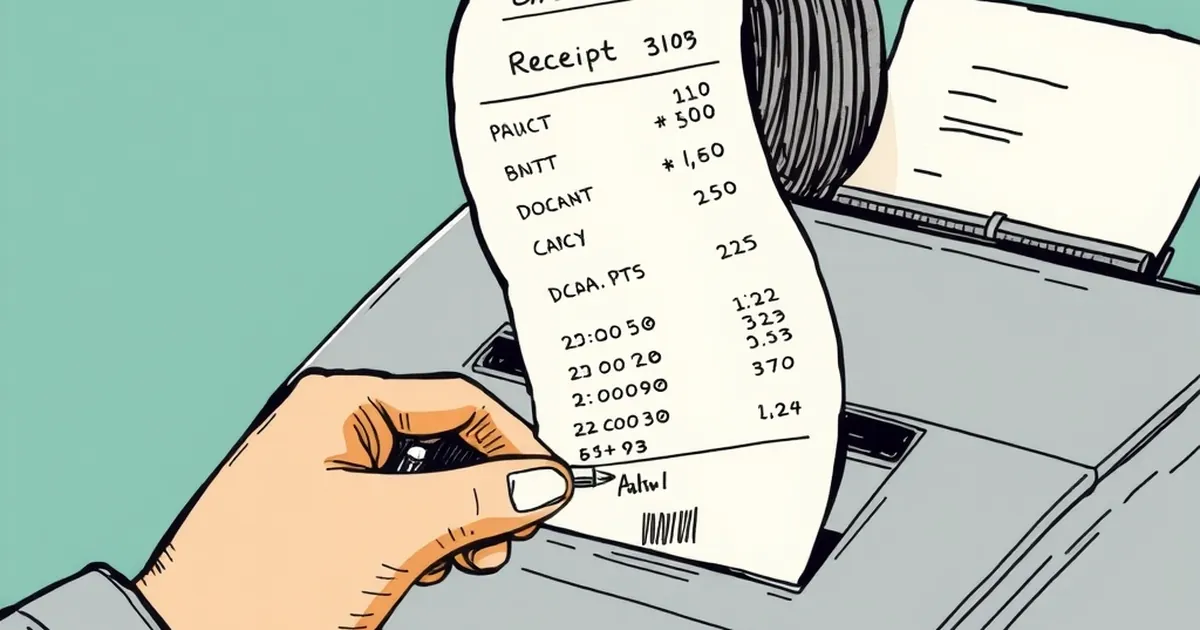
Something odd happens when a receipt shows a cash figure next to your points total. A balance of "12,450 points" is an abstraction, easy to ignore. A line reading "12,450 points = $124.50" changes the object in your head. It stops being a score and starts being money you haven't spent yet. So what does that shift do to the way people behave — and to the way banks and card networks design rewards programs?
From scoreboard to ledger
Loyalty points have always lived in a strange category. They're not cash, but they're not nothing. They expire, they can be devalued overnight, and they can't pay rent. Program managers have historically benefited from that ambiguity: unredeemed points are a liability on paper, but a cheap one, and breakage (points that never get used) is a quiet profit center.
Printing a cash equivalent on the receipt collapses that ambiguity. It converts an ill-defined token into a priced asset, and people treat priced assets differently. This is close to what behavioral economists call mental accounting — the tendency, described by Richard Thaler, to sort money into separate buckets with their own rules. A point balance sits in a vague bucket labeled "rewards." A dollar figure sits in a bucket labeled "mine." The second bucket is much harder to ignore, and much harder to watch get devalued.
There's a second effect: loss aversion. Kahneman and Tversky's central finding — that losses hurt roughly twice as much as equivalent gains feel good — applies awkwardly to points. Losing 5,000 points to expiry stings, but it's a fuzzy sting. Losing "$50" to expiry is a concrete loss, and concrete losses motivate action. Programs that print cash values are, whether they intend it or not, making their own expiry rules more emotionally expensive for members.
The receipt as a nudge, in both directions
Consider a straightforward scenario. A cardholder has 40,000 points. Under the old display, that's a number. Under the new one, it's "$400 toward your next statement." What changes?
Redemption goes up. A visible price tag removes the mental work of figuring out whether a reward is worth it. If you know your balance is worth $400, deciding whether to spend 25,000 points on a $180 item becomes a simple comparison rather than a research project. Higher redemption sounds like a win for members, but it's also a win for issuers, because redeemed points cost less than points that sit on the books for years while members grow resentful.
Perceived value becomes contestable. The moment you print a conversion rate, you invite scrutiny. If 10,000 points equals $100 on a receipt, members will notice when the same 10,000 points buys only $80 worth of a flight through the travel portal. That gap — the difference between the headline rate and the actual redemption rate — becomes visible in a way it never was when everything was denominated in points. Some programs will find this uncomfortable. The more honest ones will treat it as a reason to close the gap.
Spending behavior shifts. This is the part that touches payments strategy most directly. When points feel like wages, the earn side of the equation starts to feel like getting paid. A card that earns 2% back in points feels fine. The same card framed as "you earned $24 this month" feels like income — and income invites benchmarking. Members start comparing their effective earn rate the way they'd compare savings account yields.
What the research says about framed value
The framing effect literature is old and robust. People respond differently to logically identical propositions depending on how they're described — the classic example being "90% survival rate" versus "10% mortality rate" for the same surgery. Loyalty programs have been running a version of this experiment on themselves for decades without always noticing.
There's a well-documented phenomenon in prepaid and gift-card research: when people hold a stored balance, they spend more freely than when spending from a checking account, because the money already feels "spent." Points behave similarly — they lower the friction of a purchase. But here's the wrinkle: printing a cash value may reverse part of that effect. If the balance reads as $124.50, it starts to feel like real money again, and real money brings back the pain of paying. Programs that want frictionless redemption should be careful about how prominently they display the conversion, and programs that want to reduce breakage should display it everywhere.
This tension is real and probably unresolvable in a single design. You're choosing which behavior to optimize: spend-freely-with-points, or redeem-before-you-lose-them. Most issuers will end up segmenting — showing cash equivalents to dormant members to prompt redemption, and keeping points-as-points in the purchase flow where the abstraction is doing useful work.
The competitive angle: transparency as a differentiator
Card networks and issuers compete on a handful of levers: earn rate, sign-up bonus, lounge access, transfer partners. Transparency about point value has historically not been one of them, largely because opacity was more profitable. That's changing, partly because regulators in several markets have started asking whether "points" constitute a misleading representation of value, and partly because fintech challengers have made real-time cash-equivalent displays a selling point.
Once one major program prints cash values at the point of transaction, the others face a choice. Match it and accept the scrutiny, or don't match it and explain why your points are "worth more" without a number on the receipt. The second position is harder to defend every quarter.
There's a competitive-play dimension here too, borrowed from how people behave in ranked or scored environments. When a score is visible and comparable, players optimize for the score rather than the underlying activity. If your points display as dollars, members will optimize for dollars — which means they'll gravitate toward whatever redemption path gives the best conversion, and they'll notice when the program's own portal offers a worse rate than a transfer partner. That's a healthy pressure, but it's pressure the program has to be ready for.
Where this goes next
The receipt is becoming a statement, and the statement is becoming a dashboard. Real-time earn tracking, cash-equivalent balances, and per-transaction reward previews are all technically trivial now. The interesting question isn't whether programs will print cash values — most eventually will — but what they'll do when members start treating those numbers as a benchmark rather than a gift.
Three things worth watching. First, whether programs standardize a single "reference rate" for point value and stick to it publicly, the way a fund publishes a NAV. Second, whether expiry policies survive contact with a printed dollar figure; it's one thing to let "$0.00 of abstract tokens" lapse, another to let "$38" vanish. Third, whether the cash-value display migrates upstream — onto the card app, onto the checkout screen, into the moment of decision rather than the moment of record.
If you work on the product side, the practical move is to decide which behavior you're trying to shape before you decide what to print. A cash figure is not a neutral disclosure. It's a design choice with a behavioral payload, and the members will read it exactly as written.