Live dealer tables cap at 7 seats; the waitlist holds 40
Seven seats and a forty-person waitlist reveal the hidden industrial design, staffing, and pricing constraints behind live dealer casino tables
4 min read
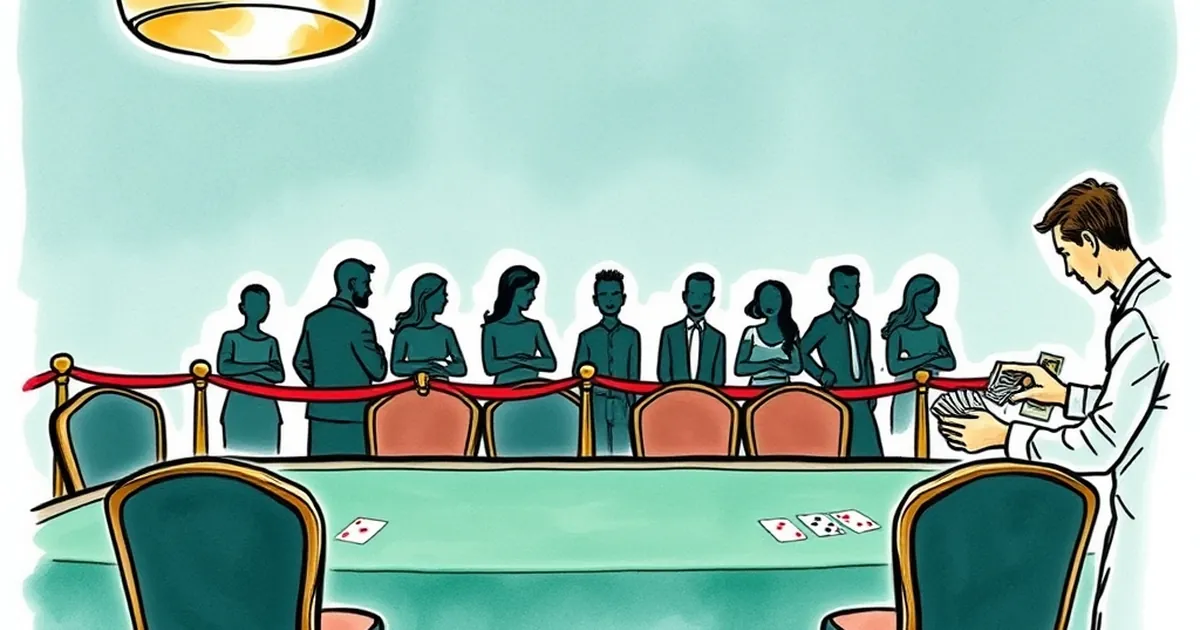
Live dealer tables cap at 7 seats, and the waitlist holds 40. That ratio — one seat for every 5.7 people queuing — is the quiet constraint shaping how live casino floors get built, staffed, and priced. It also explains why a game that feels effortless on screen is, behind the camera, a rigid piece of industrial design.
The number isn't arbitrary. Seven is what fits in a single camera frame at a readable size on a phone held at arm's length. Forty is roughly where a queue stops feeling like a queue and starts feeling like a rejection, so operators cap it there and let the list churn. Everything else about live dealer economics flows from those two figures.
Why seven is the ceiling, not a target
A live blackjack table has a physical footprint. You need the dealer's arc, the shoe, the discard tray, and enough felt for seven betting boxes without players' hands colliding. More importantly, you need every seat legible on a 360p-to-1080p stream. At eight or nine boxes, the cards get small, the chip stacks blur, and mobile players start squinting. The seven-seat layout is a compression decision as much as a gaming one.
There's a staffing layer too. One dealer handles seven seats comfortably at a pace of roughly 60–80 hands an hour depending on rule set and how often the shoe is shuffled. Push to nine and the dealer's reach becomes a bottleneck; hands slow, and the effective hourly handle per table drops even though seat count rose.
The math operators actually run
A single live blackjack table with seven seats, running 70 hands an hour at an average bet of €10, turns over about €4,900 an hour in wagers. At a house edge of 0.5% on a decent basic-strategy game, that's roughly €24.50 an hour in theoretical win per table. Thin. The seat cap is why live dealer margins depend on volume across many tables rather than squeezing more players onto one.
The 40-person waitlist is a pressure valve
Forty is generous as a cap and revealing as a design choice. If a table fills, the queue absorbs demand without forcing the operator to open a new table the moment seats run out. Opening a table means a dealer, a studio position, a camera operator, and a pit boss's attention — a fixed cost that only makes sense if the queue is deep enough to keep it full.
The waitlist also smooths the spikes. Live casino traffic clusters hard around evening hours in each timezone and around major sports fixtures. A 40-deep queue at 21:00 CET tells the operator to spin up another table for the next shift. A queue of six tells them to wait.
What a 40-long queue does to the player
Practically, being 30th in line on a busy table is a signal to go elsewhere. Regulars learn to check seat availability before committing, and many migrate to less crowded variants — different blackjack rule sets, roulette, or game-show formats — rather than wait. That fragmentation is fine for the operator, which runs the same studio across multiple tables, but it does mean the "premium" table you wanted isn't the table you play.
Where the cap bites hardest
Not every live game feels the seven-seat limit equally. The constraint lands differently across formats.
- Live blackjack: seven boxes is the standard, and it's the format most exposed to the cap. Popular low-limit tables fill first, pushing casual players into the queue.
- Live roulette: effectively unlimited in theory, because players bet on a shared layout rather than occupying a box. The seat cap barely applies — which is part of why roulette absorbs overflow demand.
- Live poker: six to nine seats depending on variant, but the waitlist logic is different; poker tables need balanced stacks, so a queue of 40 means several tables running in parallel rather than one long line.
- Game-show style tables: designed for scale, often with no meaningful seat cap at all, which is precisely why operators have leaned into them.
The pattern is clear: formats that scale past seven seats have absorbed the growth in live casino demand over the past five years. Blackjack's seven-seat ceiling hasn't moved, and there's no obvious reason it will.
The mobile squeeze
On a phone, seven boxes is already tight. A 6.1-inch screen showing the dealer, the shoe, seven bet spots, and a bet-sizing interface leaves little room. Any push beyond seven seats would need a UI rethink as much as a studio one — and the operators know it.
Does the cap protect the experience or throttle it?
There's a defensible argument that seven seats is a feature. A seven-seat table feels like a table. You can see the other players' bets, the dealer can make eye contact, and the pace stays human. Push to twelve and it becomes a conveyor belt with a card shoe attached.
But the 40-person waitlist is where that argument gets shaky. If the cap protects the experience, why does the queue need to be six times the table size? Because the queue exists to manage operator costs, not player comfort. It's a buffer that lets the studio run lean and fill seats on its own schedule.
The open question is whether the seven-seat model survives the next few years. Operators keep expanding studio capacity — more tables, more variants, more languages — but the per-table seat count hasn't budged. If demand keeps climbing and the queue keeps hitting 40, the pressure to rethink the format will come from the players stuck in line, not the ones already seated. And when it does, the first thing to watch won't be the table — it'll be the queue length on a Friday night.