Live dealer tables buffer 3 seconds behind your sports bet
Live dealer streams run about three seconds behind actual play, a deliberate delay that reshapes what live means when tracking two markets at once
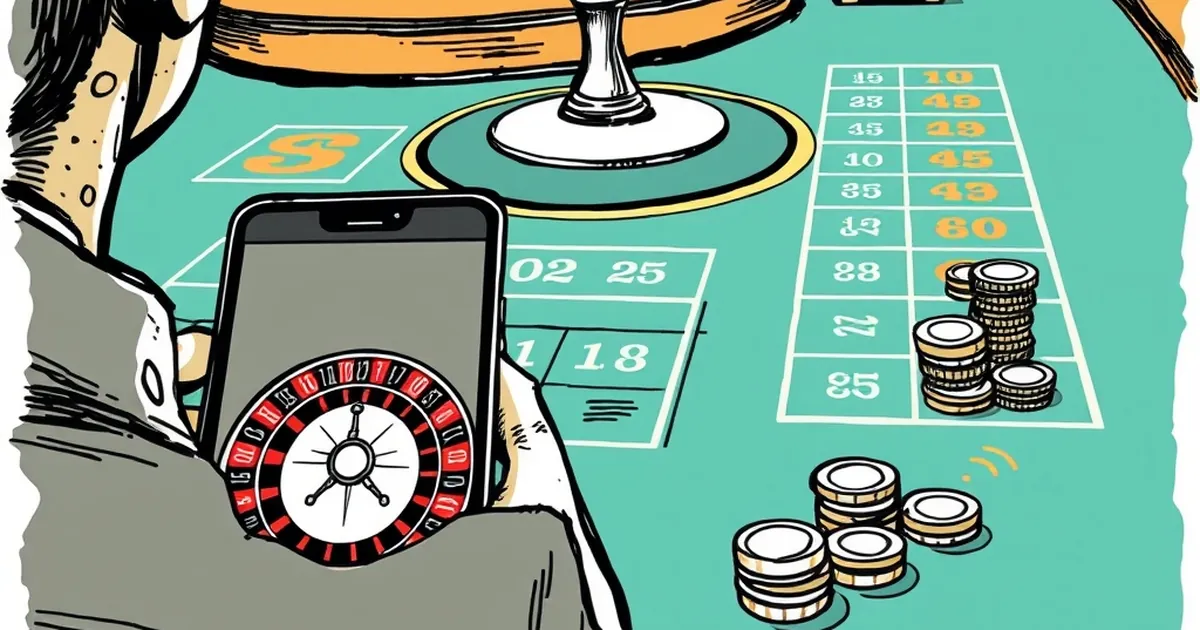
If you're watching a live dealer table while a football bet is running, the stream you see is typically running about three seconds behind the actual dealing of the cards. That delay is not a bug, and it is not your connection. It is deliberately engineered into the video pipeline, and it changes what "live" means when you are trying to watch two markets at once.
The three-second figure is a rough industry norm rather than a published standard. Operators and studios rarely confirm exact numbers, because the delay is a risk-control tool and they would rather you did not treat it as a fixed quantity. But the components are well understood: capture, encode, a buffer, a CDN hop, decode on your device. Stack those up and you land somewhere between 2.5 and 4 seconds on a good connection, more on a bad one.
Why the buffer exists at all
A live dealer table is not a broadcast. It is a wagering product with a video interface, and every second of latency is a second in which someone could act on information they should not have.
Consider the mechanics. The dealer draws a card. The camera captures it. That frame is encoded, pushed through a buffer, distributed, and decoded on your screen. In that window, the result already exists in the physical world but not yet in your view. If the delay were near zero, anyone with a fast enough pipeline and a screen-scraping script could read the outcome marginally ahead of the betting cut-off.
Three seconds is long enough to make that race impractical and short enough that the table still feels live. The buffer also smooths jitter. A stream that stutters is worse for trust than a stream that lags, so studios trade a little latency for stability. The same logic applies in sports streaming, where a goal often appears on your screen several seconds after it has been logged by the odds feed.
The cut-off is the real clock
Here is where it gets interesting for anyone running a live dealer table and a sports bet side by side. The betting cut-off on a live table is not tied to what you see. It is tied to the server's clock and the game state on the operator's side. When the interface says betting is closed, it has been closed on the backend for a moment already, and the card you are about to see was dealt before that.
So you have two clocks running. The table's clock, which is authoritative and invisible, and your screen's clock, which is roughly three seconds behind. If you are also watching a football match with its own 5-to-30-second streaming delay, you now have three timelines in your head, and only one of them settles bets.
What this does to in-play sports betting
In-play markets move on events, and events reach you late. A goal, a red card, a penalty — each one takes time to travel from the stadium to your screen, and the odds feed usually updates faster than the video. That gap is why bookmakers suspend markets during major incidents. It is not paranoia; it is the same race condition as the card-reading problem, just at a larger scale.
Live dealer and in-play sports betting therefore share a structural feature: the product you are watching is a delayed representation of a state that has already resolved. The difference is that the table's delay is engineered and fairly consistent, while the sports stream's delay depends on the broadcaster, the CDN, and your device.
Practical consequences
A few things follow from this, and they are worth internalising if you play both formats.
- Odds you see may already be stale. If a market looks unusually generous during a live event, the event that would have moved it may simply not have reached you yet.
- Cash-out values lag too. A cash-out offer is computed from the current state, not your view of it. Accepting an offer during a fast-moving passage of play is a bet on a number that may already be wrong.
- Table results are never in question. The delay does not affect fairness. The RNG or the shoe determines the outcome; the stream is only a window onto it. A 3-second lag does not change a 97.3% RTP figure on a live roulette variant, because the RTP is a property of the game rules, not the video.
That last point matters. Some players assume latency implies something is being hidden. It does not. It implies the operator is protecting the integrity of the betting window, which is a different thing entirely.
Where the numbers actually come from
Latency budgets in live streaming are usually described in terms of glass-to-glass delay: the time from a photon hitting the camera sensor to that photon leaving your display. For standard HTTP-based streaming, glass-to-glass of 5 to 10 seconds is normal. For low-latency variants using chunked transfer or WebRTC, 2 to 4 seconds is achievable. Live dealer studios sit at the aggressive end because they have to.
Encoding adds 100 to 300 milliseconds. The buffer adds the most, and it is tunable. A CDN edge hop adds tens of milliseconds if you are near a node and considerably more if you are not. Decode and render add another 50 to 150 milliseconds depending on your hardware.
Roughly, then: three seconds is a low-latency configuration, not a default one. Studios pay for it, because a table that feels four seconds behind feels broken, and a table that feels broken does not retain players.
Regional variation is real
If you are in a region far from the studio's origin servers, your delay will be longer. A player in Manila watching a table hosted in Malta will see more latency than a player in Berlin watching the same table, even on identical hardware. This is not a fairness issue — the game state is identical for both — but it does mean the "three seconds" figure is a best case, not a universal constant. VPNs add their own hop and their own delay, and using one to reach a table you would otherwise be geo-blocked from is a separate problem with its own consequences.
The uncomfortable question
If the video is a delayed representation of an authoritative state you cannot see, then what exactly are you reacting to when you click?
You are reacting to a reconstruction. That is true of almost every digital product, but betting is one of the few where the reconstruction has a financial edge attached to it. The operator sees the true state first. You see it three seconds later. The rules are written so that this asymmetry does not cost you anything in a fair game — the cut-off protects both sides — but the asymmetry exists, and it is by design.
Which raises something worth thinking about. As low-latency streaming improves, the buffer will shrink. One second is already achievable. At what point does a shorter delay stop protecting the betting window and start exposing it? The industry has an interest in keeping latency high enough to be safe and low enough to feel live, and those two pressures pull in opposite directions. Where the line settles is a commercial decision, not a technical one, and nobody has published where they think it should be.