Three scatters trigger free spins; the fourth just pays 2x
Three scatters start free spins while a fourth pays a flat 2x, a rule worth reading literally since extra scatters add no spins or upgrades
6 min read
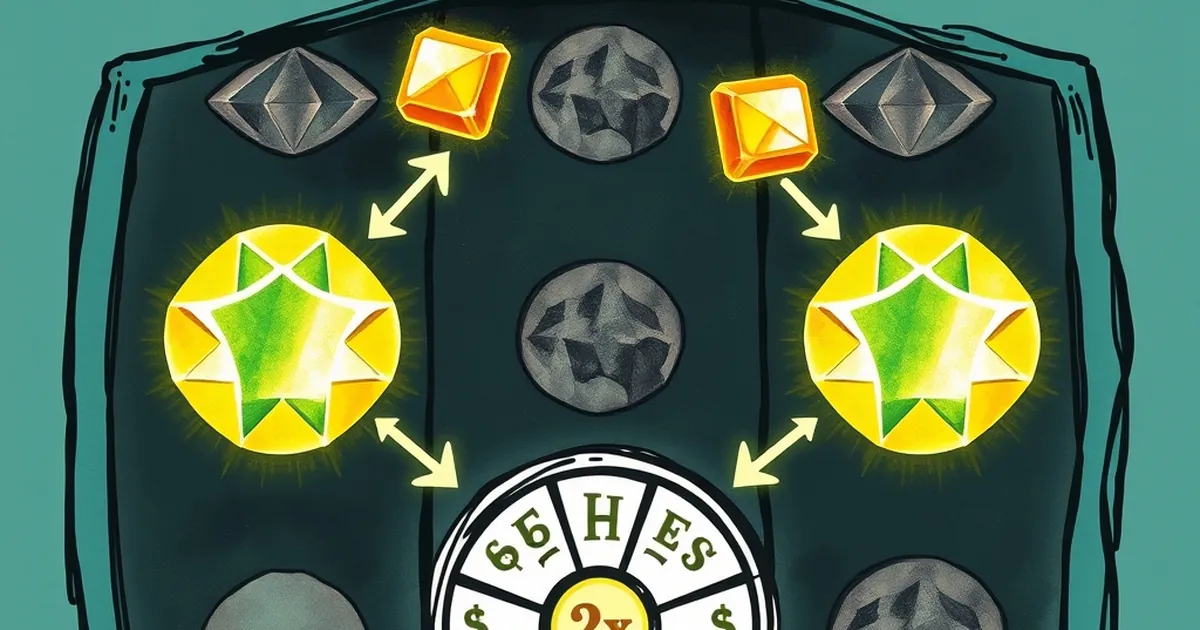
Three scatters trigger free spins; the fourth just pays 2x. That's the whole rule, and it's worth taking literally, because a lot of players misread the fourth scatter as a bonus extender or a retrigger and then wonder why nothing happened. The slot doesn't care that you nearly got four. It pays the four-scatter prize and the feature still starts on three.
The confusion is understandable. Most slots treat extra scatters as a good thing, and many do something with them: add spins, upgrade the multiplier, bump you into a second tier. This game doesn't. Three gets you in, four gets you a flat 2x on your total bet, and the free spins run exactly as they would have with three. Once you internalise that, the scatter behaves less like a jackpot symbol and more like a small side payment that occasionally lands alongside the thing you actually want.
What the rule actually pays
Run the numbers on a typical stake. At €1 per spin, four scatters returns €2. That's it. If you were on €5 spins, it's €10. The free spins that come with it are the same free spins you'd have received for three scatters — same count, same rules, same volatility profile.
Compare that to what a scatter usually represents. On a slot with a 96.2% RTP and a feature worth, say, 40x your bet on average, the three-scatter trigger is worth far more than the four-scatter cash prize. So the fourth scatter isn't a bonus. It's a consolation payment attached to a bonus you were already getting.
This matters for expectation-setting. Players who assume four scatters means "bigger feature" will feel cheated when the free spins look identical to a three-scatter trigger. Players who understand the rule will see the 2x for what it is: roughly two spins' worth of stake back, no strings, no wagering.
Where the 2x lands in the payout order
Worth checking the paytable before you assume anything about stacking. On most slots with this structure, the four-scatter 2x is a scatter pay in its own right, separate from the free spins award. It's paid immediately, added to your balance, and doesn't interact with the feature's win multiplier. If the free spins carry a 3x multiplier, that 3x does not apply to the 2x scatter pay. The 2x is a flat cash amount on total bet, full stop.
A few slots do apply the feature multiplier to scatter pays, but that's the exception. If you're playing a title where you're unsure, the paytable rules section will say "scatter wins are multiplied by the current multiplier" or it won't. Don't guess.
Why designers build it this way
The four-scatter 2x isn't laziness. It's a math decision.
Scatter symbols have to be frequent enough that the three-scatter trigger feels achievable — usually somewhere between 1 in 150 and 1 in 250 spins depending on the slot's volatility. That frequency means four-scatter hits aren't rare either. On a slot where three scatters land roughly once every 200 spins, four scatters will show up at a rate determined by the symbol weighting, often somewhere in the region of 1 in 1,500 to 1 in 3,000 spins.
If four scatters triggered a bigger feature, the math would have to pay for it somewhere: lower base-game RTP, weaker free spins, or a rarer three-scatter trigger. None of those are attractive. So designers cap the upside at a modest cash prize and keep the feature economics clean.
The RTP argument
Here's the part players miss. That 2x isn't free money from the casino's perspective — it's baked into the published RTP. On a slot advertising 96.1%, the four-scatter pay is one of dozens of contributions to that number. Strip it out and the RTP would drop, probably by a fraction of a percent. It's small, but it's real, and it's why the rule exists.
The practical upshot: you're not being shortchanged by the 2x. You're being paid exactly what the math says you should be paid for that outcome. The disappointment comes from comparing it to an imagined bigger feature, not from any actual shortfall.
How to read a paytable before you spin
The four-scatter rule is a two-minute check, and it tells you a lot about how a slot is built.
Look for the scatter row in the paytable. You want three numbers: the three-scatter award, the four-scatter award, and the five-scatter award if there is one. If three scatters pays "10 free spins" and four scatters pays "2x total bet," you've got the structure described here. If four scatters pays "15 free spins" or "10 free spins with a 2x multiplier," you've got a tiered feature and the fourth scatter genuinely matters.
Red flags worth noting
A slot that pays nothing for four scatters — just the free spins — is telling you the scatter is purely a trigger, not a pay symbol. That's fine, but it means the fourth scatter is dead weight on that spin. Some players find that more frustrating than a small cash prize.
A slot that pays a large four-scatter award, say 20x or 50x total bet, is a different animal. That's a genuine near-miss payout, and it usually comes with a rarer three-scatter trigger to compensate. Check the trigger frequency before you assume the bigger prize is a better deal.
And a slot that pays five scatters a jackpot-tier amount but four scatters only 2x is making a deliberate choice: it wants the five-scatter hit to feel like the ceiling, and it's willing to make the four-scatter outcome feel flat to get there. That's a design philosophy, not a flaw, but it does change how the game feels in play.
What this means for your session
If you're choosing between slots, the four-scatter rule is a small but useful signal about volatility and feature design. A slot that pays 2x for four scatters is usually one where the feature is the main event and the scatters are a supporting mechanism. A slot that pays more for four scatters is usually one where the base game carries more of the variance.
Neither is better. But knowing which you're playing changes how you read a session. On the 2x slot, a four-scatter hit is a small refund, not a near-miss. On a tiered slot, a four-scatter hit is a genuine event. Treating them the same will leave you either over-excited or under-whelmed, depending on which you're on.
The 2x also gives you a clean way to think about the value of a spin. If four scatters pays 2x total bet, and three scatters triggers a feature worth an average of 40x, then the scatter symbol's expected value is dominated by the three-scatter outcome. The four-scatter pay is a rounding error in the maths. That's not a criticism — it's just how the distribution works, and it's why the feature, not the scatter pay, is what you're actually playing for.
Set a budget before you spin, and treat the 2x as what it is: a small return on a rare outcome, not a reason to chase. If you find yourself spinning specifically to see four scatters again, that's a sign to step back, because the maths doesn't reward it.
The open question
The four-scatter 2x rule is clean, predictable, and slightly underwhelming — which is probably the point. But it raises a question the paytable can't answer: does a flat 2x actually feel better than nothing, or does it just remind you that you were one symbol away from a feature you were already getting?
That's a design question, not a maths one, and different players will answer it differently. The maths is settled. The feeling isn't.