Your brain treats a 2-second approval like a win, a 7-day hold like a loss
Why a 2-second payment approval feels like a win and a 7-day hold feels like a loss, and what that gap reveals about banking design
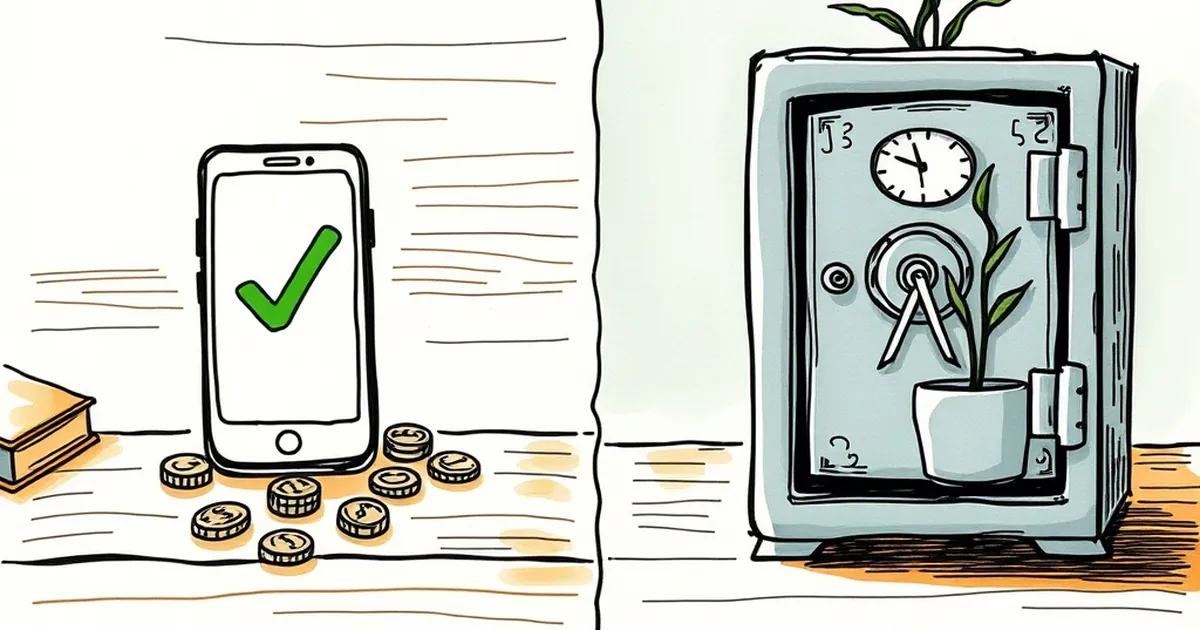
Two payments leave your account on the same afternoon. One clears before you've put your phone down; the other sits in review for a week with no explanation. Same amount, same merchant, same you. So why does the first feel like a small win and the second like a small insult?
That gap between the two experiences isn't a quirk of your personality. It's the predictable output of a nervous system that was never designed for electronic money, and it has become one of the most underrated design problems in banking.
Your brain runs on "now" and "maybe," not on "soon"
Behavioral economists have spent decades documenting what they call time inconsistency: we don't discount the future in a smooth, rational curve. We weight the immediate present enormously and everything else much less. Richard Thaler's work on mental accounting and self-control showed this repeatedly — people will happily choose a smaller reward now over a larger one later, then reverse that preference when both options are pushed into the future. The reversal isn't hypocrisy. It's two different decision systems answering two different questions.
The practical consequence is that "immediate" and "delayed" aren't points on the same scale. They're different categories. An instant approval lives in the category your brain treats as real. A seven-day hold lives in the category your brain treats as hypothetical — and hypothetical things that cost you money read as threats, not neutral waits.
There's a second layer here. Daniel Kahneman and Amos Tversky's work on loss aversion found that losses register roughly twice as strongly as equivalent gains. A pending transaction isn't a loss in the accounting sense — the money hasn't moved — but it feels like one, because your available balance dropped and you can't act on it. Your brain is registering a loss on an ambiguous event and charging you the emotional price of a real one.
The slot-machine rhythm of instant payments
Now look at what instant approval does to the same system.
B.F. Skinner's research on variable-ratio reinforcement is the canonical reference: behavior reinforced on an unpredictable schedule is far more persistent than behavior reinforced every time. He demonstrated this with pigeons, but the pattern generalizes to anything where a fast action produces an uncertain reward. The key ingredients are speed and unpredictability, not the reward itself.
Tap-to-pay has both. You don't know for certain whether the terminal will accept, whether the bank will flag it, whether the loyalty offer will trigger. When it works, you get a clean, immediate, unambiguous confirmation — a green check, a haptic buzz, a sound. That's a reward signal arriving within a second or two of the action. The reward is trivially small in dollar terms, but the timing is what your dopamine system cares about. Anticipation and resolution, tightly looped, is the shape your brain finds most compelling.
This is why contactless payments feel frictionless in a way that's hard to explain to someone who hasn't used them. It's not just convenience. It's the loop closing fast enough that the deliberative part of your brain never gets a turn.
The seven-day hold is a design choice, not a law of physics
Here's the uncomfortable part: most of the delay in a "seven-day hold" isn't settlement. It's risk management layered on top of settlement.
Real interbank settlement for many payment rails is same-day or next-day. What stretches to a week is usually a combination of fraud review queues, manual underwriting for a new merchant relationship, chargeback exposure windows, and — frankly — legacy batch processing that runs on a schedule nobody has revisited since it was set.
From the bank's side, that's defensible. A hold is cheap insurance against a fraudulent merchant or a disputed charge. The cost of the hold is borne by the customer in the form of uncertainty; the benefit accrues to the institution in the form of reduced loss exposure. That's a real trade-off, and institutions have historically resolved it in their own favor because the customer's cost was invisible on the balance sheet.
But it isn't invisible. It shows up as support calls, as abandoned transactions, as customers who route their next payment through a competitor because they can't tell whether the money is gone or just parked. A hold is a message, and the message most holds send is: we don't know yet, and we're not going to tell you why.
What the asymmetry actually costs
Consider a concrete, well-documented case: the rollout of real-time payment rails such as the UK's Faster Payments, India's UPI, and the EU's SEPA Instant scheme. Each of these compressed settlement from days to seconds, and in each case the adoption curve was steep — not because the underlying economics changed dramatically, but because the experience changed. UPI in particular grew from a standing start to billions of monthly transactions, and a large part of that was the loop closing instantly for both payer and payee. People trusted it faster than the fraud statistics alone would predict, because every successful transaction delivered immediate proof.
Contrast that with the persistent complaints around delayed payouts on marketplace platforms: sellers who can see the sale but not the money describe the gap in language that sounds a lot like betrayal. Nothing has been taken from them. But the uncertainty is unresolvable, and unresolvable uncertainty is more stressful than a known bad outcome. That's consistent with a large body of research on ambiguity aversion — people will accept a known 50% risk over an unknown probability, even when the unknown is probably better.
So the cost of the hold isn't the delay. It's the illegibility of the delay.
Where this pushes payment design next
The interesting frontier isn't making everything instant. Some holds are genuinely necessary, and pretending otherwise would be dishonest. The frontier is making the wait legible and bounded.
That means a few concrete shifts:
Status as a first-class feature. A hold with a named reason and a specific expected resolution time is a completely different psychological object than a hold with a spinner. "We're verifying this merchant, funds release Thursday 14:00" converts an ambiguous threat into a scheduled event. Ambiguity aversion mostly disappears when the probability becomes known.
Partial release. Releasing 80% immediately and holding 20% against risk keeps most of the fraud protection while eliminating most of the felt loss. Institutions rarely do this because it's operationally awkward, not because it's unsound.
Progress signals during the wait. Anything that shows forward movement — a timestamp, a stage indicator, a countdown — interrupts the "nothing is happening" narrative that the brain fills in with worst cases.
Honest language. "Pending" is the worst possible word. It's a null. It tells the customer nothing except that someone, somewhere, might do something. Replacing it with a specific reason costs nothing and changes everything about how the wait is experienced.
The underlying insight is simple. Your brain doesn't evaluate payments as accounting entries. It evaluates them as events with a shape — fast and resolved on one end, slow and unresolved on the other — and it responds to the shape, not the number. The institutions that internalize this will find that a lot of what they've been calling a customer-education problem is actually a latency problem wearing a disguise.
The next round of competitive advantage in payments probably won't come from shaving another hundred milliseconds off authorization. It'll come from making the slow paths feel as resolved as the fast ones. That's a design problem, and it's wide open.