Your brain banks a reward in 2 seconds, a refund in 9 days
The two-second thrill of a card tap versus the nine-day wait for a refund reveals how payment design exploits the brain's reward and loss asymmetry
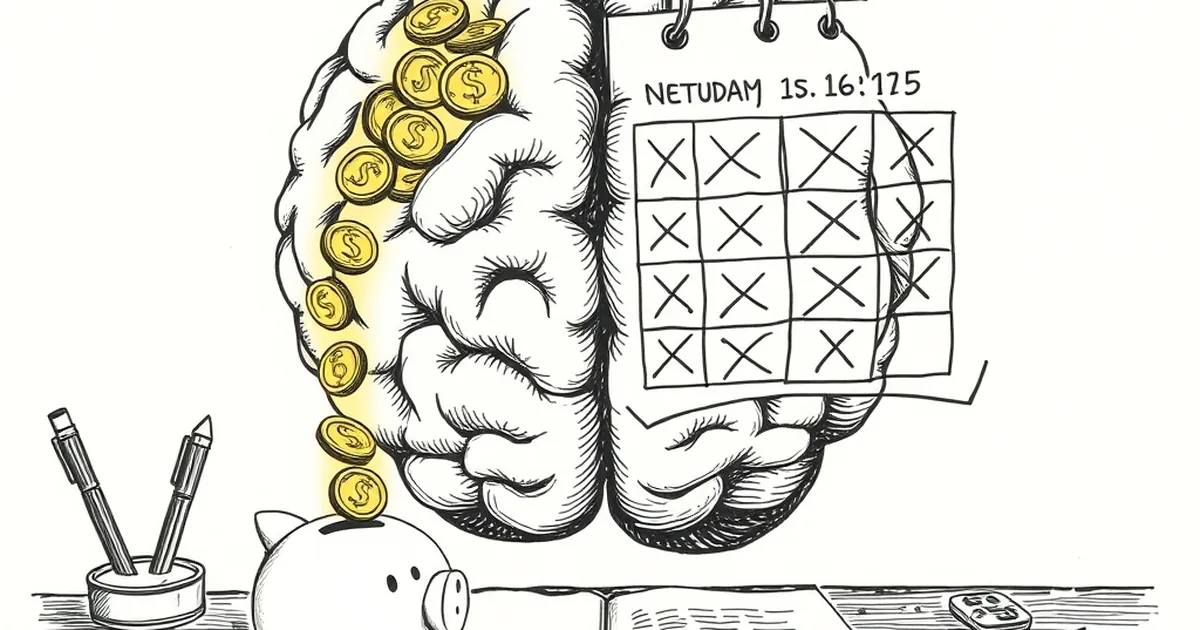
There's a moment when a card tap or a "Buy Now" button resolves, and your brain registers a win almost instantly — a small, clean hit of completion. Compare that to the moment you're waiting on a refund, a chargeback, or a disputed transaction, refreshing an app for the fourth time in a week. The asymmetry isn't a glitch in your patience. It's a design feature of how humans process rewards and losses, and the payments industry has quietly built itself around it.
The two-second reward and the nine-day wait
Think about what actually happens at the point of sale. You tap, the terminal beeps, the merchant's system says approved, and you walk away with the goods. From your perspective, the transaction is finished. The reward — the coffee, the jacket, the flight — is immediate and tangible.
Now follow the money. Behind that beep sits a chain of authorization, clearing, and settlement steps involving the merchant's acquirer, the card network, and your issuing bank. None of that is your problem until something goes wrong. When it does, the timeline stretches: provisional credits, investigation windows, and mandatory response periods that can run to 45 days or more depending on the jurisdiction and the network's rules. A refund from a merchant is usually faster, but still measured in days, not seconds.
Behavioral economists have a name for why this gap feels so much worse than it looks on paper. Loss aversion — the finding, popularized by Kahneman and Tversky, that losses loom roughly twice as large as equivalent gains — means the nine-day wait isn't experienced as "neutral time." It's experienced as an active loss, every day, until the money returns.
Why your brain treats a hold like a wound
Here's the part that genuinely interests me. The money isn't gone. In most dispute scenarios, it's pending, ring-fenced, or provisionally credited. Rationally, you should be indifferent between "spent and refunded in nine days" and "not yet spent." You aren't, and neither am I.
Part of the reason is that the reward and the loss aren't processed on the same clock. A purchase delivers what psychologists call an immediate, consummatory reward — the thing itself, right now. A refund is a delayed, symbolic correction — a number changing back. The brain weights these very differently, and it does so before you've had a chance to reason about it.
There's a second layer. Payments have become a running scoreboard for a lot of people. Available balance, pending transactions, reward points, cashback counters — these are all feedback signals, and feedback signals are what shape behavior. When the scoreboard shows a pending debit that shouldn't be there, it doesn't read as bookkeeping. It reads as a small, ongoing threat.
The variable-ratio problem hiding in your rewards app
If you want a cleaner example of reward-loop mechanics in finance, look at cashback and points. Some offers are predictable — 2% on groceries, every time. Others are not: rotating categories, surprise multipliers, limited-time boosts. The unpredictable ones are far stickier, and the reason is well documented in the psychology literature as variable-ratio reinforcement — the same schedule that makes intermittent rewards so compelling in animal learning studies. You don't know if this purchase will be the one that triggers a bonus, so you check. And checking is its own small reward.
This is worth naming plainly, because it's not a conspiracy. It's an emergent property of a system where engagement metrics and transaction volume both matter. The loop works because the human brain is built to chase uncertain rewards harder than certain ones.
The nine days are a product decision, not a law of physics
Here's where the finance side gets interesting, and where I think the real story sits. Settlement speed is not fixed by nature. It's set by rules, risk appetite, and infrastructure — and it has been changing fast.
Real-time payment rails now operate in dozens of countries: the UK's Faster Payments, India's UPI, Brazil's Pix, the EU's instant payments regulation, FedNow in the United States. Card networks have compressed settlement windows. Some merchants issue refunds in minutes. The technical capability to move money in seconds exists almost everywhere now.
What hasn't moved at the same pace is the dispute and chargeback process, which is still largely built around batch processing, evidence windows, and manual review. That's the gap. Instant money in, slow money back.
And that gap has a behavioral cost that shows up in how people use their cards. If a consumer has been burned by a slow refund once, they'll often route future purchases differently — to a different card, a different payment method, or a different merchant. Trust in a payment instrument is built transaction by transaction and lost in a single unresolved hold.
What competitive pressure is actually doing here
Payment providers compete on speed at the point of sale because that's where the reward is felt. They're now starting to compete on the other end too, because consumers have begun to notice. "Instant refunds" and "same-day dispute resolution" are becoming marketing claims rather than back-office footnotes. That's a healthy shift, and it's driven less by regulation than by the simple fact that a bad refund experience is memorable in a way a good checkout experience is not.
Loss aversion cuts both ways. A provider that removes the nine-day wait is offering something disproportionately valuable relative to its actual cost — because it's eliminating a loss, not adding a gain.
Designing for the asymmetry instead of against it
If you work in payments, product, or financial UX, the practical implication is fairly direct. Stop treating the refund and dispute experience as an edge case. It's the emotional center of the relationship for anyone who's had a problem, and problems are inevitable at scale.
A few directions that follow from the psychology:
Show the timeline, not just the status. "Pending" is ambiguous and ambiguity feeds anxiety. A specific expected date converts an open-ended loss into a bounded one — and bounded losses are far easier to tolerate.
Front-load provisional credit where risk allows. The reward arrives in two seconds; the correction should arrive as close to that as the fraud model can responsibly permit.
Make the scoreboard honest. If a transaction is pending, say so clearly and say why. A balance that appears to have lost money for no stated reason is a trust event, whether or not anyone intended it that way.
Treat speed on the return leg as a product feature, not an operations metric. It's the cheapest loyalty you'll ever buy, because you're paying in latency rather than in margin.
None of this requires rewriting the settlement layer overnight. It requires accepting a simple premise: people don't experience payments as a ledger. They experience them as a sequence of moments, and the moments are not weighted equally. The tap is a two-second reward. The wait is a nine-day loss. Whoever closes that gap — technically, and in how they communicate it — wins the next decade of consumer trust.
The interesting question isn't whether the industry can move money back as fast as it moves it out. It clearly can. It's whether the organizations that control the return leg decide that speed there is worth as much as speed at the register. The behavioral evidence says it's worth more.