Your bet slip syncs in 4 seconds, the odds change in 2
The four-second sync gap between your bet slip and live odds explains why two people can tap the same selection and still get paid at different prices
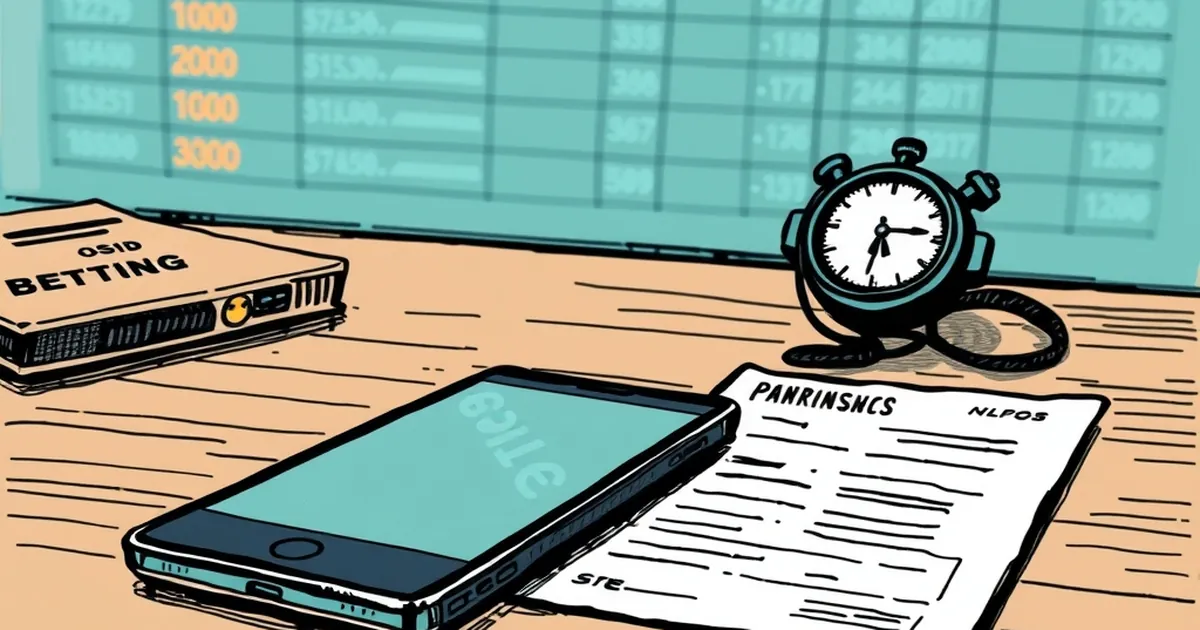
Your bet slip syncs in about four seconds. The price you agreed to can move in two. That gap is not a bug in any single app — it's the shape of the modern sportsbook, where your phone holds a cached copy of a market that a server somewhere is rewriting hundreds of times a minute. And it's the reason two people can tap the same selection, see the same number, and get paid at different odds.
The mechanics are duller than the marketing. A book's trading desk pushes price updates to an API; your app polls that API or listens on a websocket; your slip renders whatever it last received. Four seconds is a reasonable round trip on mobile data. Two seconds is a reasonable interval between meaningful line moves on a liquid market like an EPL match or an NBA spread. Overlap those two windows and you get the thing every bettor has felt but few can name: you were right, the number was real, and it still wasn't yours.
Why the slip and the price were never on the same clock
A bet slip is a local object. It lives in your app's memory or a cookie, and it stores what you saw, not what exists. The sportsbook's actual price lives in a risk engine that repriced the market three times while you were deciding whether to add a second leg.
This is deliberate. Continuous streaming of every market to every client is expensive, and it's also dangerous — books don't want to hand out a millisecond-accurate feed that arbitrage bots can scrape faster than a human can read. So they throttle. Typical client refresh intervals land between 2 and 10 seconds depending on the operator, the sport, and how close you are to kickoff. In the final ten minutes before a match, updates get more frequent and the tolerance for stale prices gets smaller.
The practical consequence: your slip is a photograph, and the market is a film. When you hit "place bet," you're asking the book to honour a photograph.
Some do. Many don't.
The 4-second sync vs the 2-second move
Where the numbers come from
Four seconds isn't a standard anyone publishes. It's an observed average — the kind of figure you get from watching network logs on a mid-range Android device over 4G, which is how most of the world actually bets. On wifi it's closer to one second. On a congested network at a stadium, it can stretch past ten.
Two seconds is likewise a rule of thumb, not a spec. On a high-liquidity market with sharp money arriving, a price can survive less than a second. On a niche market — Hungarian second-division corners, say — a price might sit untouched for twenty minutes.
But the asymmetry is the point. The window in which your slip is wrong is longer than the window in which the market is stable. That's structural, and no amount of app polish fixes it.
What the book does when the price moves
Three things can happen when you submit a bet on a price that's no longer available.
Accept at the new price. Some books, particularly in jurisdictions with stricter conduct rules, will take the bet at the current number and tell you. If the move went against you, you've been filled at a worse price than you agreed to. If it went your way, you got a gift. Most bettors only notice the first case.
Reject and re-quote. The app bounces back with "odds have changed" and a new number. You can accept or walk. This is the cleanest behaviour, and it's what most regulated operators in the UK, Australia, and parts of the EU do by default.
Reject outright. The bet simply fails. Common on accumulator legs where any one selection has moved. Frustrating, but at least it's honest.
The problem is that these behaviours aren't always disclosed clearly at the point of submission, and they vary by market, by sport, and sometimes by how much you're staking. A €10 bet might sail through on a stale price. A €2,000 bet on the same selection will get flagged, because the book's risk engine treats stake size as a signal that you might know something.
That last part is worth sitting with. The same stale price is honoured or refused depending on how much you're putting on it.
Why "odds have changed" hits different bettors differently
If you're betting £5 on a Saturday accumulator, a two-tick move is noise. You shrug, re-tap, move on.
If you're betting into a closing line value strategy — tracking whether you consistently beat the final price — the same two-tick move is the entire game. CLV is measured against the closing number, and if your execution keeps landing on the wrong side of a four-second lag, your recorded edge evaporates into slippage you can't see in your bet history.
This is where the maths gets uncomfortable. Suppose you have a genuine 2% edge per bet. Now suppose that on half your bets, the price moves against you by an average of 1.5% between slip and submission. You've just given back three-quarters of your edge to latency. Not to the book's margin — to the clock.
Professional bettors solve this with direct API access, co-located servers, and automated submission. Most people don't have that, and increasingly, books are restricting API access precisely because it neutralises the lag advantage. Retail bettors are left with the four-second window and a thumb.
What actually helps, and what doesn't
Refreshing the slip manually before submitting helps a little. It forces a re-fetch, so you at least see the current number before you commit. It doesn't eliminate the gap, but it shrinks it to the time between refresh and tap.
Using "accept odds changes" settings — where available — is a trade-off, not a solution. You get fewer rejections and more fills at prices you didn't choose. Whether that's good depends entirely on whether you're beating the close or just along for the ride.
Betting earlier helps more than any app setting. Prices move most in the final hour before an event. If you're placing bets 24 hours out, a two-second update cycle barely matters, because the market itself is quiet. The trade-off is that you're betting into a less efficient price, which is its own cost.
What doesn't help: blaming the app. The lag is a design decision made upstream of the interface, and no amount of dark mode or animation smoothing changes the round trip.
The question nobody in the industry wants to answer plainly
Regulators have spent a decade tightening rules on bonus terms and advertising. Almost none have touched execution latency. There's no standard that says a book must display the age of a price, no requirement to timestamp a slip, no disclosure of how many seconds passed between the number you saw and the number you got.
Ask yourself what would change if every bet slip carried a visible timestamp — "this price is 3 seconds old" — and every rejection showed the exact movement. Would bettors place fewer bets? Probably. Would they trust the ones they place more? Almost certainly.
The technology to do this exists and costs almost nothing. The reason it isn't standard isn't technical. It's that a four-second sync window, on a market that moves in two, is quietly profitable for the house — not through any single bet, but through the aggregate slippage of millions of them. The question is whether that's a feature of the product or a cost the customer was never told they were paying.