Why Your Card Gets Declined at a Gas Pump but Not Inside the Store
Discover why gas pumps decline your card while the same card works inside—payment network rules explained simply
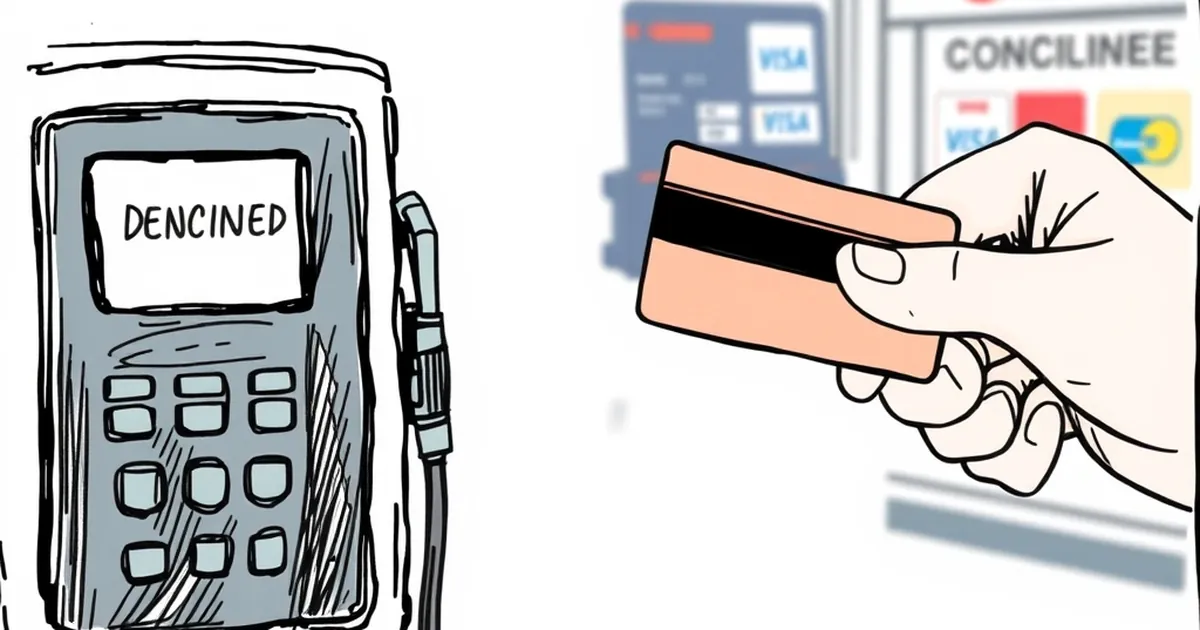
It happens to nearly everyone eventually. You pull up to the pump, swipe your card, and the screen flashes a confusing error: “See cashier.” Yet, two minutes later, you walk inside, buy a soda with the same card, and it works perfectly. What gives?
The short answer is that gas stations are treated differently by the payment networks than just about any other type of merchant. The system is designed to protect both you and the bank, but it creates a frustrating split-second moment of judgement that can feel personal. Let’s break down exactly why that pump rejects you while the store register welcomes you.
The $1 Hold vs. the $50 Fill-Up
At the heart of this problem is a fundamental mismatch between what the pump asks for and what you actually spend. When you swipe a card at the pump, the merchant doesn't know how much gas you're going to pump.
How Pre-Authorization Works
The pump sends a pre-authorization request to your bank for a relatively small amount—often just $1 in the United States, or a fixed equivalent like €1 or £1 in other regions. The bank checks your available balance, sees if that tiny amount is covered, and sends back an approval code. The pump then releases the nozzle.
But here’s the catch: that $1 hold doesn’t actually test whether you have enough money for a full tank. If your balance is, say, $30, and the hold is $1, the bank approves it. You then proceed to pump $50 worth of gas. When the final transaction settles for $50, your account goes negative, triggering an overdraft or a decline on the final settlement.
Why the Store Register Is Different
Inside the store, the cashier knows the exact total before you even swipe. They type in the amount, the terminal requests an authorization for that precise figure, and the bank either approves or declines it in real time. There’s no guessing game. If you have $20 in your account and your soda costs $2, the transaction goes through cleanly. The pump, on the other hand, is working on a gamble that you’ll stay within your means.
The “Card Not Present” Security Zone
There’s another layer at play here that most people don’t see: the risk profile of the transaction itself.
Chip vs. Swipe vs. Tap
Gas pumps are notoriously slow to upgrade their point-of-sale hardware. In many parts of the world, pumps still rely on the magnetic stripe swipe, a technology that is far less secure than chip or contactless payments. Because the stripe data can be cloned more easily, banks treat these transactions with higher suspicion. If your card’s issuing bank has a strict fraud algorithm, it might decline a swipe at the pump even when it would approve the same card inside the store using a chip or tap.
Inside the store, you’re almost always using the chip reader or tapping your phone. That’s a “card present” transaction with dynamic data—much harder for fraudsters to replicate. The bank sees a lower risk and is more likely to say yes.
The Address Verification Problem
Another subtle factor is the billing address check. Some gas station pumps attempt a ZIP code or postal code verification, especially if you’re paying at the pump without a PIN. If you recently moved, or if your billing address doesn’t exactly match what’s on file (like a typo in your street name), the pump will decline you. Inside the store, the cashier never asks for that code—they just run the card. So your address mismatch only matters when you’re standing outside in the rain.
Regional Differences in Pump Behavior
Your experience with gas pump declines can vary wildly depending on where you are in the world.
The US Model: “Pay at the Pump” Culture
In the United States, pay-at-the-pump is the default. The $1 hold is standard, and many drivers have learned to carry a backup card or pay inside if they’re near their limit. Some stations have started raising that hold to $25 or even $50 in an attempt to prevent overdraft headaches, which ironically causes more declines for people with lower balances.
Europe and Asia: Pre-Pay or PIN Required
In many European countries and parts of Asia, pay-at-the-pump works differently. You often have to pre-authorize a specific amount—like inserting your card and selecting “€50” before you pump. If you only pump €35, the extra hold is released within a few days. This system eliminates the surprise decline because the bank sees the exact amount upfront. The downside? If you guess too low, you have to go through the whole process again.
A Concrete Example: The $45 Tank That Cost $1
Let me tell you about a friend of mine, Jake, who drives a beat-up sedan with a 15-gallon tank. He’s meticulous about his finances, keeping his checking account balance right around $100 to avoid overspending. One Friday, he pulls up to the pump, swipes his debit card, and gets the dreaded “See cashier.” He’s frustrated—he knows he has money. He goes inside, buys a pack of gum for $1.50 with the same card, and it works instantly.
Here’s what happened: Jake’s account had $100. The pump sent a $1 hold, which was approved. But on the same day, he had a pending $45 automatic payment for his car insurance that hadn’t yet posted. The bank’s system saw that pending payment plus the $1 hold and calculated his available balance as $54. When Jake tried to pump $50 worth of gas, the final settlement would have exceeded that $54, so the pump declined the authorization. Inside the store, the $1.50 gum purchase was small enough to slip through the cracks of the pending hold logic. Jake wasn’t broke—he was just caught in a timing trap.
The Practical Takeaway
If you want to avoid this headache, here’s the one thing you can do: pay inside whenever your account balance is tight. It’s not a sign of weakness—it’s a smart workaround. When you hand your card to the cashier and say “$40 on pump three,” the transaction is authorized for exactly $40, and you know instantly whether it will go through. No $1 hold games, no pending payment surprises.
Looking ahead, the payment industry is slowly moving toward “pre-auth with final capture” improvements that will make this smoother. Some newer pumps now show you the exact hold amount before you swipe, and contactless payments at pumps are becoming more common, which reduces the fraud risk that causes declines. But for now, if you want to avoid that awkward moment at the pump, just walk inside. You’ll save yourself the confusion—and maybe a little dignity.