Why Your Brain Treats Skipped Payments Like Missed Streak Bonuses
Your brain treats skipped payments like broken streaks, triggering a loss response that shapes your financial habits
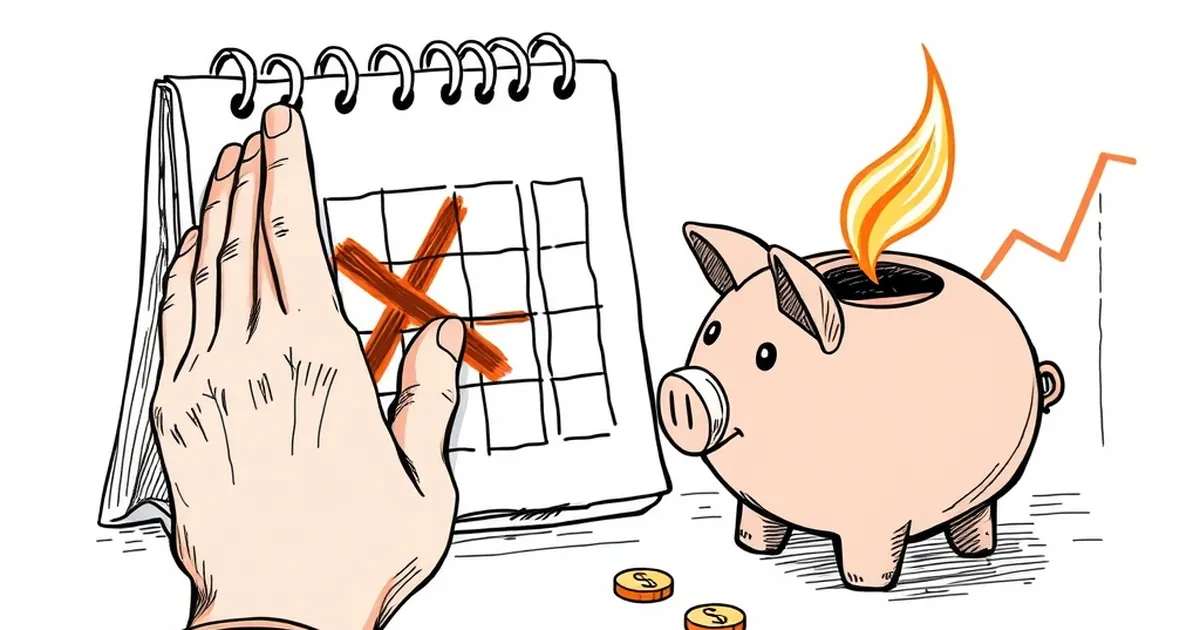
Your credit card statement arrives. You glance at the due date, do some mental math, and decide to push the payment to next Tuesday. No big deal, right? You have the funds, you’re just optimizing your cash flow. But somewhere in your limbic system, a tiny alarm just went off. And it’s not about the interest.
We tend to think of personal finance as a purely rational domain—a spreadsheet of inflows and outflows. But the brain doesn’t see a bill payment that way. It sees a streak. And when you break a streak, even voluntarily, your brain reacts the same way it does when you miss a day on a habit-tracking app or lose a multi-day win sequence in a game. The psychology of "streaks" is deeply wired into how we process commitment, loss, and reward. So why does skipping a payment feel so much like breaking a chain, and what does that mean for how you manage money?
The Streak Mechanic: More Than Just a Number
Let’s talk about the "streak" mechanic in behavioral psychology. It’s not just a gamification gimmick used by language-learning apps and fitness trackers. The underlying principle is variable-ratio reinforcement, a concept first mapped out by B.F. Skinner. In simple terms, if you get a reward after an unpredictable number of actions, you’ll keep doing the action obsessively. But there’s a flip side: if you have a consistent history of actions—like paying your bill on the 1st of every month for 14 months straight—the brain treats that consistency as a baseline for safety.
When you skip that payment, you’re not just changing a date. You’re introducing a perturbation into a system that had achieved predictive stability. The brain hates that. It’s the same reason why a "streak freeze" in a game feels like a lifeline; you’re paying to avoid the cognitive dissonance of a broken chain. In finance, we don't have a "streak freeze" button, so the brain registers the break as a minor threat, even when you’re 100% solvent.
The Endowment Effect on Timeliness
Here’s where it gets interesting. You don’t just own your money; you endow your payment history. The endowment effect, a concept from behavioral economist Richard Thaler, suggests we value things more once we possess them. Your perfect payment history is a psychological asset. Skipping a payment—even to a later date—feels like a loss of that asset. You’re not losing money, but you’re losing the status of being "on time." And loss aversion, as Kahneman and Tversky showed, is twice as powerful as the pleasure of a gain. The pain of breaking the streak is roughly double the pleasure of holding onto your cash for an extra five days.
The Hidden Cost of "Strategic" Delays
Now, let’s flip the script. Many financial advisors actually recommend you don't pay early if you have a zero-interest grace period. It’s mathematically optimal to hold your money in a high-yield savings account until the last second. So why does it feel so wrong?
Because the brain doesn't optimize for interest; it optimizes for completion.
When you pay a bill, your brain gets a dopamine hit—a small, clean release of reward for closing a loop. That’s the "reward loop" in action. Delaying the payment means keeping that loop open, which is cognitively taxing. Your working memory has to hold "remember to pay on the 28th" as an active file. That’s mental overhead. The brain prefers to close the file, take the dopamine, and move on.
I once tested this on myself. I automated a bill payment to go out on the 1st, but then switched it to the 15th to earn a few extra cents in interest. For the first three days of that month, I kept checking my account. I wasn't worried about funds; I was anxious about the unfinished task. It felt like I had left a burner on. The interest gained was negligible; the cognitive load was real.
The "Almost Missed" Phenomenon
There’s a specific scenario that reveals this the most: the near-miss. You pay your bill at 11:58 PM on the due date. The payment processes, you're fine. But your heart rate was elevated for an hour before that. Why? Because the brain’s pattern-recognition systems are hyper-vigilant for near-misses. In behavioral science, near-misses activate the same reward circuitry as actual wins, but they also spike anxiety. The brain says, "You avoided the loss, but you were close to the cliff." This is why people who pay late—even by a minute—report feeling disproportionately guilty, far beyond the actual late fee.
Why Credit Cards Are Designed to Exploit This
Let’s get specific about the payment ecosystem. Visa and Mastercard don't just move money; they manage rhythms. The credit card billing cycle is a masterclass in behavioral design. You get a statement, a due date, and a minimum payment option. The minimum payment is a trap for your streak psychology. It lets you "stay on track" while actually breaking the full-payment streak. The brain accepts the minimum payment as a "streak save"—you didn't miss the deadline, so you're still "good."
But the real manipulation is the grace period. It creates a false sense of security. You think you have a buffer, so you skip a payment. That breaks your internal streak. The next month, you might skip again because the streak is already broken—a phenomenon known as the "what-the-hell effect." You missed one workout, so you eat a whole pizza. You skipped one payment, so you skip two. The financial industry knows this. They don't want you to miss one payment; they want you to miss two because that resets your baseline and makes them money on interest.
A Concrete Example: The 30-Day Lapse
A study from the Federal Reserve Bank of New York in 2019 looked at consumer behavior around missed payments. They found that a single missed payment on a credit card increased the likelihood of a second missed payment by 47% within the next three months. That’s not a math problem; that’s a psychology problem. The first skip is a logistical error or a cash-flow hiccup. The second skip is a behavioral pattern. Once the brain sees the streak as broken, the cost of re-establishing it feels too high, so you stay in the "broken" state longer.
Practical, Forward-Looking Close
Here’s the takeaway, and it’s not "just pay on time." That’s boring and unhelpful. Instead, understand that your brain is going to treat payment schedules as emotional events. So design for that.
First, reframe the streak. Don't track "payments on time." Track "months without a late fee." That’s a positive streak you can build. It’s a different metric, but it gives you a clean win that doesn't trigger the anxiety of the near-miss.
Second, use the "open loop" to your advantage. If you want to delay a payment for financial optimization, do it with a visible reminder that feels like a physical object. Set a calendar alert that says "STREAK INTACT" on the day you schedule the payment. You’re giving your brain a completion event, even if the money hasn't left your account yet.
Third, automate the baseline, not the exception. Set up automatic payments for at least the minimum on every single account. You’re creating a "streak floor"—a safety net that prevents the catastrophic psychological break of a missed payment. Then, manually pay the extra when you want. You get the dopamine hit of paying more, without the anxiety of breaking the chain.
Finally, embrace the "two-payment" rule. When you’re tempted to skip a payment, ask yourself: "Will I skip this twice?" If the answer is no, skip it without guilt. If the answer is yes, pay it now. You’re not just managing cash flow; you’re managing your brain’s propensity for cascading losses. The goal isn't to never skip. The goal is to skip deliberately, not reactively. That’s the difference between playing the game and being played by it.