Why Your Brain Treats Card Declines Like Failed Skill Checks
Why a card decline triggers the same brain response as failing a high-stakes skill test
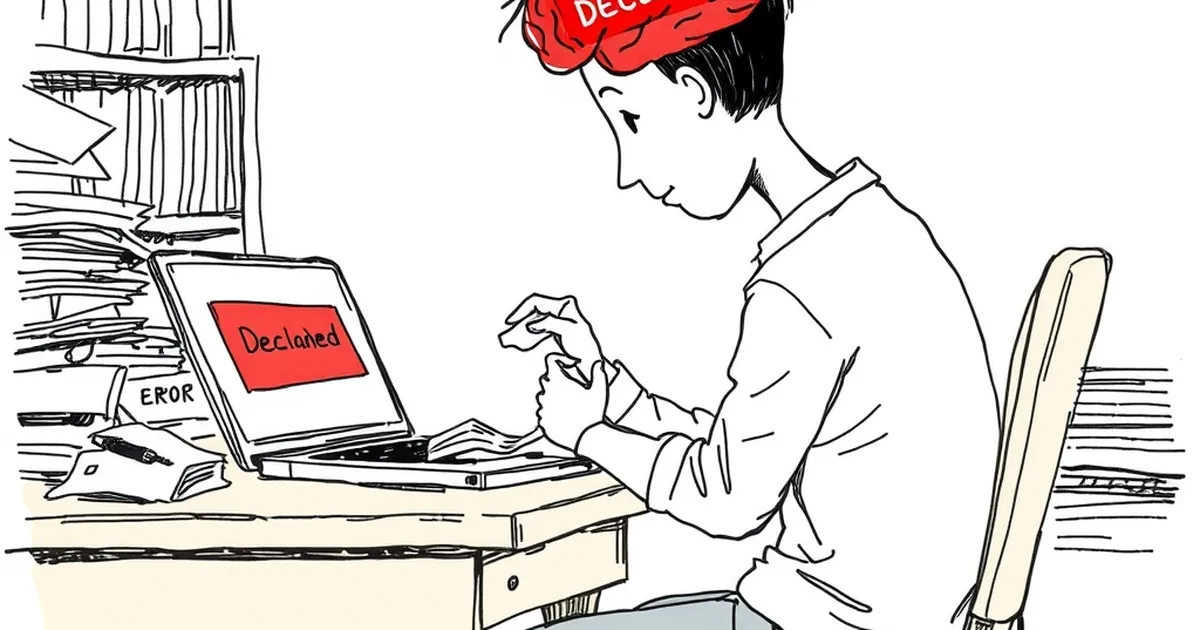
You’re standing at a checkout. The terminal beeps. You swipe again. Beep. You tap. Nothing. A third time, slower, as if the machine speaks a language you can learn through rhythm. The clerk looks at you. You feel a flush of heat, a spike of something that isn’t quite embarrassment but isn’t far from it. You were not expecting this. The card should work. You have the money. The system, for reasons unknown, says no.
Why does a simple payment failure feel so much like failing a test? Not a boring test, either — one where you studied, knew the material, and still drew a blank under pressure. The answer lives in the overlap between behavioral psychology and the invisible architecture of payments. Card declines are not just technical errors. They are tiny, high-stakes events that your brain processes using the same circuitry it uses for skill checks, social judgment, and competitive play.
The Skill Check Illusion
In behavioral psychology, a skill check is a moment where effort and competence determine outcome. You aim a basketball, you shoot, you either make it or you don’t. Your brain tracks the relationship between what you do and what happens next. This is the foundation of what psychologists call internal locus of control — the belief that your actions shape your results.
A card decline hijacks this system. You present a card. You enter a PIN. You tap. These are actions that feel like inputs. But the outcome — approval or decline — depends on variables you cannot see: issuer risk models, network routing, fraud algorithms, available balance, daily limits, velocity checks. Your brain, hungry for causality, searches for what you did wrong. It finds nothing, so it invents something. Maybe I tapped too fast. Maybe the chip is dirty. Maybe I should have used the other card.
This is the illusion of a failed skill check. You experience the emotional sting of a missed free throw, but you didn’t actually take a shot. The system made a decision about you, and you had no meaningful input. The mismatch between felt agency and actual control is what makes the moment so jarring.
The Variable-Ratio Reinforcement Trap
Payments operate on a variable-ratio reinforcement schedule — the same pattern that makes slot machines (and, more relevantly, notification badges and social media likes) so compelling. Sometimes the card works on the first tap. Sometimes it takes three tries. Sometimes it works after you switch to cash and then mysteriously works again on the next transaction.
Your brain does not distinguish between “the system approved me” and “I succeeded at a task.” Dopamine fires on approval, and the unpredictability of when approval comes only strengthens the behavioral loop. You keep tapping, keep swiping, keep trying different angles, because somewhere deep in your limbic system, you believe the next attempt might be the skill check you finally pass. The decline, then, isn’t just a rejection — it’s a failure to solve the puzzle, which makes you want to try again.
Loss Aversion and the Pain of Rejection
Daniel Kahneman and Amos Tversky’s work on loss aversion tells us that losing something feels roughly twice as bad as gaining the same thing feels good. A card decline is a special kind of loss: you never had the money in hand, yet you experience a loss of status, competence, and social standing all at once.
Consider the social context. You are in a line. People are waiting. The decline is public. Even if no one says a word, your brain registers a threat to your social standing. In evolutionary terms, being unable to complete a transaction in front of others signals resource scarcity — a dangerous signal to broadcast. Your heart rate rises. Your palms sweat. You start explaining: I just checked my balance. I don’t know why it’s doing this.
This is loss aversion applied to identity. You are not just losing a purchase; you are losing the identity of a competent, resource-adequate adult. The brain treats this as a threat, which is why the emotional response feels disproportionate to the event.
A Study That Makes It Real
In 2018, researchers at the University of Toronto and Harvard published a study on what they called “the pain of payment.” They found that the act of paying activates the insula — the same brain region associated with physical pain and disgust. But here’s the part that matters for this conversation: the rejection of a payment activates the anterior cingulate cortex, which is involved in processing social rejection and error detection. Your brain literally processes a card decline the same way it processes being left out of a group or making a mistake in front of peers.
The study used fMRI scans while participants completed transactions. When a card was declined, the brain lit up in patterns nearly identical to those seen in social exclusion experiments. You are not being dramatic. Your brain is, quite literally, treating a declined payment as a social threat.
The Competitive Play Element
There is a quieter layer here, one that connects payments to competitive play. When you hand over a card, you are entering a game with asymmetric information. The merchant knows the price. You know your balance. The network knows everything else — fraud scores, spending patterns, issuer policies — and never tells you the rules.
This is a game of incomplete information, not unlike certain strategy games where you have to guess your opponent’s hand. The “win” condition is a smooth transaction. The “loss” is a decline. But because you don’t know the rules, every decline feels like an unfair move. You want to know why you lost. Was it a hidden fee? A daily limit? A fraud flag? The system does not explain itself.
This creates a loop of competitive rumination. You replay the transaction in your head. Should I have used the other card? Should I have told the bank I was traveling? You are trying to reverse-engineer the game’s mechanics so you can win next time. This is the same cognitive process gamers use when analyzing a lost match. The difference is that in payments, the rules change without notice.
The Forward-Looking Shift
Here is where things get interesting — and more hopeful. Payment systems are beginning to understand that the human brain is not a rational calculator but a pattern-seeking, status-protecting, threat-detecting machine. The next generation of payment design is moving toward psychological transparency.
Instead of a generic “declined” message, some issuers now send real-time alerts: “We flagged this as unusual activity. Reply YES to retry.” This turns the decline from a failed skill check into a solvable puzzle with a known rule. The brain’s threat response drops because you now have agency — you can respond, you can fix it, you can win.
Other systems are experimenting with graceful failures. Instead of a hard decline, the terminal offers alternatives: “Try another card” or “Would you like to split payment?” This reframes the moment from a verdict to a choice. Your brain, hungry for control, relaxes when it sees options.
The practical takeaway for you, the person standing at the register, is this: when the card declines, pause before the shame spiral. Recognize that your brain is doing exactly what evolution designed it to do — treating a financial transaction like a social threat. Breathe. Try a different card. Ask the clerk to run it as credit instead of debit. Know that the system is not judging your competence; it is running a probability model that has nothing to do with your worth.
And for those of us who design or work in payments, the forward-looking question is not how to make fewer declines — some declines are necessary for security. The question is how to make declines less punishing to the human brain. How do we turn a moment of rejection into a moment of clarity? How do we give the player — because you are a player in this game — a visible set of rules and a chance to try again?
The answer will not come from better encryption or faster networks. It will come from understanding that every beep, every tap, every silence after the swipe is a conversation between a human brain and a machine that doesn’t yet know how to say why.