Why Your Brain Treats a Visa Notification Like a Game Badge
Discover why your brain treats routine visa notifications like rewarding game badges and what that reveals about human psychology
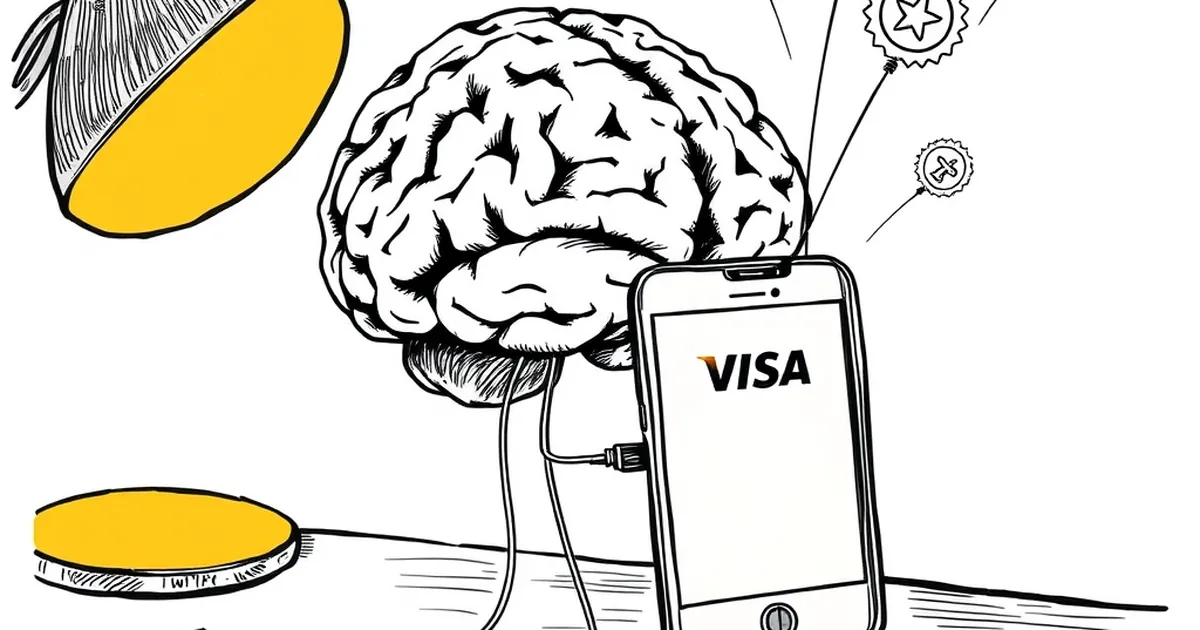
Why Your Brain Treats a Visa Notification Like a Game Badge
You glance at your phone. A push notification from your banking app lights up the screen: “Visa purchase approved—$47.83 at Urban Outfitters.” Your heart does a tiny, imperceptible skip. You feel a flicker of something—satisfaction? Validation?—before you swipe it away. Now ask yourself: why does a routine transaction, a simple transfer of digits from one ledger to another, trigger any emotional response at all? You aren’t winning anything. You haven’t beaten a level. And yet, your brain just awarded you a small, silent badge of progress.
The answer lies in the strange architecture of how our minds have evolved to interpret signals of reward and status. Payment networks like Visa and Mastercard didn’t set out to hack your dopamine system. But by accident of design—and by decades of careful behavioral tuning—they’ve created a feedback loop that feels eerily similar to the one you get when you clear a milestone in a video game. Let’s pull back the curtain on that loop.
The Variable-Ratio Slot in Your Pocket
The most powerful psychological mechanism in gaming isn’t graphics or story. It’s the schedule of reinforcement. Specifically, variable-ratio reinforcement—the principle that a reward delivered at unpredictable intervals is far more compelling than one given every single time. B.F. Skinner demonstrated this with pigeons pecking at levers. Game designers perfected it with loot boxes and random drops.
But your credit card doesn’t give you random rewards. Or does it?
Consider the humble notification. You never know exactly when it will arrive. It could be a $2 coffee at 8 AM or a $400 plane ticket at 2 AM. Each ping is a small, unpredictable event. And because the purchase itself is usually tied to something you wanted—a new book, a meal out, a subscription to a streaming service—the notification becomes a proxy for a positive outcome. The brain bundles the signal of the transaction with the pleasure of the acquisition. Over time, the notification itself becomes a secondary reinforcer. You start to crave the ping, not because you’re spending money, but because the ping means something good just happened.
This is why people check their banking apps far more often than they need to. It’s not financial prudence. It’s the same compulsion that makes you check for a new message or a like on social media. The variable interval of the notification—sometimes rewarding, sometimes neutral, rarely punishing—keeps you hooked.
Loss Aversion and the “Spending High”
Daniel Kahneman and Amos Tversky gave us a framework that explains why spending money feels painful—and why, paradoxically, it can also feel good. Their prospect theory showed that loss aversion is roughly twice as powerful as the desire for gain. Losing $20 stings about twice as much as finding $20 pleases.
So how does a payment notification flip that script? It doesn’t, at least not directly. What it does is reframe the perception of the loss. When you tap your card or phone, the money disappears instantly and invisibly. The physical act of handing over cash—the tactile sensation of loss—is gone. What remains is the notification, which arrives after the transaction is complete. By that point, the loss has already been processed. The notification now serves as a confirmation of a completed action, not a reminder of a sacrifice.
Think of it like a boss fight in a game. You don’t feel the pain of losing health potions or ammunition in the moment you use them. You feel the satisfaction of seeing the boss’s health bar drop. The notification is that health bar. It tells you, “You did the thing. The thing worked. You got the item.” The loss is abstracted away; the completion is highlighted.
This is why some people report a mild “spending high” after a large purchase. It’s not about the stuff they bought. It’s about the successful execution of a plan, validated by a system that rewards completion. The notification badge—the little checkmark next to the transaction—is the brain’s cue that you’ve navigated a complex social and economic system and come out the other side intact.
The Social Scoreboard You Didn’t Know You Were On
We don’t talk about it much, but payment networks are deeply social systems. Every transaction is a signal. When you hand over a premium card—black, metal, carbon fiber—you’re not just paying. You’re broadcasting status. But the notification layer adds a subtler, more private layer of social scoring.
Consider a study from the Journal of Consumer Research (2017) that examined how people feel after using credit versus cash. Participants who used credit cards reported feeling more powerful and in control compared to cash users, even when spending the same amount. The researchers argued that the card itself acts as a symbolic extension of the self—a tool that enables agency. The notification, then, is the confirmation of that agency. It’s a little message that says, “Yes, you have the resources. Yes, you made a choice. Yes, you are a competent actor in the marketplace.”
Now layer on the gamification elements that banks and networks have quietly added. Points, miles, cashback percentages, “spend $500 more to unlock a bonus tier”—these are literal game mechanics. But the most powerful one isn’t the points. It’s the badge. The “You’ve been approved” notification. The “Your payment was processed successfully” message. The “Congratulations, you’ve reached Platinum status” email. Each one is a discrete, collectible piece of social proof, even if only you see it.
Your brain doesn’t distinguish between earning a badge in a video game for defeating a final boss and earning a badge in your banking app for hitting a spending threshold. Both are arbitrary goals set by an external system. Both trigger the same neural circuitry: the striatum, which processes reward anticipation, and the prefrontal cortex, which registers accomplishment. The content of the badge matters less than the fact of earning it.
The Practical Future: Designing Downstream Consequences
So what do we do with this knowledge? The obvious takeaway is that payment systems are already gamified, whether we admit it or not. The more interesting question is whether we can design better feedback loops—ones that don’t exploit our reward systems for pure consumption, but instead help us make smarter decisions under uncertainty.
Here’s one concrete example: a behavioral nudge called “pre-commitment with feedback.” Imagine a banking app that lets you set a weekly spending goal for discretionary purchases. Every time you spend, you get a notification, but instead of a neutral “approved” message, you see a progress bar: “You’ve used 40% of your weekly budget. 3 days remaining.” That’s not a reward. That’s a dashboard. It turns the variable-ratio reinforcement of the notification into a predictable, transparent metric.
Early pilots of similar systems (like those used by the behavioral design firm ideas42) showed that people who received real-time, non-judgmental feedback on their spending were more likely to stay within their self-set budgets than those who only saw monthly statements. The key was that the feedback wasn’t punishing. It was informative. It treated the user as a player in a game they designed for themselves—not a subject in a Skinner box.
The forward-looking shift is this: instead of letting payment networks optimize for engagement (more notifications, faster approvals, bigger spending), we can optimize for awareness. The same neural circuitry that makes a Visa notification feel like a badge can be repurposed to make a savings milestone feel like a level-up. A “You saved $50 this week” notification, delivered on a variable schedule, could trigger the same dopamine hit as a purchase confirmation—but with a very different downstream consequence.
The brain doesn’t care whether the badge says “spent” or “saved.” It only cares that it earned something. The smartest systems will let you choose which badge you want to chase.