Why Your Brain Treats a Payment Decline Like a Wrong Turn
A declined payment triggers the same brain response as a wrong turn—here’s why it feels so unsettling
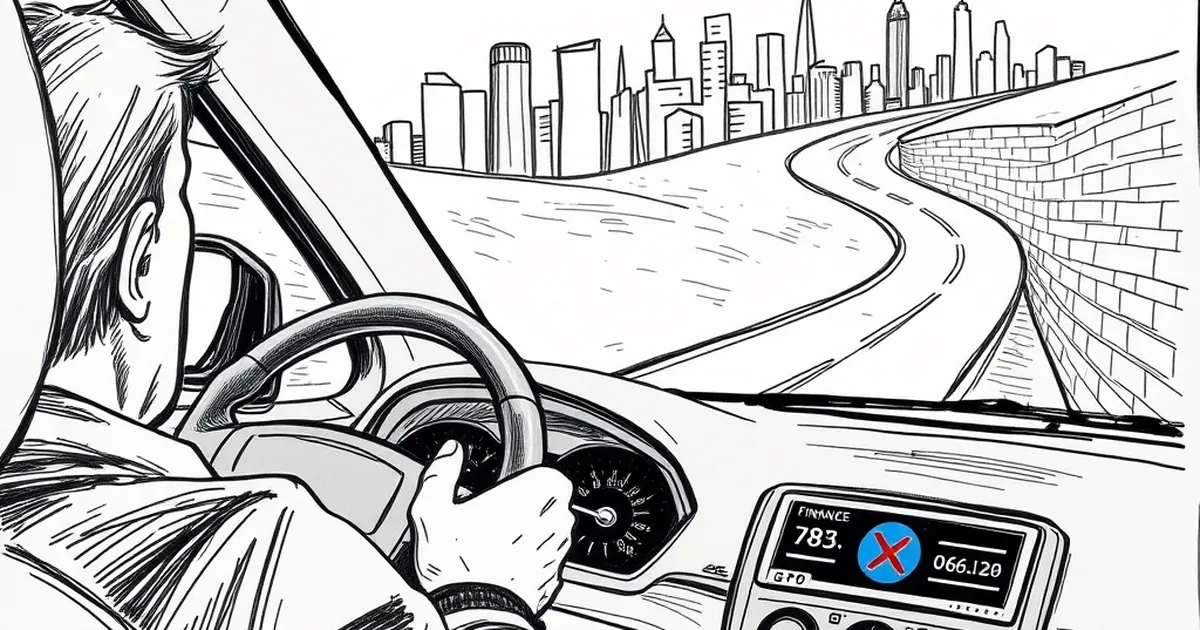
There’s a peculiar moment that happens when you tap your card or phone at a terminal and the screen flashes that dreaded red light. Your stomach drops. You immediately check the card, the balance, the chip. But here’s the thing: that feeling of panic isn’t just about the money. It’s about a broken pattern in your brain’s navigation system.
We tend to think of payments as purely logical transactions—a transfer of numbers from one ledger to another. But the reality is that your brain processes a declined payment the same way it processes a wrong turn on a familiar road. It’s not just an error; it’s a violation of an expected path. Let’s look at why a tiny financial hiccup triggers such a disproportionate cognitive response, and what that means for how we design, use, and think about money.
The Expectation Engine
Your brain is a prediction machine. It doesn’t wait for information; it constantly generates forecasts about what will happen next, based on past experiences. When you walk into a coffee shop and order the same latte, your brain isn’t just thinking about caffeine. It’s simulating the entire sequence: the greeting, the smell, the beep of the terminal, the receipt.
This is where the concept of predictive processing comes in. Your neural pathways are essentially wired to minimize "surprise." A successful payment is a confirmation that your model of the world is correct. It’s the neural equivalent of a smooth, green light on your daily commute.
When a payment is declined, it’s not a neutral event. It’s a prediction error. And prediction errors are expensive for the brain. They require immediate attention, a re-evaluation of the situation, and a rapid search for a new plan. Think about the last time you missed a highway exit. You didn't just calmly note it; your body had a micro-stress response. Your jaw tightened, you checked your mirrors, and your brain started rapidly re-calculating a new route. A declined card triggers the exact same cascade—minus the steering wheel.
The Pain of Paying (and the Agony of Being Stopped)
Behavioral economists have long studied the "pain of paying," the psychological friction associated with spending money. Dan Ariely and George Loewenstein have shown that the form of payment changes the intensity of this pain—cash hurts more than credit cards because it’s tangible. But a decline amplifies this in a different way. It’s not just the pain of parting with money; it’s the sudden, unexpected rejection of that transfer.
This is where loss aversion kicks in, a concept made famous by Daniel Kahneman and Amos Tversky. We feel losses roughly twice as intensely as equivalent gains. But a decline isn't a loss of money; it's a loss of agency. It’s a forced stop. Your brain interprets this as a threat to your autonomy and your status.
Consider the social context. Paying is a performance. It’s a public declaration of solvency. When that transaction fails, you’re not just dealing with a technical error; you’re facing a social risk—the judgment of the cashier, the queue behind you, the fear of being seen as unreliable. This is why the brain treats it like a wrong turn: it’s a deviation from a well-rehearsed social script, and your brain desperately wants to get back to the "main road" of normalcy.
The Variable-Ratio Trap of Rewards
Here’s where the intersection gets interesting. While a decline is a negative surprise, the rewards attached to payments are a masterclass in positive reinforcement. Loyalty points, cashback percentages, and "you earned this" notifications are all built on a principle called variable-ratio reinforcement.
This is the same mechanism that keeps you checking your phone for likes or refreshing your inbox. When you don't know exactly when the reward is coming, the dopamine response is stronger. You tap your card, and sometimes you get 1 point, sometimes 5, sometimes a random bonus. This unpredictability makes the act of paying itself slightly more engaging.
But this creates a dangerous cognitive loop. Your brain is primed for the potential reward of the transaction, making the decline feel even more jarring. It’s like taking a wrong turn in a maze where you were promised a prize at the end. The frustration isn't just about being lost; it’s about the interruption of the reward anticipation. This is why a declined payment feels so much worse than, say, a declined login attempt. The stakes feel higher because the potential for a "win" was so close.
The "System 1" Fallback
When a payment is declined, you might think you’re making a rational decision about what to do next. But you’re not. You’re running a primal script.
In Thinking, Fast and Slow, Kahneman distinguishes between System 1 (fast, intuitive, emotional) and System 2 (slow, deliberate, logical). A successful payment is a System 1 operation—it’s automatic, it requires no thought. A decline, however, forces a sudden, violent shift to System 2. You have to check your account, log into an app, or fumble for a different card.
This cognitive gear-shift is exhausting. It’s the reason why a single declined transaction can ruin your mood for an hour. It’s not the amount of money; it’s the cognitive load of having to re-route your mental GPS. You have to rebuild the plan from scratch. This is why many people, when faced with a decline, will simply abandon the purchase entirely, even if they have enough money in another account. The brain says, "This route is blocked. Let's go home." It’s a defense mechanism against further uncertainty.
Designing for the "U-Turn" Moment
So, if a decline is a wrong turn, how do we make the road easier to navigate? For years, payment systems treated declines as binary, cold events. But the future of fintech is about redesigning this specific moment of friction.
Think about the best navigation apps. When you miss a turn, they don't just say "Error." They say, "Re-routing." They immediately offer a new path. The best payment systems are starting to do the same. Instead of a stark "DECLINED," they’re moving toward "Action Required" with instant, contextual solutions—like offering a split payment, suggesting an alternative funding source, or proactively checking if the issue is a temporary hold.
The practical takeaway for you, as a consumer, is to recognize the wrong turn for what it is. When your card is declined, you are not being judged by the universe; you are experiencing a prediction error. The most resilient financial behavior isn't about having more money—it's about having more routes. It’s about having a mental map that includes alternative paths: a backup card, a digital wallet, or simply the calm to say, "No problem, let me try another way."
We’re moving toward a world where payments are less about a single "yes/no" gate and more about a fluid negotiation between your intention and your accounts. The goal isn't to eliminate the wrong turn—that's impossible. The goal is to make the re-routing so seamless that your brain never has to panic. Because the true cost of a decline isn't the failed transaction. It’s the cognitive detour you have to take to get back to your life. And that’s a road we all want to be shorter.