Why Your Brain Treats a Payment Decline Like a Game Over
Why your brain treats a payment decline like a game over—and what that reveals about expectation, status, and reward
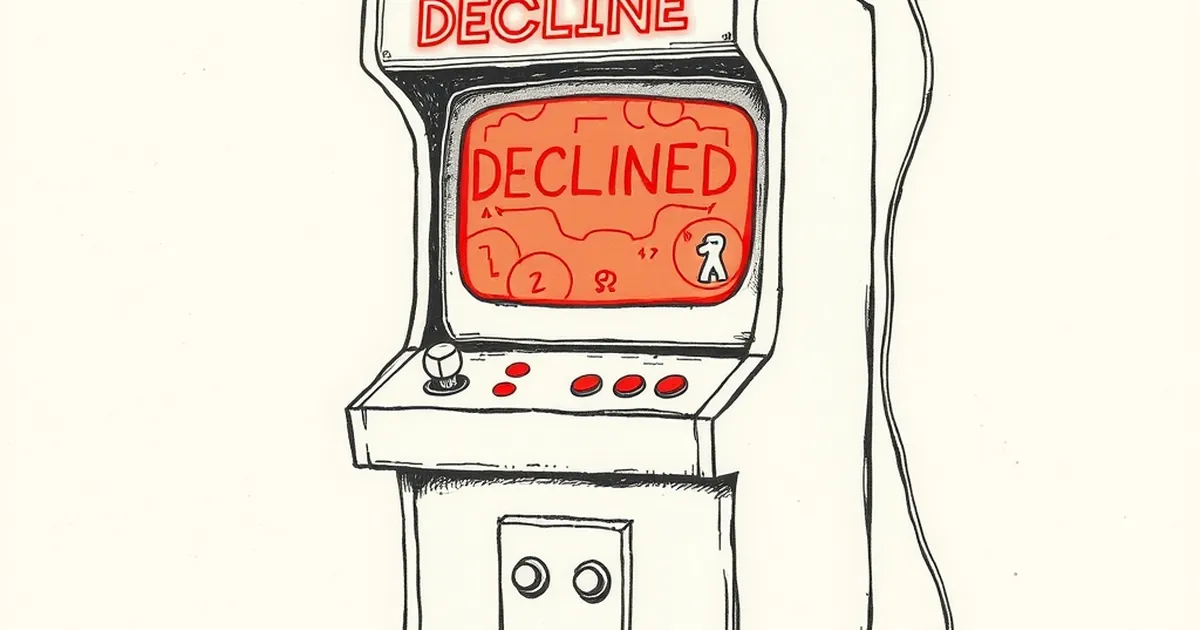
You’re tapping your phone against the terminal. Once. Twice. A third time. Nothing. The screen flashes a red X, and the machine spits out a slip of paper that reads, in effect: You lose. You feel a prickle of heat on your neck, a knot in your stomach. All you wanted was a coffee. So why does a simple payment decline hit like a personal failure, a sudden loss of status, a small but unmistakable game over?
It turns out your brain isn't just processing a financial transaction. It's running a rapid-fire loop of expectation, risk, and reward that is neurologically identical to how it handles a competitive challenge. And when that loop breaks, the response is primal.
The Variable-Ratio Trap: How Payments Became a Slot Machine
To understand why a decline stings so much, you have to understand how your brain learned to expect the approval. Every time you tap a card or phone, you are engaging in a system known in behavioral psychology as variable-ratio reinforcement. It’s the same pattern that makes checking your phone for a new notification so addictive.
The core idea, first formalized by B.F. Skinner, is simple: a behavior is most resistant to extinction when the reward comes after an unpredictable number of responses. In the early days of credit cards, every swipe was a moment of suspense. You handed over the plastic, the clerk ran the imprinter, and you waited. Today, that wait has been compressed into a fraction of a second, but the underlying mechanism hasn't changed. The vast majority of your taps result in a green checkmark—a reward. You get the coffee. You get the dopamine.
But here’s the trap: because the system is so reliable (you’ve approved 99.9% of your recent transactions), your brain stops treating the approval as a special event. It becomes the baseline. The reward loop shifts. The real emotional event is when the pattern breaks. A single decline, in a sea of approvals, is a massive, salient signal. It’s the one time the machine didn't pay out. And your brain, wired to avoid loss more intensely than it seeks gain (the famous loss aversion bias from Kahneman and Tversky), interprets this as a threat.
The "Near-Miss" That Isn't
The payment terminal even mimics the structure of a near-miss. Think about the sequence: you initiate the action, you hold the device close, you wait for the beep. The longer that wait, the more your brain anticipates the "win." A delay of three seconds can feel like an eternity. When the decline finally comes, it’s not a neutral outcome. It’s a promise broken.
The Social Stakes: Decline as Public Shaming
The mechanics inside your head are only half the story. The other half is happening in the physical, social world. A payment decline is rarely a private event. It happens at a register, with a cashier watching, with a line of people behind you, or with a friend waiting to split the bill.
This transforms the transaction from a simple exchange of value into a public performance of financial competence. You are, in that moment, being judged. Are you good for it? Do you belong here? The decline feels like a failed audition for a role you already thought you had.
Psychologists call this social evaluation threat. It’s the same anxiety that comes with public speaking or a job interview. Your brain doesn’t distinguish between “my card was rejected” and “I was rejected.” The social pain centers of the brain—the anterior cingulate cortex and the anterior insula—light up in both scenarios. You aren't just angry at the bank. You are embarrassed. You feel a drop in social standing.
The Amygdala Hijack
This is where things get physical. The amygdala, your brain’s threat detector, takes over. Your heart rate increases. Your palms might sweat. You might snap at the cashier or fumble for a different card. You are no longer making a rational decision about how to pay. You are in a stress response, trying to escape a socially dangerous situation. The line behind you isn't just a line of people waiting for coffee. It's a jury.
The Risk-Taking Rebound: Why You Spend More After a Decline
Here is the most counterintuitive part of the whole loop. The immediate aftermath of a decline often leads to more spending, not less. This is the risk-taking rebound.
Consider a study published in the Journal of Consumer Research. Researchers found that when people experienced a sudden financial rejection (like a declined card), they were subsequently more likely to choose a risky gamble—like a lottery ticket—over a sure, smaller gain. Why? Because the decline created a feeling of having already lost. Your brain enters a "what the hell" effect, a form of the sunk cost fallacy applied to your own ego. You feel you need to "win back" your status, to assert control over the situation.
You might pull out a different card, one with a higher limit, and buy something you didn't even want. Or you might switch to cash and tip more aggressively. You aren't being fiscally responsible. You are engaging in competitive play against the machine, against the social situation, against the feeling of losing. You are trying to prove to the terminal, and to everyone watching, that you are still a player.
The "Chase" in Small Doses
This is the same psychological mechanism that drives people to double down after a loss in any competitive arena. The payment decline triggers a narrative: The system tried to stop me. I will not be stopped. The purchase itself becomes secondary to the act of overcoming the obstacle. You aren't buying a sandwich. You are winning a confrontation.
Building a Better "Game Over" Screen
Where does this leave us? The payment system is designed for efficiency, not for your emotional well-being. But understanding the psychology suggests a few ways to break the loop.
For individuals, the first step is recognition. When you feel that hot flush of anger or shame at a terminal, pause. Name it. Say to yourself, "I am experiencing a loss-aversion response to a variable-ratio schedule failure." It sounds ridiculous, but it works. It moves the processing from your amygdala to your prefrontal cortex. It turns the "game over" screen into just a piece of data.
For the industry, there is a massive opportunity. The "Game Over" screen of the payment terminal is a design failure. It’s a red X. It’s a beep of shame. What if, instead of a judgment, the system offered a nudge?
Imagine a terminal that, upon a decline, displayed a simple, neutral message: "Unexpected. Check your balance or try a different method." No alarm. No red. Just a path forward. Better yet, imagine a system that preemptively handled the anxiety. Some banking apps already offer "shadow limits" or "buffer overdrafts" that prevent the decline from happening in the first place, absorbing the error before it reaches the public stage.
The most forward-looking change, however, is a shift in the metaphor itself. We need to stop thinking of a payment as a test you pass or fail. A payment is a conversation. Sometimes the line drops. Sometimes you need to dial again. It is not a verdict on your worth. The next time your card is declined, don't feel like you've lost the game. Just realize you’re playing the wrong one.