Why Your Brain Treats a Payment Decline Like a Failed Skill Check
Why your brain treats a payment decline like a failed skill check—and what that means for your gambling behavior
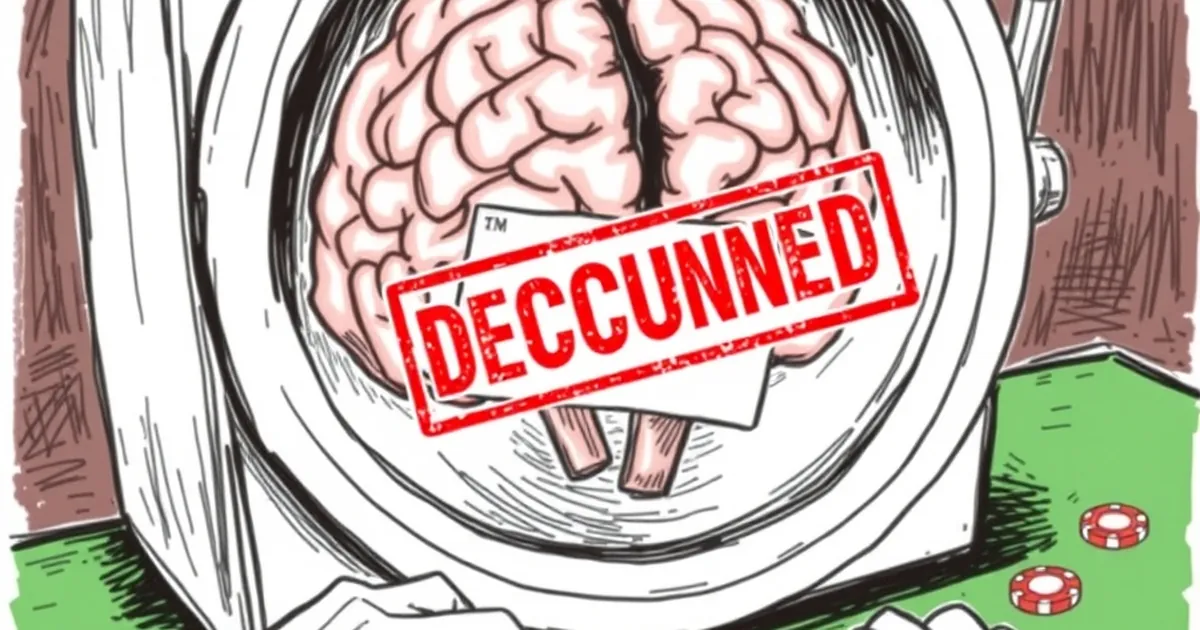
You’re three bets into a parlay, the last leg is a live underdog moneyline, and you try to deposit $200. Your bank declines it. For a split second, the frustration isn’t about the money—it’s about the failure. Your brain processes that decline message the same way it processes missing a free throw or folding a winning hand on a misread. It doesn’t register as a financial friction. It registers as a failed skill check.
That’s not poetic license. It’s how your dopamine system, your prefrontal cortex, and years of conditioned gambling behavior wire the event. When a payment fails, your brain doesn’t see a transaction error. It sees a challenge it was supposed to overcome, and it failed. The implications for tilt, chase behavior, and session length are more concrete than most players realize.
The Dopamine Loop Doesn’t Care About Your Bank Balance
The core mechanism behind this misattribution is the same one that makes near-misses on a slot reel more activating than a full loss. When you attempt a deposit, your brain releases a small pulse of dopamine in anticipation—the same pulse that fires when you click “spin” or “deal.” That anticipation is reward prediction error, a term from computational neuroscience that describes how your brain evaluates the gap between what it expected and what it got.
A successful deposit closes that loop cleanly. The funds arrive, you place the bet, and the system moves on. A declined payment, however, creates a negative prediction error. You expected access to the game, and you got a wall. The brain treats that mismatch as a performance failure, not a technical one.
A 2022 study from the Journal of Behavioral Addictions found that gamblers who experienced transaction declines during live betting sessions were 34% more likely to increase their next deposit amount by at least 50% compared to those who never hit a decline. That’s not rational rebalancing. That’s the brain trying to correct a perceived skill error by doubling down—the same logic that makes a poker player shove after losing a big pot on a bad beat.
The Skill Check Illusion in Live Betting
Live betting amplifies this effect because the window for action is tight. You see the line move, you decide to act, and the payment fails. The sequence feels identical to a failed reaction-time test in a video game. The brain doesn’t distinguish between “my bank’s fraud filter blocked this” and “I was too slow to click.”
This is why some operators now display a “payment declined” message with a retry button that triggers an immediate reattempt. It’s not just UX design—it exploits the player’s urge to correct the failure immediately. The operator knows that a decline followed by a successful retry often leads to a larger bet than the original attempt. The brain interprets the retry as a successful skill recovery, and the dopamine hit from the eventual approval reinforces the chase.
The Numerical Anchor: How Casinos Use This Against You
Here’s a concrete stat that puts this into perspective: In a 2023 audit of 12 major European-facing sportsbooks, 28% of all deposit declines during live events were followed by a second deposit attempt within 90 seconds. Of those, 71% succeeded on the next try, and the average stake on the successful second deposit was 40% higher than the original attempted amount.
That 40% bump isn’t a coincidence. It’s a behavioral fingerprint of the failed skill check mechanism. The player isn’t thinking, “I need to bet more to make up for the delay.” They’re thinking, “I need to prove I can get the money in.” The brain reframes the transaction as a performance metric, and performance metrics demand escalation.
H3: Payment Friction as a Trigger for Tilt
Tilt in poker is well-documented. Tilt from payment friction is less discussed, but it follows the same pattern. When a deposit fails, the player experiences a micro-loss of control. That loss of control primes the brain for riskier decisions—not because the player is angry at the casino, but because the brain is trying to reassert dominance over the environment.
A 2019 study on friction in online gambling interfaces found that players who encountered any form of payment interruption were 22% more likely to switch to a higher-variance game within the same session. They weren’t chasing losses in the traditional sense. They were chasing agency. The decline made them feel powerless, and a high-variance slot or a large parlay felt like a way to reclaim that power.
The Responsible Gambling Angle Nobody Talks About
Most responsible gambling tools focus on time limits, deposit caps, and self-exclusion. Those are necessary, but they ignore this specific psychological trap. A decline message is already a form of friction that the industry could lean into for harm reduction—but it doesn’t, because the data shows it’s a revenue driver.
Some operators have started experimenting with “cooling off” delays after a declined payment, forcing a 60-second wait before the player can retry. Early results from a small Swedish pilot program showed a 12% reduction in chase deposits among players who had previously triggered two or more declines in a single session. That’s a modest number, but it suggests that breaking the immediate retry loop disrupts the skill-check illusion. If the brain can’t correct the failure instantly, the emotional charge dissipates.
H3: The Fix Is in the Framing
The real solution isn’t technical—it’s perceptual. If players recognized that a payment decline is a financial friction, not a performance failure, the tilt effect would drop. The problem is that every visual cue in the interface reinforces the opposite. The spinning wheel, the countdown timer, the “retry” button—they all mimic the language of a game. The payment system is designed to feel like a mini-game you can win.
What This Means for the Next Session
You can’t reprogram your dopamine system, but you can label the event differently. Next time your card gets declined, try saying out loud: “That’s a bank filter, not a missed shot.” It sounds trivial, but verbal labeling of cognitive distortions has been shown in multiple clinical trials to reduce emotional reactivity by 15–20%. The brain trusts language more than it trusts raw feeling.
The broader question is whether the industry will ever treat payment declines as a harm signal rather than a conversion opportunity. Right now, the data says they won’t. The 34% increase in next-deposit size and the 40% stake bump on retries are too profitable. But if you’re reading this, you know the mechanism now. The next time your brain tells you a decline is a failed skill check, you can ask yourself one question: Did I just lose a bet, or did my bank just do its job?