Why Your Brain Treats a Payment Decline Like a Failed Daily Quest
Why a payment decline triggers the same brain circuitry as a failed quest, and what that means for your money habits
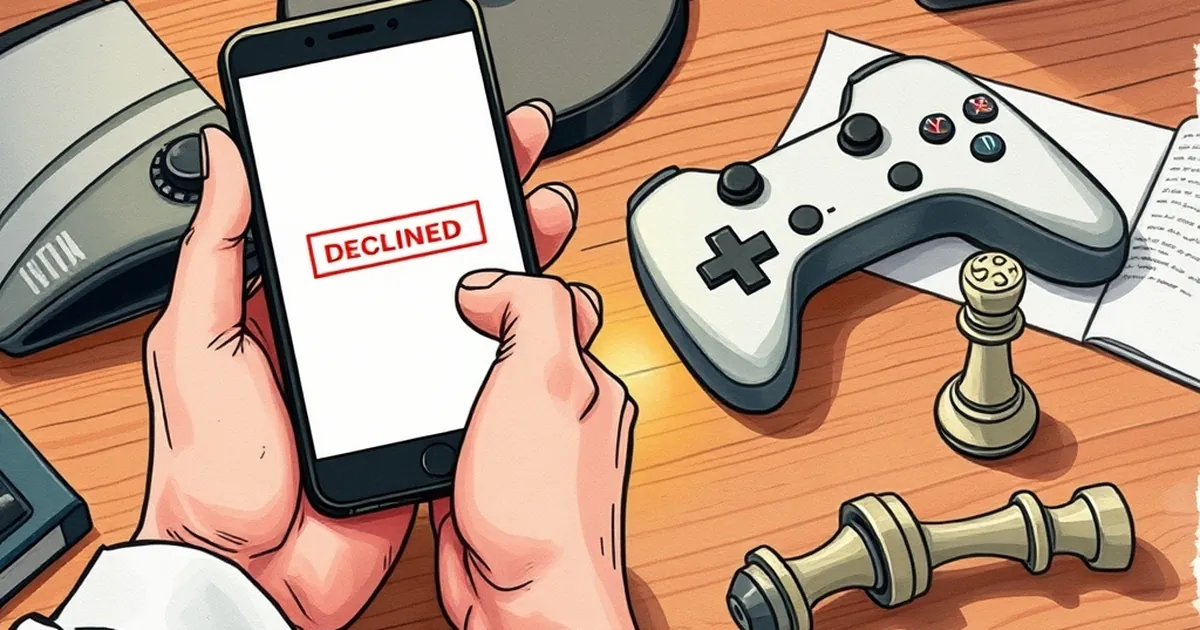
It’s 2:47 PM on a Tuesday. You’re in line for a coffee, you’ve already mentally moved on to your next meeting, and you tap your phone against the reader. Declined. Your heart rate spikes. Your cheeks flush. You mutter an apology to the barista and fumble for a different card, even though you know you have $4,000 in your checking account.
Why does that tiny, digital rejection feel so personal? It’s not just embarrassment. It’s not just the inconvenience. It’s that your brain just processed a failure state in the exact same neural circuitry it uses for a video game quest that you failed to complete.
We think of payment rails as infrastructure—boring, binary, logical. But your brain doesn't see a network handshake. It sees a reward loop that just got interrupted. And understanding that mismatch is the key to why we overspend, why we panic, and why the future of fintech isn't about faster chips, but about better psychology.
The Variable-Ratio Reinforcement of "Swipe and Win"
Let’s talk about the elephant in the room: the slot machine. Wait, no—we’re not talking about gambling. We’re talking about behavioral psychology and the work of B.F. Skinner. Specifically, his concept of variable-ratio reinforcement.
Here’s the gist: If you reward a behavior every single time, the behavior extinguishes quickly when the reward stops. But if you reward a behavior unpredictably, the behavior becomes nearly impossible to extinguish. That’s why a pigeon will peck a lever 10,000 times if the food pellet drops randomly.
Now, look at your wallet. Every tap, dip, or swipe is a lever pull. The "reward" isn't the coffee or the groceries—it's the approval. The beep. The green checkmark. The "Approved" screen. For 99% of transactions, the reward comes through. But here’s the dirty secret of modern payment systems: the timing and frequency of that approval is effectively random from the user's perspective.
Sometimes it takes 0.3 seconds. Sometimes it takes 3 seconds and makes you hover nervously. Sometimes it declines for a stupid reason—like the merchant's terminal having a bad internet connection—and then works perfectly on the second try. That randomness is precisely what Skinner found to be the most potent driver of persistence. Your brain is literally addicted to the anticipation of the "Approved" signal, not the purchase itself.
This is why a decline hurts so much. It’s not a logical error message. It’s a failed reward prediction. Your dopamine system expected a hit, and it got a null. The sting you feel is the chemical signature of an unmet expectation, similar to the frustration of a gamer who just missed a 95% hit chance in a turn-based RPG.
Loss Aversion: The $4 Coffee That Feels Like $40
Kahneman and Tversky’s Prospect Theory tells us that losses loom roughly twice as large as gains. But we rarely apply this to the payment moment itself. We usually think about loss aversion in terms of the price of the item. But the decline triggers a secondary loss: the loss of social standing (the line behind you), the loss of time (re-entering the PIN), and the loss of self-efficacy (the feeling that you can't control your own money).
Here’s the kicker: your brain doesn't distinguish between a loss of money and a loss of status or autonomy. They all activate the anterior insula—the region associated with pain and disgust.
Consider a study from the Journal of Consumer Research involving "payment transparency." Researchers found that when the pain of paying is high (like handing over cash), people spend less. But when the pain is hidden (like a card), they spend more. A decline flips this switch violently. It forces you to confront the payment actively. Suddenly, the abstract "swipe" becomes a tangible, public failure.
This is why a decline for a $4 coffee feels worse than a $40 declined charge at a car mechanic. The mechanic decline is rational—maybe you hit your limit. But the coffee decline? That's an identity threat. You feel poor, disorganized, and embarrassed. The magnitude of the transaction is irrelevant to your amygdala. The surprise of the rejection is everything.
The "Daily Quest" Structure of Modern Banking
Let’s bring it back to the gaming analogy in the title. In mobile games, a "Daily Quest" is a small, repeatable task—log in, collect 100 gold, kill three boars. They are designed to be easy, routine, and low-stakes. But if you fail a daily quest, the game doesn't punish you physically. It just shows you a red "Failed" text. Yet, gamers report feeling disproportionately annoyed by this.
Why? Because daily quests create a commitment loop. You've established a streak. You've built a mental model that says, "I do this, and I get that." A payment decline breaks the streak in the same way.
Your brain treats your bank balance as a "health bar" and your spending as "resource gathering." When you tap to pay, you're not just buying a sandwich—you're executing a micro-quest: "Convert available balance into sandwich." The decline is the game engine saying, "Quest Failed. Insufficient Mana."
But here's the crucial difference: in a well-designed game, failure states are informative. They tell you why you failed and how to improve. In payments, the decline message is usually cryptic: "Try Again" or "Contact Your Bank."
This ambiguity is the real problem. When your brain receives a failure signal without a clear remediation path, it enters a state of learned helplessness—the feeling that you have no control over the outcome. This is why people often don't retry a declined card even when they know they have funds. They fear the ambiguity more than the failure itself.
The Behavioral Fix: Designing for "Retry Grace"
So, what do we do with this? We can't remove the decline—fraud prevention and credit limits are necessary. But we can redesign the failure state to align with our cognitive wiring.
The future of payments isn't about making the approval faster; it's about making the decline smarter.
First, we need "Decline Reasoning." Instead of a generic "Declined," imagine a terminal that says: "Insufficient funds in Checking, but Savings has $200. Transfer to continue?" or "Possible fraud hold. Verify with thumbprint to override." This converts a dead-end into a branching quest. It gives the user agency back.
Second, we need to decouple the social embarrassment. The problem isn't the decline; it's the audience. We're seeing early-stage tech where the terminal screen shows a generic "Processing" message while a subtle haptic buzz on your phone tells you specifically what went wrong. This reduces the "loss of status" component of the pain.
Third, we need to gamify the recovery, not the spending. Instead of rewarding you for spending more (airline miles, cashback), banks could reward you for successful recovery from a declined state. Imagine a notification: "You resolved a decline in 30 seconds. You're in the top 10% of financially resilient users. Here's a small interest rate break." This flips the variable-ratio loop from "spend to win" to "manage to win."
The Forward-Looking Close
We are moving toward a world where the payment is invisible—embedded in your car, your watch, or your neural interface. But the decline will never be invisible. It is the one moment where the system must speak to you.
The brands that win the next decade of fintech won't be the ones with the lowest transaction fees. They'll be the ones who treat the decline not as a binary technical error, but as a psychological event. They'll build systems that respect your loss aversion, clarify your ambiguity, and turn a moment of panic into a moment of problem-solving.
Next time you get a decline, take a breath. Your brain isn't broken. It's just a quest that needs a better hint system. And the banks that figure out how to write those hints are the ones who will earn our loyalty—not just our transactions.