Why Your Brain Treats a Payment Decline Like a Failed Boss Fight
Discover why a payment decline triggers a stress response similar to failing in a video game, and what it reveals about your brain
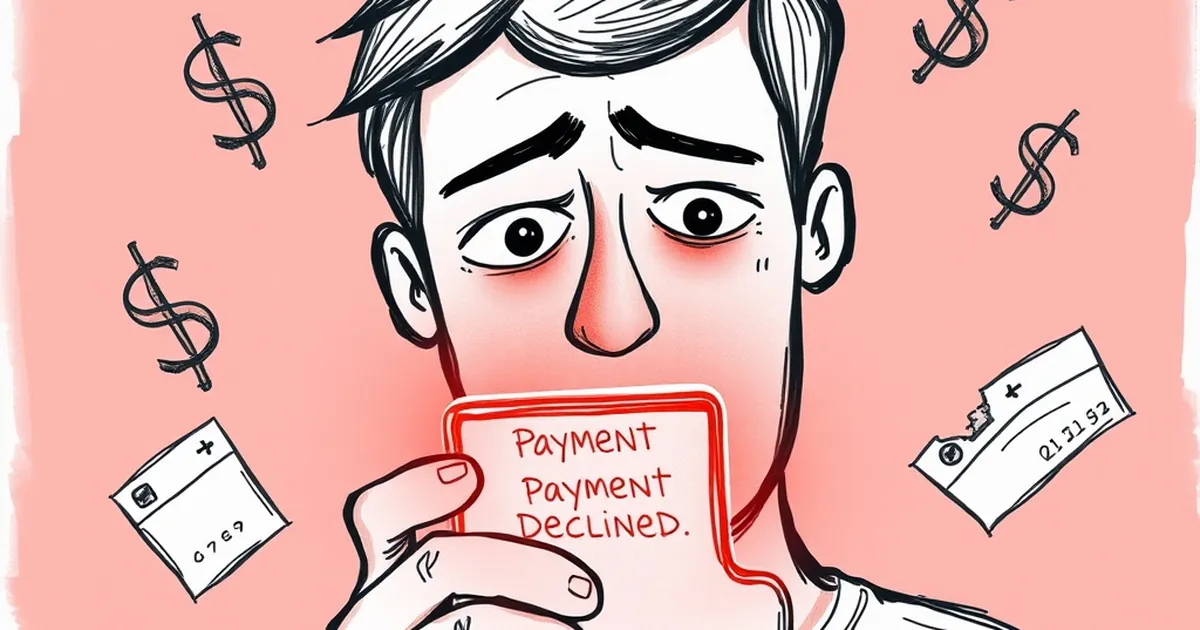
There’s a specific kind of jolt that happens when you tap your phone to pay and the terminal flashes red. It’s not just annoyance. For a split second, your brain registers a small but measurable spike in cortisol. Your heart rate changes. You might feel a flicker of something that feels oddly like shame.
Why does a simple transaction denial hit so hard? We’re not talking about a life-altering sum of money. We’re talking about a coffee, a subway ride, a monthly subscription. And yet, the emotional weight of a declined payment often feels wildly disproportionate to the event. To understand why, we have to stop looking at the transaction and start looking at the game.
The Hidden Architecture of the "Payment Game"
We don’t usually think of paying for something as a game. But structurally, it shares almost everything with one. There’s a clear goal (complete the purchase). There’s a required action (tap, swipe, insert). There’s a binary outcome (approved or declined). And crucially, there’s a feedback loop that happens in microseconds.
This loop is powered by what behavioral scientists call variable-ratio reinforcement. Made famous by B.F. Skinner’s experiments, this principle states that a reward delivered after an unpredictable number of responses creates the strongest, most persistent behavioral drive. Slot machines are the textbook example, but your payment card works on a similar psychological frequency.
Most of the time, you tap and it works. The green checkmark appears. The dopamine hits. You walk away. But because the system is mostly reliable, not always reliable, each tap carries a tiny wisp of uncertainty. Will this one work? That uncertainty is what keeps you engaged. When it does work, the reward feels slightly more satisfying than if it were guaranteed. When it doesn’t work, the violation of expectation is sharp.
You were mid-stride, mid-conversation, mid-thought. The system was supposed to say "yes." It said "no." That’s not a financial event. That’s a failed attempt in a game you didn’t realize you were playing.
The Boss Fight Analogy
Think about the last time you played a video game and faced a boss you expected to beat. You had the right gear. You knew the pattern. You pressed the button. And then you got flattened in three seconds. That moment of "Wait, what?" — that’s exactly the same neural signature as a payment decline.
In game design, a failed boss fight is a deliberate teaching moment. It resets your strategy. It forces you to re-evaluate your resources. But in payments, there’s no narrative purpose. The decline isn’t teaching you anything about your technique. It’s just a wall. Your brain, however, doesn’t know the difference. It processes the failure as a threat to your competence. You weren’t just denied a sandwich. You were denied a successful completion of a goal. And your brain hates unfinished goals more than it hates almost anything — a phenomenon known as the Zeigarnik Effect, where we remember interrupted tasks far better than completed ones.
Loss Aversion in Real Time
Daniel Kahneman and Amos Tversky taught us that losses hurt roughly twice as much as equivalent gains feel good. But we usually apply this to money — losing $20 feels worse than finding $20 feels good.
A payment decline flips this. You haven’t lost any money. But you have lost face. You’ve lost time. You’ve lost the smooth, frictionless flow of social belonging. In a split second, you go from "person buying a thing" to "person whose card was declined." That’s a social identity loss. And your brain codes it as a loss, even though your bank balance is unchanged.
There’s a study from the University of Bonn that touches on this indirectly. Researchers found that when people experienced payment friction — a slight delay or a request for confirmation — their subjective sense of "pain of paying" actually decreased. The friction gave them a moment to process the expense. But a decline is the opposite of friction. It’s a hard stop. It’s a system saying, "You don’t get to play anymore." That triggers a limbic response — the ancient part of your brain that handles survival threats. Your amygdala doesn’t know the difference between a saber-toothed tiger and a red notification on a terminal. It just knows something went wrong, and it needs your attention.
The Shame Spiral
Here’s where it gets personal. The public nature of a decline — the beep, the line of people behind you, the cashier’s patient look — triggers what sociologist Erving Goffman called "the presentation of self in everyday life." You were performing the role of a competent adult. The decline broke character. Suddenly, you’re not the person who pays smoothly. You’re the person holding up the line.
This is why people often react with a strange, disproportionate emotion: anger at the bank, defensiveness toward the cashier, or a quiet, internal spiral of "I should have checked my balance." It’s not about the money. It’s about the failed performance. Your brain treats it as a social penalty, not a financial one.
The Variable-Ratio Reward Trap
Let’s go back to Skinner. In his experiments, rats that received food after a random number of lever presses became obsessive. They pressed the lever hundreds of times, even when the food stopped coming. This is the extinction burst — the frantic escalation of behavior when a reward disappears.
Now look at your payment behavior. You tap. Decline. You tap again, harder. You try a different angle. You swipe instead of tap. You pull out a different card. This is the extinction burst playing out in real life. Your brain is saying, "The pattern worked before. If I just try one more time with slightly different inputs, the reward will come back." And sometimes it does. That unpredictable success only reinforces the behavior more strongly.
Payment systems, by their very nature, exploit this loop. Not maliciously — they’re just designed for speed and security. But the side effect is a behavioral architecture that keeps you engaged, alert, and slightly anxious every time you tap. You’re not just paying. You’re playing a game with invisible odds.
A Concrete Example: The Starbucks App
Consider the Starbucks mobile app. It’s one of the most successful payment platforms in the world. Why? Because it removed the decline anxiety almost entirely. You pre-load money. The app shows your balance. When you tap, the transaction is almost guaranteed to work — unless you’re truly out of funds. The reward loop is still there (the green check, the stars, the "ding"), but the uncertainty is drastically reduced.
Compare that to a contactless card tap. You have no idea if it will work until it does. The uncertainty is baked in. And that uncertainty is what makes the system feel like a game you’re barely winning.
Forward-Looking: Designing for the Brain, Not the Ledger
The future of payments isn’t just about speed or security. It’s about emotional design. The best payment experiences will be the ones that acknowledge the player — the human with a brain wired for pattern recognition, loss aversion, and social performance.
What if a decline came with a gentle explanation? Not "Transaction Declined," but "Your card’s daily limit was hit. Try again in two hours." That reframes the failure from a personal incompetence to a system constraint. What if apps offered a "practice tap" — a way to test a card without a real charge, letting you see the green checkmark before you commit? That would satisfy the brain’s need for certainty before the real game begins.
We’re already seeing glimpses. Virtual cards with dynamic CVVs. Biometric confirmations that feel less like a test and more like a nod. The next leap won’t be in processing speed. It will be in processing meaning. Because the moment you understand that your brain treats a payment decline like a failed boss fight, you stop designing for the transaction and start designing for the player.
And that’s a game worth winning.