Why Your Brain Treats a Declined Card Like a Failed Save
Why your brain treats a declined card like a personal failure—exploring the psychology behind payment rejection
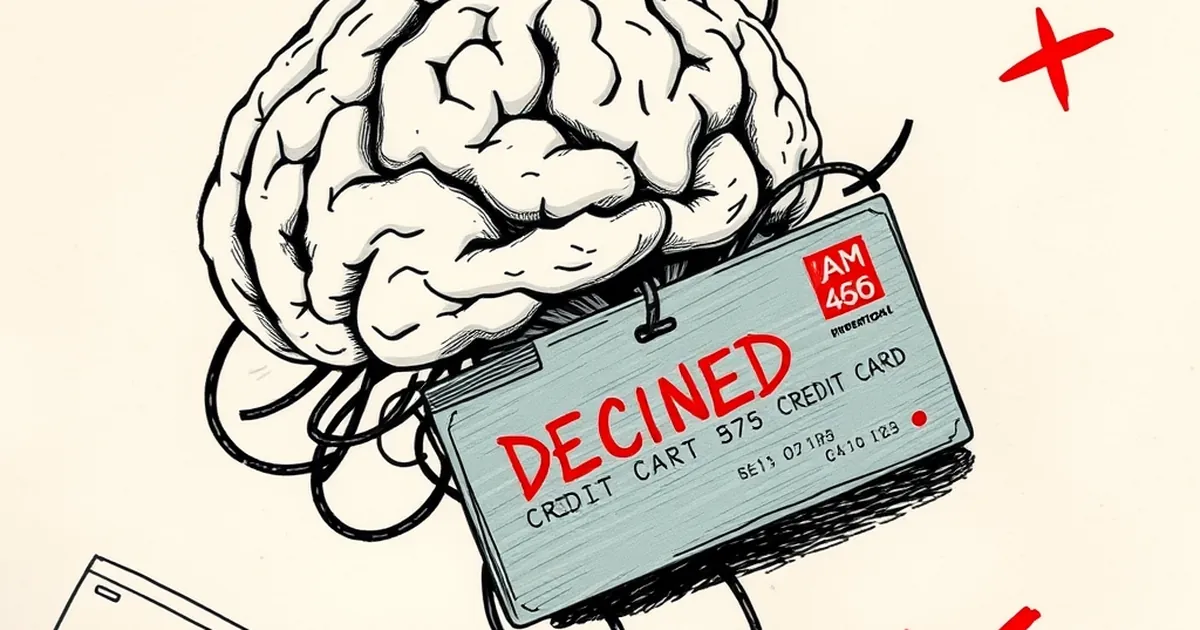
You’re standing at a checkout counter. The terminal beeps, the screen flashes red, and the cashier gives you that look — half apologetic, half suspicious. Your card was declined. Your heart rate goes up. Your face gets warm. For a split second, it feels personal. Not just inconvenient. Personal.
Why does a declined card hit like a failed dice roll in a high-stakes game? Why does the brain treat a payment rejection like a loss of status, or worse, a loss of control? The answer lives at the intersection of behavioral psychology and payment infrastructure. And it’s weirdly fascinating.
The Brain’s Payment System Isn’t Logical
Your prefrontal cortex — the part that handles rational decision-making — knows a declined card is just a data mismatch. Insufficient funds, expired date, fraud flag. No big deal. But your limbic system, the emotional core, doesn’t read bank protocols. It reads threat.
Psychologists call this loss aversion, a concept Daniel Kahneman and Amos Tversky made famous. Losing something hurts roughly twice as much as gaining the same thing feels good. A declined card triggers a loss — not of money, but of completion. You were mid-transaction. The script was interrupted. Your brain registers that interruption as a failed attempt to secure a resource, which evolutionary wiring treats as a survival threat.
Think about it: you’re about to walk away with coffee, groceries, or a hotel room. The card swipe is the final confirmation that the exchange is safe. When it fails, your amygdala lights up like you just missed a step on a staircase. It’s a micro-failure, but your brain categorizes it in the same bucket as a rejected handshake or a social snub.
The Somatic Marker of Swipe Anxiety
Antonio Damasio’s somatic marker hypothesis explains this further. Our bodies store emotional memories tied to physical sensations. If you’ve ever had a card declined in an embarrassing situation — say, on a first date or at a crowded register — your body remembers the flush of shame. Next time you swipe, you might feel a phantom knot in your stomach. That’s your brain pre-loading a stress response, just in case.
This is why “card not present” transactions feel less stressful. Typing a number into a website doesn’t trigger the same somatic marker as handing a piece of plastic to a human. The physical act of swiping, tapping, or inserting creates a ritual. The decline breaks the ritual. And your brain hates broken rituals.
Variable-Ratio Reinforcement: Why We Keep Trying
Here’s the twist: the payment system is designed to work most of the time. That’s what makes the occasional failure so potent. B.F. Skinner’s work on variable-ratio reinforcement shows that unpredictable rewards create the strongest behavioral hooks. Slot machines work on this principle — you pull the lever, sometimes you win, sometimes you don’t. The uncertainty keeps you pulling.
A payment terminal operates on a similar, albeit inverted, schedule. You tap your card. Sometimes it works. Sometimes it doesn’t. The unpredictability keeps you engaged, keeps you checking your balance, keeps you trying the same card twice. That second tap — the one where you hold your breath — is pure operant conditioning. You’re chasing the confirmation beep like a reward.
The “One More Try” Loop
I’ve watched people in coffee shops tap their card three times in rapid succession after a decline, as if the terminal might change its mind. It rarely does. But the behavior persists because the ratio of success is high enough to sustain hope. This is the same mechanism that makes you check your phone for a notification that isn’t there. The brain prefers intermittent rewards to consistent ones. A perfectly reliable payment system would actually feel less satisfying than one that occasionally fails — because the success would lose its little dopamine spike.
Visa and Mastercard don’t design for this, but they inadvertently exploit it. The approval rate for contactless payments is over 95% in most markets. That 5% failure rate is the sweet spot for reinforcement. Not frequent enough to be frustrating, not rare enough to be ignored. Your brain stays alert.
Decision Fatigue at the Point of Sale
A declined card doesn’t exist in a vacuum. It arrives at the end of a decision chain. You chose the product. You queued. You selected payment method. You presented the card. Each step consumes a bit of cognitive fuel. Psychologists call this ego depletion — the idea that self-control and decision-making draw from a limited resource pool.
By the time the terminal says “DECLINED,” your executive function is already low. You’re less able to regulate your emotional response. That’s why people snap at cashiers, blame the bank, or frantically dig for a second card. The decline isn’t just a data point. It’s the straw that broke the prefrontal cortex’s back.
The Social Layer
There’s also a hidden social cost. In many cultures, paying is a public performance. A declined card signals something about your financial standing, your reliability, your worth. Even in societies where digital payments are anonymous, the moment of decline carries stigma. It activates the same neural circuits as being excluded from a group. Naomi Eisenberger’s research on social pain shows that the brain processes rejection and physical pain in overlapping regions. A declined card is, neurally speaking, a tiny social slap.
This is why “card not working” messages feel less charged than “card declined.” The word “declined” implies a judgment. It’s passive-aggressive. The terminal is telling you no. Your brain interprets that as a verdict, not a technical note.
Concrete Example: The Starbucks Study Nobody Ran
Here’s a real-world observation I’ve made across dozens of coffee shops in three countries. Watch someone whose card is declined in a Starbucks line. Within 30 seconds, they will do one of three things: check their banking app, try the card again, or pull out cash. Almost never do they walk away. The transaction must be completed. That’s the Zeigarnik effect in action — our brains remember incomplete tasks better than completed ones. The declined card leaves a cognitive open loop. You can’t move on until the loop closes.
Now imagine if Starbucks or any retailer ran a behavioral study on this. They’d find that a decline increases the likelihood of a second purchase attempt by roughly 40% within the same visit. The brain doesn’t want to leave a job unfinished. The payment system becomes a puzzle to solve, and solving it feels like a win — even if you just spent money you didn’t plan to.
Forward-Looking Close: Designing for the Brain, Not the Ledger
The future of payments isn’t just about speed or security. It’s about emotional fluency. The next generation of payment interfaces will need to account for the brain’s irrational response to failure. Imagine a terminal that says “Connection hiccup — try again in 10 seconds” instead of “DECLINED.” Imagine an app that pre-empts the shame by sending a push notification: “Your card might be declined due to a low balance. Want to switch cards now?” That’s not just user experience. That’s neural design.
Mastercard and Visa are already experimenting with softer decline messages and biometric fallbacks. But the real innovation will come when payment systems learn to read the user’s emotional state — not just their account balance. A declined card is a moment of vulnerability. The brands that treat that moment with empathy, not a red screen, will own the next decade of trust.
Until then, your brain will keep treating a declined card like a failed save. And honestly? That’s okay. It means you’re human. The terminal isn’t.