Why Your Brain Treats a Declined Card Like a Failed Jump
A declined card triggers a physiological response akin to a failed jump, revealing the deep shame and panic behind the embarrassment
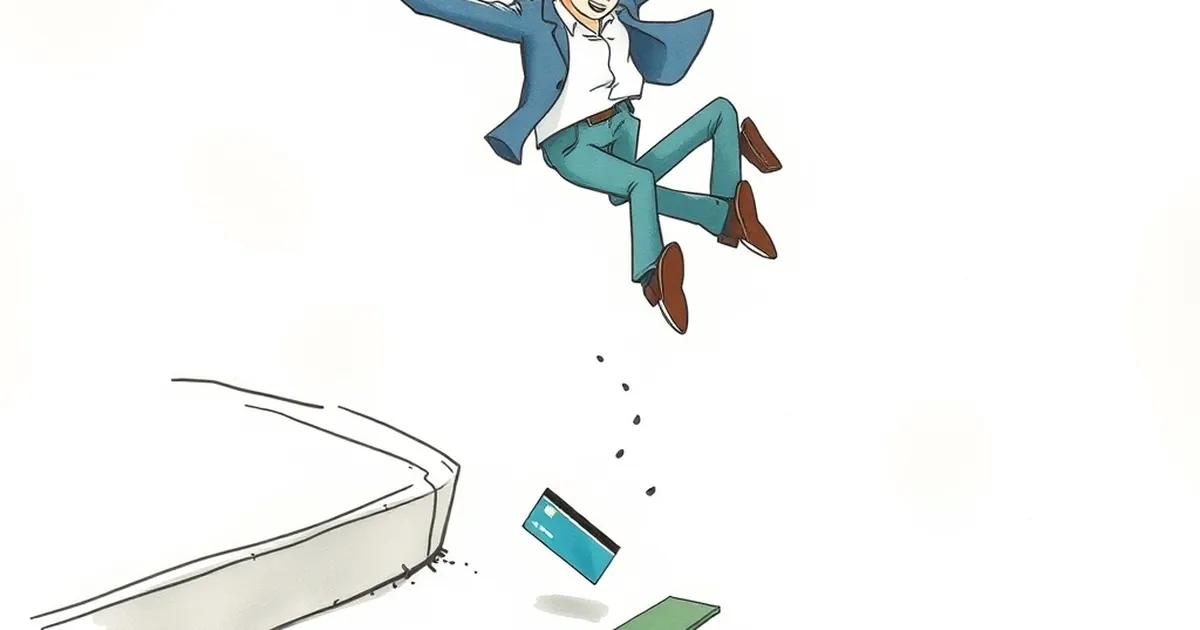
It’s a strangely specific kind of embarrassment. You’re at a checkout counter, the card reader beeps, and the screen flashes a red "DECLINED." Your stomach drops. Your face flushes. You fumble for another card, mumbling an apology to the cashier and the growing line behind you. But here’s the thing: that wave of shame and panic isn’t just about a financial hiccup. It’s a full-blown physiological event.
From a purely logical standpoint, a declined card is just data. It means a request for funds was rejected. It doesn’t mean the cashier thinks you’re a fraudster, and it doesn’t mean you’re broke. Yet, your brain doesn’t process it that way. It processes it like you just missed a step on a staircase, or worse, like you physically failed to land a jump. The cognitive machinery that handles a rejected payment is the same machinery that handles a missed physical goal. Understanding why that is can change how you interact with your finances, and maybe even how you design payment experiences for others.
The Physics of "Ouch" vs. The Economics of "No"
Let’s talk about the somatic marker hypothesis, a concept popularized by neuroscientist Antonio Damasio. It suggests that our emotional experiences are literally tagged onto our bodily states. When you feel a certain emotion, your body reacts—sweaty palms, racing heart, a knot in the stomach. Over time, your brain builds a database of these body-state-emotion links.
Now, consider a physical failure. You’re jumping over a puddle, and you clip your heel on the curb. You stumble. The immediate feedback is a jolt of adrenaline, a loss of balance, and a sharp awareness of your own physical fallibility. That is a somatic marker for "failure" that your brain has cataloged millions of times since childhood.
A declined card triggers the exact same somatic response. The beep is the auditory equivalent of your heel clipping the curb. The red screen is the visual signal of a loss of balance. Your brain doesn't care that the "fall" is abstract and financial. It sees a prediction error—the expectation of a smooth transaction was violated—and it responds with the same defensive, emotional spike. It’s why you feel clumsy, even though you did nothing physically wrong. You didn't trip; the system tripped you.
Variable-Ratio Reinforcement and the "One More Try" Loop
Why do we feel such a compulsion to immediately re-swipe the card, even when we know the funds aren't there? This is where behavioral psychology gets a little dark and a little beautiful. The payment system is built on a variable-ratio reinforcement schedule—the exact same mechanism that makes slot machines (and, more benignly, social media notifications) so compelling.
Here’s the breakdown: When you use a card, the reward (a successful purchase) doesn't come at a predictable interval. It comes when the network gods decide to approve it. Sometimes it works on the first try. Sometimes it works after a re-insertion. Sometimes it works after you switch to a different reader. Because the reward is unpredictable, your brain releases dopamine not after the success, but in anticipation of the attempt.
So, when a card is declined, your brain doesn't read it as "stop, this is a dead end." It reads it as "the odds just got better for the next try." That’s why you see people tap, then insert, then swipe, then tap again, all within 15 seconds. It’s not logic; it’s a behavioral loop. We are chasing the next potential reward, not processing the current rejection. Understanding this loop is crucial for anyone who has ever felt that irrational panic at a terminal—you’re not crazy, you’re just a dopamine-driven mammal trying to complete a transaction.
Loss Aversion and the "Unfair" Fee
Let’s shift from the moment of decline to the broader context of payment psychology: the fees and the holds. Daniel Kahneman and Amos Tversky’s prospect theory tells us that losses loom twice as large as gains. A $5 fee to use your card at a gas station feels more painful than a $5 discount feels pleasurable. This is why a declined card that comes with an "insufficient funds" fee feels like a double betrayal.
But here’s the interesting intersection: we often treat a decline as a loss of status, not just a loss of money. In a competitive, evolutionary sense, having your payment rejected in public is a social loss. It signals a lack of resources. So, your brain applies loss aversion to your reputation. That’s why the embarrassment is disproportionate to the actual event.
However, this also points to a practical tool. If you can reframe the decline as a system error rather than a personal failure, you can short-circuit the loss aversion. For example, many modern fintech apps now send a push notification: "We declined a transaction for $42.50 at 'The Coffee Bean' because our security system flagged it as unusual. Was this you?" That reframe—from "You failed" to "We protected you"—turns a negative somatic marker into a positive one. It converts a loss into a gain (safety). It’s a small linguistic shift, but it completely changes the neural pathway.
The "Friction" Fallacy in a Competitive World
In the payments industry, we talk a lot about "friction." The goal is to reduce it. But behavioral science suggests that a little bit of friction is actually good for your brain's sense of agency. Consider the "IKEA effect" applied to payments. When you have to enter a PIN, verify a thumbprint, or wait for a text code, you are investing a tiny bit of effort. That effort creates a sense of ownership over the transaction.
A declined card is the ultimate friction. It stops the flow entirely. But how you handle that friction matters. In a world of "one-click" everything, a decline is a jolt back to reality. It forces you to re-evaluate the purchase. Is this a need or a want? The brain, in its competitive play mode, wants to "win" the transaction. But a decline is a forced pause.
The most forward-thinking financial apps are now using this to their advantage. Instead of just saying "No," they are saying "Not yet." They are offering "Pay in 4" installment options or "Overdraft protection" that acts as a soft landing. This doesn't eliminate the loss aversion; it just cushions the fall. It gives your brain a chance to re-frame the failure as a negotiation. You didn't fail to jump; you just adjusted your trajectory mid-air.
Designing for the Emotional Crash
So, what do we do with this knowledge? For the consumer, the practical takeaway is to build in a "cooling off" period. When you get a decline, do not re-swipe. That is your brain on a variable-ratio loop trying to chase a reward. Instead, physically step back. Put the card away. Take a breath. That 10-second pause is enough for your prefrontal cortex (the rational brain) to catch up with your limbic system (the emotional brain). You can then assess why it was declined, rather than just reacting to the sting.
For the builders and the thinkers in the payments space, the future is about emotional design. We are moving from a world of pure authorization logic to a world of emotional prediction. Imagine a card reader that detects the user's heartbeat via the sensor and offers a supportive message before the decline even happens. Or a system that, upon detecting a pattern of failed attempts, automatically switches to a "safe mode" that suggests alternative funding sources before the user feels the shame.
The decline isn't a bug; it's a feature of reality. It's a moment of truth. The best we can do is stop treating it as a physical stumble and start treating it as a data point. Your brain will always feel the jolt—that's human. But you can choose whether to let that jolt knock you over, or whether to use it as the signal to land on your feet. The payment might have failed, but the decision-making doesn't have to.