Why Your Brain Treats a Card Decline Like a Missed Combo
A card decline feels like a missed combo, not a tech glitch—here’s why your brain treats it as a real loss
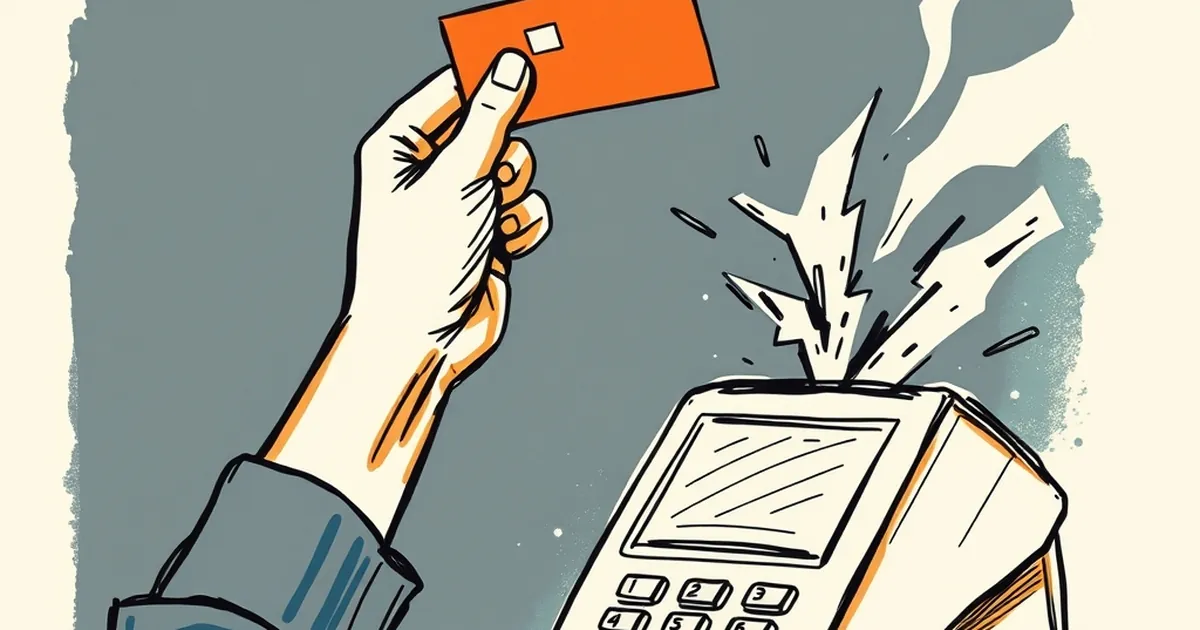
Why does a card decline sting so much more than the tap that goes through? You’re at a coffee shop, the barista hands you a cold brew, you wave your phone, and—bzzzt—the terminal flashes red. Your heart rate spikes. You feel a flush of heat. It’s not about the money; it’s about the interruption. A successful payment is a micro-moment of flow, a seamless combo in the rhythm of daily life. A decline is a hard break in that sequence, and your brain processes it as a genuine loss, not just a technical hiccup.
The psychology of payments is a strange beast. We think of a transaction as a purely rational exchange—goods for funds—but it’s actually a complex neurological event that borrows heavily from the same circuits that govern physical pain and competitive reward. Let’s pull back the curtain on why that red screen feels like a missed combo, and what it means for how we design (and use) payment systems moving forward.
The Combo Breaker: Interrupted Prediction Loops
In fighting games, a "combo" is a sequence of inputs that, once started, is unbreakable if timed correctly. Your brain runs on similar predictive loops. When you initiate a payment, your brain has already simulated the entire sequence: tap, beep, green check, walk away. It’s a motor plan completed in milliseconds.
This is where prediction error comes into play, a concept deeply rooted in neuroscience (often associated with the work of Karl Friston and the free-energy principle). Your brain is a prediction machine, constantly trying to minimize surprise. A successful payment generates zero surprise—it confirms the model. A decline, however, is a massive prediction error. It’s a violation of a deeply ingrained expectation.
Think of it like a musician missing a note in a perfectly rehearsed solo. The audience (your brain) doesn’t just notice the wrong pitch; it feels the disruption of the harmonic flow. The decline isn’t just a "no"—it’s a break in causality. You did everything right, and the universe said "wrong." This is why the emotional response is often disproportionate to the actual financial impact. It’s not a $4 loss; it’s a failure in a sequence you thought you had mastered.
The "Near Miss" Effect in Reverse
Interestingly, a decline often triggers a stronger reaction than a simple "insufficient funds" notice. Why? Because many declines are ambiguous. Is it the card? The terminal? The bank? That ambiguity creates a cognitive loop that resembles the "near-miss" effect studied in behavioral psychology.
Researchers like A. David Redish at the University of Minnesota have shown that the brain’s dopamine system responds not just to rewards, but to predictions of reward and, crucially, to the proximity of a reward. In a slot machine study, a near-miss (two cherries and a lemon) activates the same reward circuitry as a win. A card decline is the inverse: it’s a near-miss for a failure you didn't anticipate. Your brain says, "I was SO close to a successful transaction," which paradoxically makes the failure more salient than if you had expected it.
Loss Aversion: The Asymmetric Weight of the Red Screen
We can’t talk about payment psychology without invoking Daniel Kahneman and Amos Tversky’s Prospect Theory. The core tenet is loss aversion: the pain of losing is psychologically about twice as powerful as the pleasure of gaining. In payments, this is usually applied to spending—people hate seeing money leave their account more than they love getting goods.
But there's a subtler application here. When a card is declined, you don't just lose the transaction; you lose the social standing attached to it. You lose the time you spent in line. You lose the confidence you had in your own financial autonomy. In the context of a queue, you also lose face. This is a compounded loss, hitting multiple psychological domains simultaneously.
A study by George Loewenstein and colleagues on "hot-cold" empathy gaps suggests that when we are in a state of social pressure (the queue behind us), we make decisions that are more emotionally charged. A decline in that state isn't just a technical failure; it's a public performance failure. The physical sensation of embarrassment is real—your body’s sympathetic nervous system kicks in, releasing cortisol, making you feel flustered and even angry at the machine.
The Variable-Ratio Reinforcement of "Tapping"
Here’s where it gets weird. We know declines happen, yet we rarely check our balance before tapping. This is the power of variable-ratio reinforcement schedules, a concept famously identified by B.F. Skinner.
When you tap your card, you are playing a lottery where the odds are heavily in your favor (95-99% success rate). But the schedule of failure is unpredictable. Sometimes it fails due to a low balance, sometimes due to a merchant error, sometimes due to a network glitch. This unpredictability is precisely what makes the behavior (tapping) so resistant to extinction. If a decline happened every time you tapped, you’d stop tapping. But because it’s random, your brain treats the tap as a "pull of the lever" with a high probability of a reward (the green check).
This is why the decline feels like a missed combo in a video game. In games, if you land 90% of your hits, the 10% you miss are devastating because they break your rhythm. The brain doesn’t average the success rate; it focuses on the salience of the break. The decline is a "whiff" on a move you usually land blindfolded. It’s not just a failure; it’s a statistical anomaly that your brain flags as a threat, prompting you to double-check your card, your app, your life.
The "Frictionless" Paradox
The payment industry has spent a decade removing friction. Contactless, one-click, biometrics—all designed to make the combo seamless. But this creates a paradox: the more frictionless the system, the more jarring the failure.
If you had to type in a 12-digit PIN and wait 10 seconds for approval, a decline would feel like a logical outcome of a complex process. But when the process takes 200 milliseconds, the decline feels like a glitch in the Matrix. It’s a reminder that the invisible infrastructure we rely on is, in fact, fallible. This is why "soft declines" (where the merchant quietly retries the transaction) are becoming popular—they prevent the user from ever seeing the error, preserving the illusion of the unbreakable combo.
What This Means for the Future of Payments
So, what do we do with this knowledge? For merchants and fintech designers, the lesson is to design for the emotional decline, not just the technical one. The current "ERROR" screen is a user-hostile relic. It’s the equivalent of a game controller vibrating violently and flashing "YOU FAILED."
- Reframe the Error: Instead of a red "Declined," what if the terminal said, "Network hiccup, please retry?" This changes the attribution from you (your card, your money) to the system (the network). It preserves the user’s ego and reduces the social threat.
- Immediate Feedback Loops: Apps like Apple Pay and Google Pay are starting to pre-empt declines by checking with the bank before you tap. This moves the failure from the public terminal to the private phone screen, reducing the loss-aversion spike.
- Gamified Recovery: Some neo-banks are experimenting with "recovery modes"—if a card is declined, the app instantly offers a "boost" or a "one-time override" with a fun animation. This turns a negative event into a momentary challenge, rather than a dead end.
For consumers, the takeaway is a bit more philosophical. Next time your card is declined, take a breath. Recognize that your brain is doing exactly what it’s designed to do—flagging a violation of a prediction loop. It’s not a commentary on your financial worth; it’s a glitch in a system that is otherwise remarkably reliable.
The future of payments isn't just about speed or security; it's about graceful failure. As we move toward invisible, ambient payments (where the car pays for the toll, the fridge orders the milk), the combo will become even longer and more complex. The challenge for designers will be to make the inevitable misses feel less like defeats and more like minor, easily-corrected perturbations in the rhythm of life. Because the goal isn't to never fail; it's to fail without breaking the player's flow.