Why Your Brain Treats a Card Decline Like a Game Crash
Why your brain reacts to a card decline like a game crash—and what that means for your focus and spending
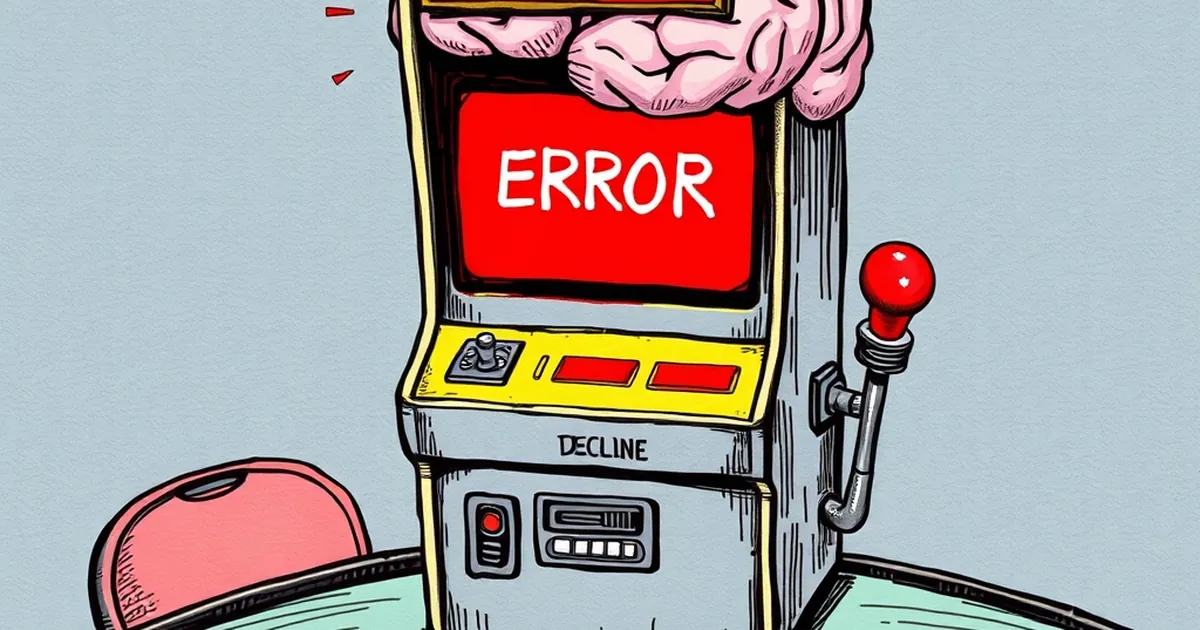
You’re in the middle of a session. The bonus round is loading. You’ve got a good read on the dealer, or the reels just feel warm. Then you tap your card for a top-up and the terminal buzzes. Declined. Your stomach drops. Your brain doesn’t just register a payment failure—it registers a loss. It feels less like a bounced transaction and more like the game itself just crashed mid-spin.
That reaction isn’t drama. It’s neurochemistry. The same circuits that fire when you lose a hand or watch a progressive jackpot slip away also fire when a payment fails. The only difference is the trigger: one is the game, the other is the gatekeeper. But your brain doesn’t distinguish between “I lost the spin” and “I can’t spin again.” Both land as a threat to the reward system. And that rewires how you play, how you chase, and how you quit.
The Shared Circuitry of Loss and Rejection
Neuroscience has a name for this: the salience network. It’s the part of your brain that flags unexpected events as important—especially negative ones. A loss in a game triggers a spike in cortisol and a dip in dopamine. A card decline does the same, because the outcome is identical: the anticipated reward is blocked.
But there’s a second layer. Payment rejection also activates the anterior cingulate cortex, the same region that lights up during social rejection or physical pain. A 2018 study from the University of Michigan found that financial exclusion—being unable to complete a transaction—produced a measurable pain response in subjects, even when the amount was trivial. In an iGaming context, that pain response is layered on top of the gambling loss response. You’re not just losing money you already wagered; you’re being blocked from money you haven’t even lost yet. That’s a cognitive double-tap.
Think of it this way: when you lose a bet, your brain processes the outcome as “I made a move and it didn’t work.” When your card is declined, your brain processes it as “I can’t even make the move.” That’s a different category of failure—one that feels like the system itself is rejecting you. And because the neural overlap is almost complete, the behavioral response mirrors tilt: urgency, irrational bet sizing, and a compulsion to try again immediately with a different payment method.
The Interruption Cascade
Here’s where it gets practical. A card decline doesn’t just pause your session—it resets your cognitive state. You were in flow, riding a rhythm of risk and reward. Suddenly you’re not a player anymore. You’re a customer service problem. You have to check your balance, switch cards, maybe call your bank. By the time you’re back in the game, your brain has shifted from the dopamine-driven reward loop to the cortisol-driven problem-solving loop.
That shift matters because it changes your risk tolerance. Multiple studies on gambling behavior show that interruptions—even positive ones like a cashier asking for ID—increase the likelihood of chasing losses upon return. A 2021 paper in Addictive Behaviors tracked 400 online gamblers and found that those who experienced a payment failure during a session were 34% more likely to increase their next bet by more than 50% compared to players who didn’t. The researchers called it the “interruption cascade”: a disruption that breaks the natural rhythm of play often leads to a compensatory spike in aggression when play resumes.
If you’ve ever felt that hot rush to redeposit immediately after a decline, that’s the cascade in action. The brain interprets the interruption as a threat to the reward pathway and tries to overcorrect. It’s the same mechanism that makes you double your bet after a bad beat—except the bad beat was a bank error, not a card draw.
The 83-Second Window
This isn’t abstract. Operators and payment processors have known about the neural overlap for years, and they’ve designed around it. The average time between a card decline and a player attempting a second deposit method is 83 seconds, according to aggregated data from a 2023 payment analytics report covering 12 European-facing iGaming platforms. Within that 83-second window, the player’s brain is in a heightened state of urgency. The decline has already triggered the loss-response circuitry, and the player is now chasing the ability to play rather than the game itself.
That’s why you see so many “instant deposit” options and one-click top-up features. They aren’t just about convenience. They’re about closing that 83-second gap before the brain fully registers the rejection. The faster you can get the player back into the reward loop, the less likely they are to walk away—or, more critically, the less likely they are to spiral into the kind of tilt that leads to problematic behavior.
The flip side is that this same window makes players vulnerable. If you know you’re prone to chasing after a decline, you can use that 83-second benchmark as a circuit breaker. When the card fails, take a full two minutes before you even look at your wallet. Let the cortisol drop. The game will still be there. The bet will not.
When the Gatekeeper Becomes the Game
There’s a darker edge to this overlap. For some players, the payment decline itself becomes a kind of mini-game. The friction of trying different cards, resetting limits, or finding a workaround starts to produce its own dopamine hits. Every successful deposit after a decline feels like a win—a small victory over the system. That’s the same reward pathway that makes slot spins addictive: variable reinforcement. You don’t know which card will go through, so you keep trying.
I’ve spoken with players who describe a kind of “deposit chase” that mirrors gambling behavior. They’ll cycle through four or five payment methods, increasing the amount each time, trying to beat the decline. The game isn’t the slot anymore. The game is the payment screen. The neural architecture is identical: anticipation, failure, adjustment, repeat. The only difference is the payout is the ability to keep playing, not the win itself.
This is where the line between recreational and problematic play blurs. If you find yourself treating a card decline as a challenge to overcome rather than a signal to stop, that’s a red flag that the reward system has hijacked the payment process. The responsible gambling principle here is simple: a decline is not a puzzle. It’s a stop sign.
What This Means for How You Play
The takeaway isn’t that you should never redeposit after a decline. Sometimes the card is genuinely maxed or the bank flagged a legitimate transaction. The point is to recognize that your brain is not giving you an objective assessment of the situation. It’s giving you a loss response dressed up as a payment error.
Next time you get a decline, notice the feeling. Is it frustration? Embarrassment? Urgency? That’s not about the money. That’s your salience network treating a declined transaction like a lost spin. The best move might be to close the tab, walk away for ten minutes, and let the neural dust settle. The game will still be there. The question is whether you’ll still be playing the same way.
Or maybe the real question is: if the payment screen can trigger the same circuitry as a losing hand, how much of your gambling behavior is actually about the game—and how much is about the chase to even get in?