Why Your Brain Spends Like a Mobile Game Refill Timer
Discover how your brain's reward system mirrors mobile game timers, driving impulsive spending and attention-grabbing purchases
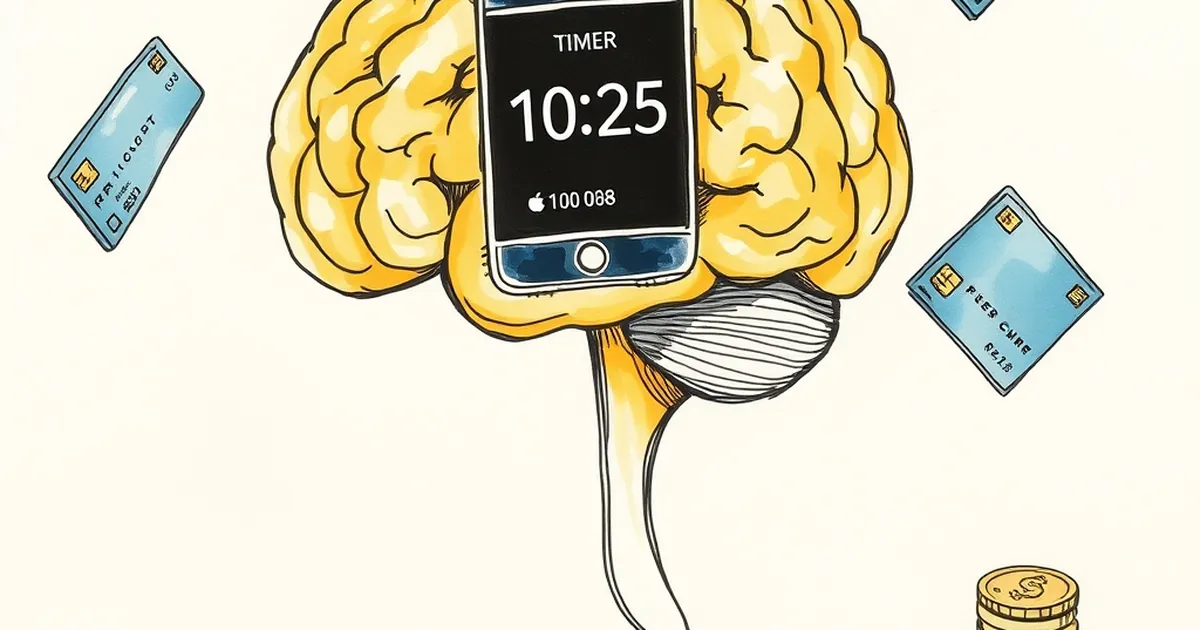
You know that feeling. You’re waiting for a mobile game to let you play again, and there it is: a countdown timer. Five minutes. Three minutes. You watch it tick down, and the moment it hits zero, you tap the screen for your next turn. There is no cost, but there is a cost. The cost is your attention, your patience, and sometimes, a small fee to skip the wait entirely.
Now think about the last time you checked your credit card balance, saw a cash-back offer expiring in three hours, and bought something you didn’t really need. The same timer was running. Your brain just didn’t see it.
Why does spending money feel exactly like waiting for a mobile game refill? Because both systems were designed by the same behavioral blueprint. And once you see the pattern, you can decide whether to keep playing — or log off.
The Variable-Ratio Slot Itself
The most famous behavioral discovery in the last century is probably B.F. Skinner’s work on variable-ratio reinforcement. The short version: if you reward a behavior unpredictably, that behavior becomes almost impossible to extinguish. A pigeon pecks a lever and gets a pellet sometimes. A person checks their phone and gets a notification sometimes. A shopper opens an email and gets a 10% discount code sometimes.
Mastercard and Visa don’t run slot machines. But they run something functionally identical: the rewards engine.
Every time you tap your phone or swipe a card, there is a chance — a small, unpredictable chance — that the transaction will trigger a reward. A point. A cash-back percentage. A “you earned a free coffee” message. These are not guaranteed. They are not equal. They come at random intervals, tied to spending behavior that you might not have planned.
You are not being paid for loyalty. You are being trained to tap the lever again.
Here is the concrete example. In 2021, researchers at the University of Zurich published a study on credit card spending and the brain’s reward system. They found that when participants used credit cards (as opposed to cash), the brain’s striatum — the same region activated by addictive substances and unpredictable rewards — lit up more intensely. The pain of payment, the “friction” of handing over cash, was gone. In its place was the dopamine hit of a potential future reward.
You are not buying a toaster. You are pulling a lever that might pay out.
The Refill Timer is Just Loss Aversion with a Clock
Daniel Kahneman and Amos Tversky gave us loss aversion: losses hurt roughly twice as much as equivalent gains feel good. But there is a subtler version of this that payment systems exploit daily. It is called the scarcity timer.
Mobile games use timers because they create a sense of impending loss. If you don’t check the app before the timer runs out, you lose the chance to play. You lose the progress. You lose the streak. The timer converts a neutral state — “I could play later” — into an urgent state — “I must play now or lose my chance.”
The Credit Card Version
Your credit card issuer sends you a notification: “0% APR on balance transfers expires in 7 days.” Your brain reads this not as an offer, but as a deadline. The loss of the offer feels like a loss of something you already had. The same applies to limited-time cash-back categories. “5% back on groceries this quarter.” That quarter has an end date. And as the end date approaches, the timer in your head starts ticking.
You are not evaluating whether you need groceries. You are trying to beat the clock.
What makes this particularly insidious is that the timer is often invisible. You don’t see it in the app. But it is there, built into the product lifecycle: the introductory APR, the sign-up bonus window, the quarterly category rotation. Every one of these is a refill timer for your spending behavior.
Competitive Play and the Leaderboard You Never Signed Up For
Mobile games thrive on social comparison. You see your friends’ scores. You see their streaks. You see that they have already completed the daily challenge, and you haven’t. This triggers a specific kind of competitive anxiety: you are falling behind in a game you didn’t know you were playing.
Payment networks have quietly built the same mechanic.
Consider the premium credit card. Not the metal card itself, but the status layer that comes with it. Priority boarding. Lounge access. Concierge services. These are not just perks. They are visible markers of rank. When you walk past the economy line and into the priority lane, you are seeing a leaderboard update in real time. You are higher than someone else. And you want to stay there.
The Spending Floor
But here is the catch: status is not permanent. It requires annual spending thresholds. You must maintain a certain level of activity to keep your rank. This is the refill timer again, but scaled up. Instead of minutes, it is months. Instead of missing a turn, you risk losing your place in the social hierarchy.
Visa and Mastercard don’t run these programs directly, but they enable them. The infrastructure of co-branded cards, points pooling, and elite tiers is a competitive ecosystem. You are not just spending. You are competing for a rank that resets every year.
And your brain treats that rank like a score. Because it is.
Decision-Making Under Uncertainty: The Hidden Fee
There is one more layer that rarely gets discussed. Mobile games often hide the true cost of skipping the timer. You might pay $1.99 to skip a 30-minute wait. That seems cheap. But if you do it ten times in a session, you have spent $20 to play a game for an extra hour.
Payment systems do the same thing with uncertainty.
When you use a credit card, you are making a decision under uncertainty. You don’t know exactly how much you will owe in interest if you carry a balance. You don’t know the exact value of the points you are earning. You don’t know whether the merchant will add a surcharge. The uncertainty itself is a cost — a cognitive fee that your brain pays every time it tries to calculate the true price of a transaction.
The Convenience Premium
This is where the refill timer meets the hidden fee. You choose the credit card because it is convenient. You skip the mental math. You let the timer run. And then, at the end of the month, the bill arrives. The cost was hidden behind the convenience.
This is not a conspiracy. It is a design choice. Payment networks have optimized for frictionless spending because frictionless spending means more transactions. More transactions mean more interchange fees. More data. More opportunities to offer you a new card with a new timer.
How to See the Timer
You cannot remove every refill timer from your life. You can, however, learn to see them.
The first step is to identify which spending decisions are being driven by a countdown. Ask yourself: Am I buying this because I need it, or because the offer expires? If the answer is the latter, you are responding to a timer that someone else set.
The second step is to introduce your own friction. Mobile games lose their power when you turn off notifications. Spending offers lose their power when you wait 24 hours before using them. The timer only works if you feel the pressure. If you let it expire, you reset the game.
The third step is to reframe the reward. That cash-back bonus is not a prize. It is a rebate on a purchase you made. The real reward is not the points. The real reward is the thing you actually wanted to buy before the timer appeared.
The Forward-Looking Close
Here is the practical takeaway: the next time you see a credit card offer with a limited-time bonus, treat it like a mobile game refill timer. Do not tap immediately. Let it run out. Watch what happens. You will feel a small pang of loss. That is the loss aversion talking. And then, after a few hours, you will realize that nothing bad happened. The game continued. The world did not end.
You are not a pigeon. You can choose not to peck.
The question is not whether the system is designed to exploit your brain. It is. The question is whether you are willing to see the timer, acknowledge it, and decide that your attention is worth more than the dopamine hit of a tap.
Because the real reward — the one that no payment network can offer — is the freedom to spend your time and money on things you actually chose, rather than things a countdown chose for you.