Why Your Brain Sees a Card Decline as a Personal Attack
Why your brain treats a card decline like social rejection, triggering the same neural pathways as personal attacks
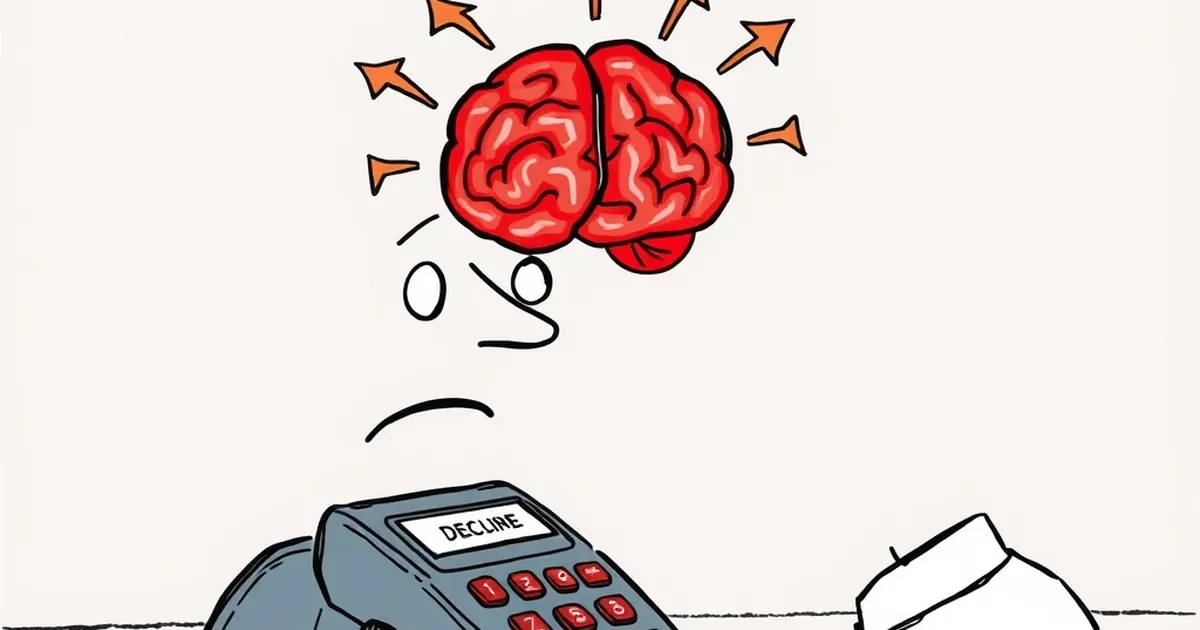
You swipe your card. The terminal pauses. A tiny red light blinks. The cashier looks up with that weird mix of pity and suspicion. The word "Declined" appears. And for a split second, your stomach drops like you just got caught doing something wrong. Why does it feel so personal?
It’s not just embarrassment. It’s a specific, visceral reaction that comes from deep inside your brain. A card decline triggers the same neural pathways as being socially rejected or physically hurt. You are not being dramatic. Your brain is literally treating a payment failure as a threat to your social standing.
The Neuroscience of "Not Enough"
Why Rejection Hurts, Even from a Machine
Researchers have known for years that social rejection activates the same brain regions as physical pain. The dorsal anterior cingulate cortex lights up when you are left out of a game, and it lights up when you burn your hand. But here is the twist: a card decline hijacks that same system.
Your brain doesn’t distinguish between "The bank declined this transaction" and "You are not welcome here." Evolution never prepared us for plastic rectangles. Thousands of years ago, being excluded from the group meant death. Today, a declined card feels like the modern equivalent of being banished from the tribe. Your heart races. You blush. You want to explain yourself. That is your ancient survival instinct screaming at you to regain social acceptance.
The Dopamine Crash of a Failed Reward
Every time you make a purchase, your brain releases a small amount of dopamine. It’s a reward for successfully completing a goal. Swiping a card and hearing "Approved" is a tiny, satisfying loop. It feels good. You don’t notice it until it breaks.
When the terminal says "Declined," your brain experiences a reward prediction error. It expected a hit of dopamine. It got nothing. Worse, it got a negative signal. That abrupt drop in dopamine creates a feeling of frustration that can spike your cortisol levels. You aren’t just annoyed about the purchase. Your brain is chemically upset that the reward didn’t arrive.
The Social Stakes of Digital Payments
The Audience Problem
A decline in private is annoying. A decline in front of a cashier and a queue of impatient strangers is humiliating. The difference is the social audience. You feel judged, even if no one says a word.
This is why people over-explain. "I have money, I swear, it must be the bank’s fraud system." You are not trying to fix the payment. You are trying to repair your reputation. You are telling the cashier and the people behind you that you are not a deadbeat. You are a responsible person with a temporary technical glitch. That need to explain is pure social anxiety, not financial logic.
The Stigma of Insufficient Funds
Let’s be honest about the elephant in the room. "Insufficient funds" carries a heavy weight. It implies you don’t have enough. You overspent. You mismanaged your life. That is the narrative many of us internalize, even when the decline is caused by a fraud alert, a typo in the app, or a server timeout at the bank.
I remember a friend telling me about the time his card declined on a first date. He was mortified. He had the money. It was a false fraud flag. But the waitress looked at him with that same pity-suspicion mix. He spent the entire dinner feeling like he had to prove he was a "real adult." That dinner cost him his appetite, not his money.
When the System Tricks You
The False Decline Epidemic
Here is a secret the payment industry doesn’t shout from the rooftops: banks decline perfectly valid transactions all the time. It’s called a "false decline." Studies from payment processors suggest that false declines account for a significant percentage of all declines. Your card gets blocked because you bought gas in a different town, or you tried to buy something at 2 AM, or the bank’s algorithm just felt "suspicious" about a transaction that was perfectly normal.
Your brain doesn’t know that. It just knows you were rejected. You get angry at the merchant, then at the bank, then at yourself. But the reality is that the system is clumsy. It is designed to protect the bank from fraud, not to protect your feelings. The false decline is a side effect of a risk-averse system, but your brain treats it as a personal accusation.
The Merchant’s Role in the Pain
The cashier’s reaction matters more than you think. A good cashier says, "No problem, try another card," and moves on. A bad cashier raises an eyebrow and says, "Is there another way to pay?" in a tone that suggests doubt.
Merchants are trained to handle declines discreetly, but training only goes so far. The real issue is the social script. The moment the terminal says "Declined," the power dynamic shifts. You are suddenly in a position of vulnerability. You have to prove you are who you say you are, that your finances are in order, that you are not a fraudster. That power imbalance is what makes the moment sting.
How to Stop Taking It Personally
Reframe the Narrative
The first step is cognitive. You have to remind yourself: this is not a character judgment. It is a data transaction. The bank’s system looked at a number and a set of rules. It made a binary decision. It did not evaluate your worth as a human being.
Say it out loud if you have to. "This is a technical error. My value is not tied to this card." It sounds silly, but it works. You are short-circuiting the ancient brain pathway that screams "Rejection!" and replacing it with a logical statement.
Have a Backup Plan
The single easiest way to reduce the panic is preparation. Carry a second card. Use a digital wallet with a different bank linked. Keep some cash in your wallet for emergencies. When you know you have a backup, the decline loses its emotional power.
I always carry a travel card and a primary card from different banks. If one declines, I smile, say "Let me try the other one," and move on. I don’t explain. I don’t apologize. I just execute the backup. That simple act of having a plan removes 90% of the anxiety.
The Forward-Looking Takeaway
The payment industry is slowly realizing that false declines and awkward terminal interactions are bad for business. Biometrics, tokenization, and smarter fraud models are reducing the number of declines. But the technology will never eliminate them entirely.
Your job is not to wait for a perfect system. Your job is to train your brain to see a decline for what it really is: a minor inconvenience, not a personal indictment. The next time that red light blinks, take a breath. Remember it’s just a machine. And then pull out your backup card with the quiet confidence of someone who knows their worth has nothing to do with a plastic rectangle.