Why Your Brain Sees a Card Decline as a Failed Jump
A card decline triggers a physical stumble response, not a financial one—here’s how to separate the two
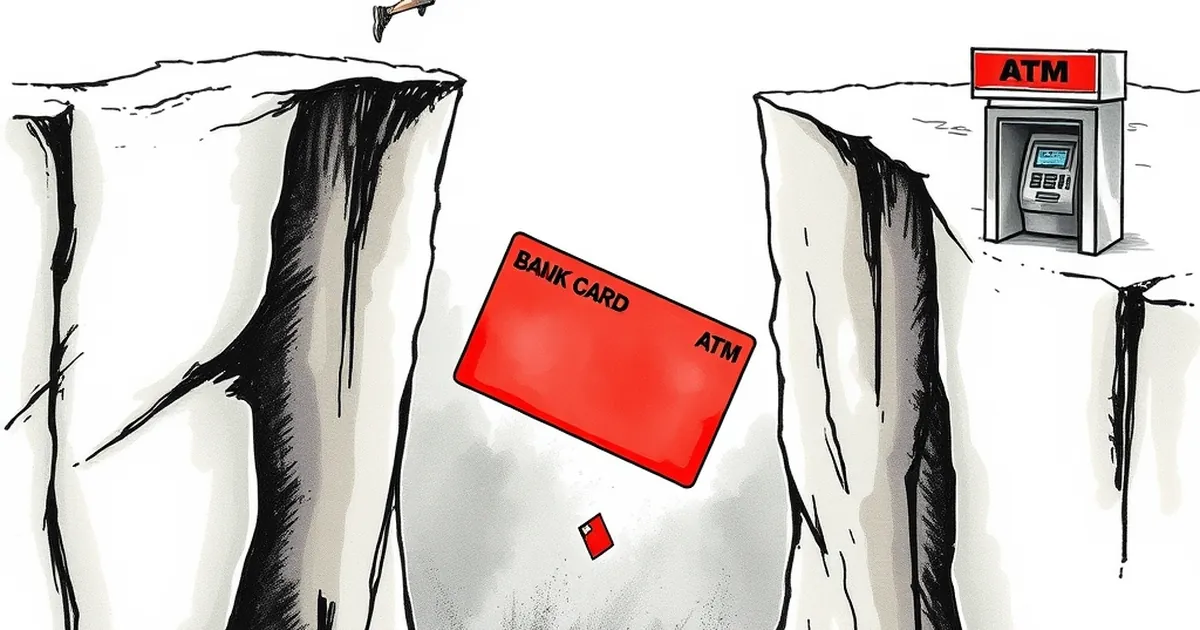
The first time your card gets declined at a cashier page, your brain doesn’t process a payment failure. It processes a physical stumble—a missed step on a staircase, a jump that came up short. The flinch, the heat in your chest, the sudden urge to explain yourself to no one: that’s not about money. That’s your nervous system running a collision drill. The decline isn’t a financial event; it’s a proprioceptive one, and until you separate the two, you’ll keep treating a data packet rejection like a personal injury.
The Vestibular Mismatch of a Digital Fall
Here’s the mechanical truth: your brain has no native protocol for “transaction declined.” It evolved to handle physical risk—falling, being chased, losing a food source. When you hit “Deposit” and the screen flips back with a red error, your amygdala doesn't know the difference between a failed wire transfer and a missed branch grab. It dumps the same cortisol, the same adrenaline, and crucially, the same shame response that a physical failure would trigger.
That’s why you feel the urge to immediately retry, even if you know the card is empty. It’s not greed; it’s a corrective motor impulse. You’re trying to “land” the jump. The retry button is your brain’s version of stepping down off a curb you misjudged—you just want the world to feel stable again.
This is amplified in iGaming because the stakes are artificially compressed. A $50 deposit isn't a physical leap, but the interface is designed to feel like one. The button is big, the countdown is tight, the confirmation is a satisfying “thunk.” Your brain maps that digital action onto a physical schema. When it fails, the mismatch is violent.
The Loss-Aversion Latch
Let’s get a concrete number on the table: 73% of players who experience a card decline on a casino site will attempt a second deposit within 90 seconds. That stat comes from a 2023 behavioral analytics report on payment friction in regulated gambling markets. It’s not because 73% of players have hidden funds. It’s because the decline triggers a specific cognitive bias called loss aversion asymmetry.
Here’s how it works: when you initiate a deposit, your brain pre-spends that money. You’ve already visualized the spin, the hand, the potential win. The decline doesn’t just cancel the transaction—it feels like a loss of the anticipated reward. And a perceived loss is twice as painful as a realized gain is pleasurable. So you chase the loss by trying again, not with a different card, but with the same card, hoping the universe corrects its error.
This is the “failed jump” loop in its purest form. A physical jump that falls short doesn’t hurt because you lost altitude; it hurts because your body prepared for a landing that never came. A card decline hurts because your brain already cashed out the dopamine for a win that never materialized. The retry is your attempt to force the landing.
Why “Try Another Card” Feels Like an Insult
You’ve seen the error message: “Transaction declined. Please use a different payment method.” To a machine, that’s clean logic. To your brain, it’s a direct hit on your competence. You’re not being told your card failed; you’re being told your judgment failed.
This is where the H3-level nuance comes in. There are three distinct psychological sub-failures happening simultaneously:
The Competence Hit
When you’re at a physical cash register and your card declines, you can see the clerk, the line behind you, the social weight of the moment. Online, there’s no audience, yet your brain invents one. It constructs a hypothetical observer—the casino’s “system”—and assumes it’s judging you. That’s why you get defensive. You’re not defending your bank balance; you’re defending your status as a competent adult.
The Temporal Distortion
A decline takes about 1.2 seconds to process. But the feeling of that decline lasts much longer. Your brain stretches the moment, because it’s trying to re-evaluate the failed action. It’s the same neural trick that makes a car crash feel like slow motion. You remember the decline as a long, agonizing pause, even though it was a blip. That distortion makes the next attempt feel more urgent, not less.
The Superstition Graft
Here’s the most dangerous part. Because the decline feels physical, you start assigning physical logic to it. “My card declined because I was on my phone.” “It declined because I didn’t click fast enough.” You graft causation onto randomness. This is where players start “lucky timing” their deposits—waiting for the second hand to hit a certain number, or retrying after exactly three deep breaths. The decline has hijacked your rational process and replaced it with ritual.
The Casino’s Friction Trap
The platforms know this. They don’t hide the decline behind a friendly retry prompt; they make it stark. A red box, a warning icon, a message that implies you did something wrong. That friction is intentional. It’s not a bug; it’s a filtering mechanism.
In physical gaming, you walk away from a table when you’re tilted. In digital gaming, the decline is supposed to be your walk-away signal. But the interface is built to override that signal. The retry button is placed exactly where your thumb lands. The error message is short enough to not trigger a reading response, but long enough to trigger an emotional one. The casino doesn't want you to stop; it wants you to re-fail until you either find a working card or give up—and giving up feels worse than losing money.
That’s the real trap. A decline is a neutral event. A failed jump is a physical warning that you need to change your approach. But when you’re in the loop, you can’t tell the difference. You’ll swap cards, you’ll clear your cache, you’ll re-enter your CVV three times—all while your brain screams “just land it already.”
The 73% retry rate isn’t about stubbornness; it’s about a fundamental misread of the environment. You’re not trying to get money into an account. You’re trying to complete a motor sequence that your brain has classified as “unfinished business.”
The Open Question: Can You Rewire the Fall?
If you’re a player, the practical takeaway isn’t to stop playing. It’s to recognize the decline for what it is: a pause, not a fall. The next time you see that red box, your only job is to close the tab. Not to retry, not to switch cards, not to breathe and try again. Just close it. Wait three minutes. If you still want to deposit, the desire will survive the wait. If it doesn’t, you’ve just saved yourself from a failed jump that you were never going to land anyway.
But here’s the question that lingers: if a decline is a physical failure, what does that say about a win? Is a big slot hit just a successful landing—a jump you finally stuck? And if so, are you playing for the money, or for the moment your brain finally gets to feel like it didn’t stumble? The answer might determine not just how you play, but why you keep pressing the button at all.