Why Visa Treats a Casino Win Like a Refund
Visa classifies casino wins as refunds, not payouts, shaping fees, speed, and bank alerts
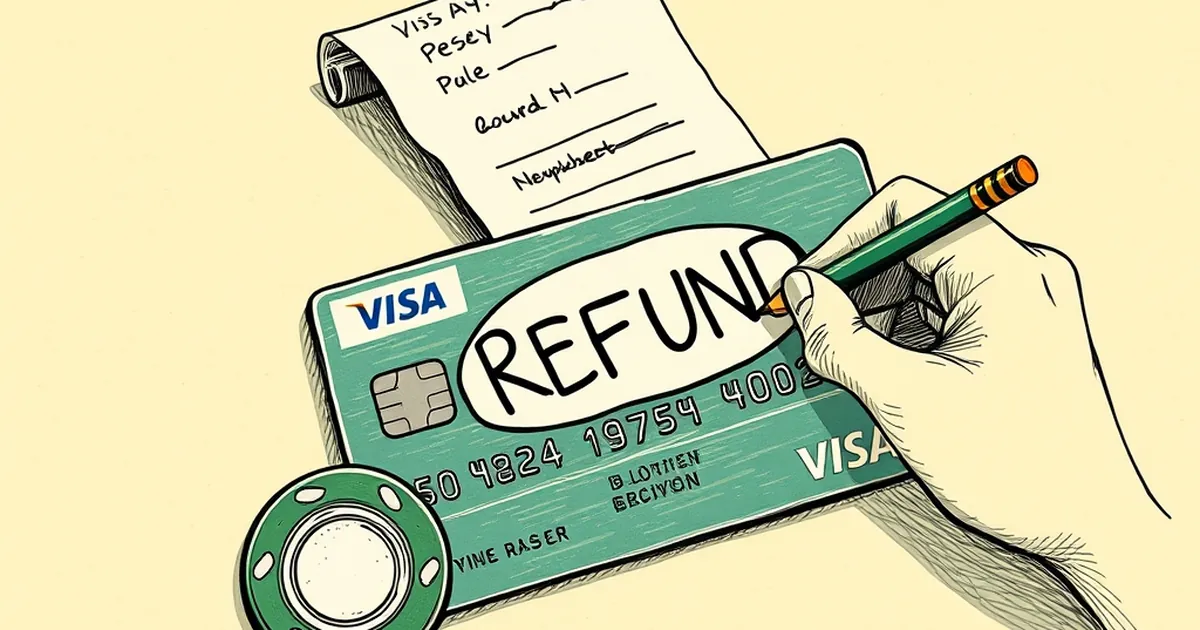
When you win at an online casino and the cashback lands on your Visa card, the payment system doesn’t see a "gambling payout." It sees a reversal of a previous transaction. That’s the entire trick. Visa categorizes most casino withdrawals as refunds, not as new credits, which means the transaction flows through a completely different set of rules, fees, and fraud checks than a standard merchant deposit. The distinction is invisible to you at the cashier window, but it dictates everything from processing speed to whether your bank gets a notification.
The practical consequence is that your "win" isn’t treated as income, a transfer, or a payout. It’s a correction. And that single classification choice—made by Visa’s network rules over a decade ago—is why your withdrawal can clear in 24 hours while your deposit took three seconds, and why some banks will still freeze the funds for a "security review" even though the casino did nothing wrong.
Why a Refund Classification Exists
Visa’s operating regulations don’t have a dedicated "gambling winnings" category for consumer credit cards. They have purchase transactions, cash advances, balance transfers, and refunds. A casino deposit is a purchase (or sometimes a cash-equivalent transaction, which carries higher fees). A withdrawal is not a purchase, so the only logical bucket left is a refund.
This isn’t a loophole the casinos exploit. It’s a structural necessity. Visa’s network doesn’t have a native mechanism to say "the merchant is sending you money because you won a bet." That would require a new transaction type, a new dispute code, and a new set of risk parameters. Instead, the network treats the payout as a reversal of the original authorization. If you deposited $200 and later withdrew $800, Visa sees one original $200 authorization, one refund of $200, and then—here’s the kicker—the remaining $600 is processed as a separate refund against a different, older transaction or as a "merchant-initiated credit" if no prior transaction exists.
The latter case is where the system gets weird. If you deposit $100, win $5,000, and withdraw the full amount, the casino sends a refund request for $5,000. Visa has no original $5,000 transaction to reverse. So it processes the first $100 as a true refund, and the remaining $4,900 as a "credit voucher" or "non-referenced credit." That’s a technical term meaning "money sent to the cardholder without a matching prior debit." And that’s the trigger for your bank’s fraud department.
The 24-Hour Rule and the $10,000 Ceiling
Here’s a concrete anchor: Visa’s global chargeback and retrieval rules state that a non-referenced credit must be posted to the cardholder’s account within 5 business days of the merchant’s transaction date, but the card issuer is not required to make those funds available until the settlement date, which can be up to 3 business days later. That’s why some withdrawals feel instant and others feel glacial.
But the more important number is $10,000. In Visa’s dispute resolution framework, any single credit transaction exceeding $10,000 automatically triggers a "large ticket" review by the issuing bank. That doesn’t mean the withdrawal is frozen—it means the bank’s compliance software flags it for manual review, often requiring a phone call to confirm you didn’t accidentally authorize a merchant to drain your account. The casino has zero control over this. The payout is legitimate, but the classification as a "large refund" looks identical to a fraudulent refund scheme where a criminal uses a stolen card to deposit, then withdraws to clean the funds.
This is why high rollers with Visa cards often see their withdrawals split into multiple smaller transactions. It’s not the casino being paranoid. It’s the casino’s payment processor trying to avoid tripping the large-ticket threshold. A $9,500 withdrawal clears in hours. A $10,500 withdrawal sits in a queue until a human at the bank reviews it.
What This Means for Your Bank Statement
You might think a refund classification is harmless. It’s not. It affects your available credit in a specific way. When a casino deposits $500 as a refund, that amount is added to your credit line, but it’s not treated as a payment. That means it doesn’t reduce your minimum payment due. If you have a $1,000 balance on the card and a $500 casino withdrawal posts as a refund, your statement still shows a $1,000 balance due. The $500 just becomes "available credit" that you can spend, but it doesn’t zero out the interest accruing on the original balance.
This is a subtle trap. Players who win and immediately withdraw to a credit card often assume the win "covers" their previous spending. It doesn’t. The refund reduces your principal, but interest continues to accrue on the average daily balance, which includes the days before the refund posted. So a $500 win on a card with a $1,000 balance at 22% APR saves you about $9 in interest for the month, not $500.
There’s also the issue of cash advance fees. If you used a Visa credit card to deposit at a casino, and your bank classifies that deposit as a cash advance (many do, despite Visa’s merchant category code rules), then the subsequent refund will first pay off the cash advance balance. That’s fine. But if you had other cash advances on the card, the refund gets applied to the oldest cash advance balance first, not the one you just made. So you might still owe cash advance interest on the casino deposit even though the refund posted. That’s a niche scenario, but it happens often enough that payment processors have dedicated FAQ pages about it.
The Issuer’s Discretion Is the Real Wildcard
Visa sets the network rules, but your specific bank can override almost any of them at the account level. Some issuers treat non-referenced credits as "unusual activity" and hold them for 7–10 business days. Others automatically convert them to a check and mail it to you, even if you have a valid card on file. This is perfectly legal under Visa’s rules—the network says the funds must be processed, but the issuer has discretion over availability.
The most aggressive issuers go further. They might block the refund entirely and ask you to dispute it as an unauthorized transaction. That sounds counterintuitive, but here’s the logic: a refund from a merchant you don’t recognize (because the casino’s billing descriptor is a shell company like "NetPay Solutions" or "New Venture Services") looks like a refund fraud attempt. The bank’s automated system sees a large inbound credit from an unrecognized merchant, assumes the merchant made an error, and initiates a chargeback to return the money to the merchant. Sound familiar? That’s why you sometimes see a casino win appear on your statement, then disappear two days later, then reappear after you call the bank and explain the situation.
The casino can’t fix this. They can only provide a "proof of play" document and hope your bank’s human reviewer accepts it. Visa’s rules allow the merchant to re-present the credit after a chargeback, but the process takes 45–60 days. That’s not a casino being slow. That’s the network’s dispute clock.
The Open Question
Now that you know the mechanics, the practical question is: why do so many online casinos still push Visa as a withdrawal method when it’s objectively worse than bank transfer or crypto? The answer is volume. Visa processes the majority of card deposits globally, and players expect to withdraw to the same method they deposited with. But the classification mismatch means every casino withdrawal via Visa is a tiny gamble—not on the game, but on your bank’s internal policies.
What happens when a major issuer decides to treat all non-referenced credits from gambling merchants as suspicious by default? The entire withdrawal landscape shifts overnight. Casinos would be forced to pivot to ACH or e-wallets for payouts, and players would lose the "instant refund" illusion entirely. That day is coming, not because of regulation, but because fraud detection algorithms are getting better at spotting the anomaly. The question is whether you’ll notice the shift when it happens—or if you’ll just see another "pending" transaction and assume the casino is slow, when it’s actually the network quietly reclassifying your win.