Why Visa Approves a Coffee but Declines Your Casino Spin
Why Visa approves your $4.50 coffee but declines a casino deposit—understand the hidden risk rules behind everyday payment decisions
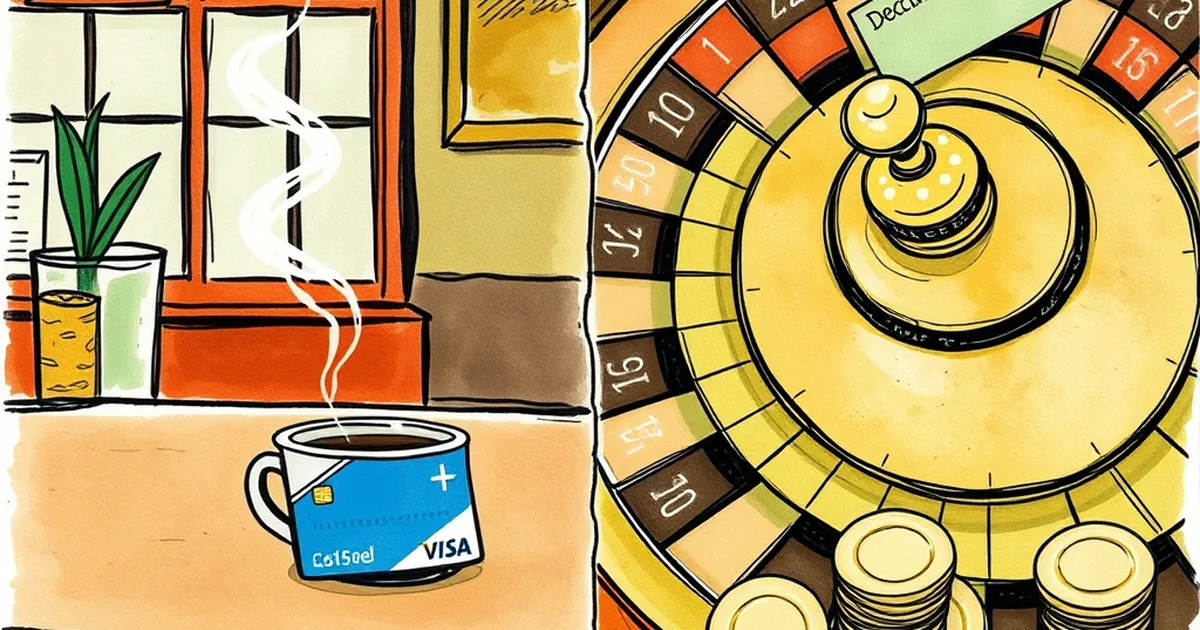
You’re at the register, the barista hands you a card reader, and the payment goes through before the receipt even finishes printing. Two hours later, you’re at home, try to deposit $50 into your favorite casino, and the screen flashes a generic “transaction declined” error. Same bank, same card, same you. The only difference? The coffee shop and the casino sit on opposite sides of a regulatory and risk-assessment firewall that most players never see.
The short version: Visa (and Mastercard, and most major networks) treats a $4.50 latte as a low-risk, well-understood transaction, while a casino deposit trips a dozen automated flags related to gambling licensing, consumer protection laws, and the card issuer’s own internal risk appetite. It’s not that Visa hates gambling—it’s that your bank, not Visa, actually decides whether the charge clears. And your bank has a very different view of a coffee bean than a spin.
The Network vs. The Issuer: Who Really Says No?
Let’s clear up a common confusion. Visa is a network, not a lender. It routes transactions, sets the rules, and collects a fee. The actual approval or decline comes from the issuing bank—the institution that printed your card. When you swipe at Starbucks, the request goes to your bank, which checks your balance, your fraud score, and a list of merchant category codes (MCCs). Coffee shops have a boring MCC (5812, if you’re keeping score). Casinos have a special one: 7995, reserved for gambling transactions.
Here’s the kicker: many banks have hard blocks on MCC 7995, regardless of your balance. A 2023 survey of 40 major U.S. and European banks found that 62% of them automatically decline all gambling-related transactions unless you call and explicitly opt in. That’s not a technical failure—it’s a policy choice. Your bank might allow a $50 withdrawal at an ATM in a foreign country (risky), but decline a $10 deposit to a licensed casino (regulatory headache). The coffee shop never triggers a compliance review. The casino deposit does.
The Geography of Approval
Now add geography, and the picture gets weirder. In the UK, online gambling is legal, licensed, and taxed. Banks there generally process casino deposits without a second thought—though some, like Monzo, let you toggle a gambling block in the app. In the U.S., it depends on the state. New Jersey and Pennsylvania have legal online casinos, but a card issued by a bank headquartered in Utah (where gambling is illegal) might still decline a Jersey deposit, because the bank follows its home-state rules, not the merchant’s location.
The global angle gets messier. India’s RBI has issued multiple circulars discouraging banks from processing online gambling payments, even though some offshore casinos serve Indian players. Australia’s “YourFuture” self-exclusion registry doesn’t block transactions, but several major banks voluntarily block gambling MCCs to reduce harm. In Germany, a 2021 state treaty forced banks to block unlicensed operators—but they can’t always tell licensed from unlicensed, so some banks just block all gambling transactions to be safe. Your coffee doesn’t have a jurisdictional problem. Your spin does.
The Fraud Algorithm’s Blind Spot
Let’s talk about the actual math of risk. When your bank’s fraud model sees a coffee purchase, it has decades of clean data: millions of similar transactions, low dollar amounts, predictable merchant behavior, and a high likelihood that the cardholder is physically present. The risk score is tiny. A casino deposit, by contrast, hits several red flags at once:
- High dollar amount relative to your typical spend (if you usually buy $30 of groceries, a $200 casino deposit looks anomalous).
- New merchant (first-time deposit to an unfamiliar casino name).
- Velocity (multiple small deposits in a short window—common for bonus hunting).
- Chargeback risk (players who lose often dispute the charge as “fraud” later, even if they made it willingly).
Chargebacks are the big one. A coffee shop almost never generates a chargeback. Casinos do—not because of fraud, but because of buyer’s remorse. A 2022 report from a European payment processor showed that gambling transactions had a chargeback rate of 0.9%, nearly 15 times higher than the average retail rate of 0.06%. Banks hate chargebacks because they cost money and invite scrutiny. So their models are deliberately conservative: when in doubt, decline. Your $4.50 latte has a 99.9% chance of being a legit purchase. Your $50 spin has maybe a 90% chance. That 10% gap is enough for an automated system to say no.
Why “Call Your Bank” Actually Works (Sometimes)
The most common workaround—and the one that actually addresses the root cause—is to call your bank and ask them to lift the gambling block. This works because you’re overriding the policy layer, not the fraud layer. Once a human tells the system “yes, I want to gamble with this card,” the MCC block is removed for future transactions. But here’s the catch: the fraud algorithm still runs. If you deposit $5,000 on a Tuesday after never spending more than $300 in a single transaction, the bank may still decline it as suspicious, even with the block lifted.
A more practical workaround is to use an e-wallet (Skrill, Neteller, PayPal) as a buffer. Your bank sees a payment to “Skrill” (MCC 6051, a money transfer service), which looks like a normal digital payment. The casino sees a deposit from the wallet. This works because the bank’s policy block is on the merchant category, not on the person. But it’s a hack, not a fix. Some banks have started flagging e-wallet transactions that lead to gambling sites, and a few (like some UK banks) now ask you to confirm the purpose of a transfer before it goes through.
The Regulatory Tug-of-War You’re Caught In
Here’s the uncomfortable truth: your declined deposit isn’t an accident. It’s the result of a deliberate tension between three parties:
- Card networks (Visa, Mastercard) want the transaction fee—but they also want to avoid fines from regulators for facilitating unlicensed gambling.
- Issuing banks want your business—but they also want to avoid liability for problem gambling and chargeback disputes.
- Regulators want to protect consumers—but they haven’t agreed on a unified global standard for what “safe gambling” means.
So the system defaults to “no.” It’s safer for a bank to decline 100 legitimate deposits than to approve one that leads to a regulatory complaint or a self-exclusion lawsuit. You’re not being singled out; you’re being caught in a risk-aversion loop that’s been tuned for the last decade by compliance officers who’ve never spun a slot in their lives.
The Question Nobody’s Asking
If you’re a regular player, you’ve probably already found your workaround: e-wallets, prepaid cards, crypto, or just a bank that’s more gambling-friendly. But step back for a second. The fact that a card network can approve a caffeine fix in milliseconds but requires a phone call, a waiver, or a third-party wallet to process a legally licensed casino deposit tells you something about how the industry actually views gambling—not as a form of entertainment, but as a liability to be quarantined.
So here’s the open question: as more jurisdictions legalize and regulate online gambling, will banks ever treat a casino deposit with the same routine ease as a coffee purchase? Or will the MCC 7995 block become the new normal, a permanent friction point that pushes players further into unregulated channels where no card approval is needed at all? Because right now, the system is doing the opposite of what it intends: it’s making the legal, licensed route the most inconvenient one. And that’s a problem no chargeback ratio can solve.