Why Visa and Mastercard Actually Compete with Each Other
Visa and Mastercard compete fiercely behind the scenes, shaping payment technology and issuer partnerships that affect your wallet
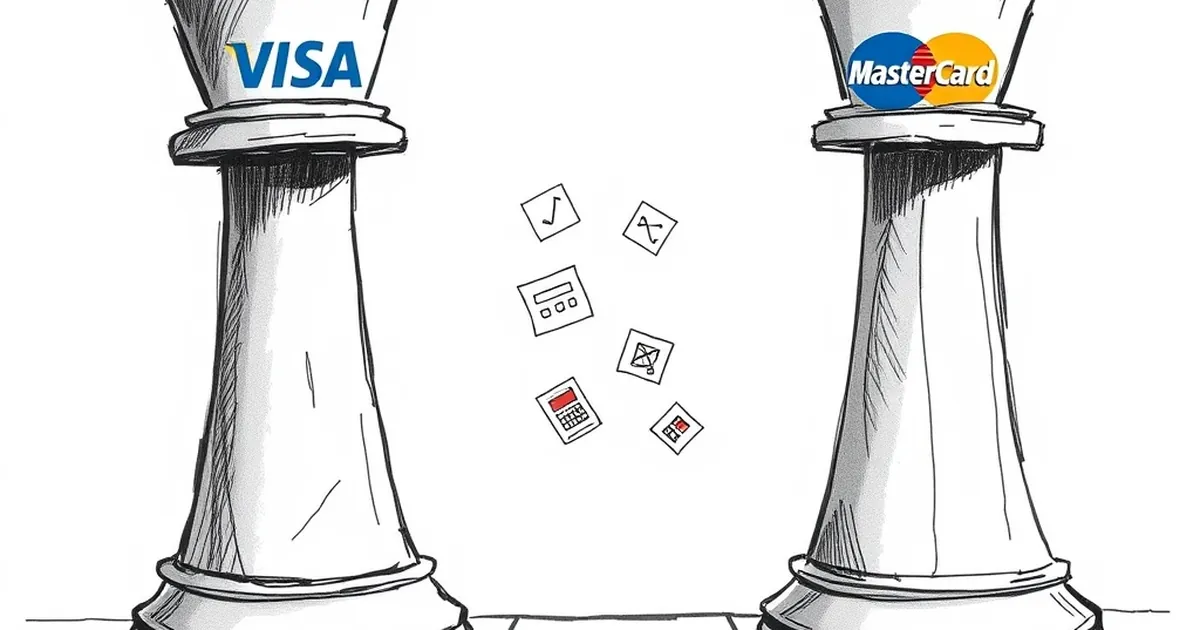
Most people assume Visa and Mastercard are best friends. They operate in the same space, charge similar fees, and are accepted almost everywhere. But here’s the uncomfortable truth: they are fierce competitors, and their battle for dominance shapes everything about how you pay.
It’s easy to miss because you rarely see a Visa or Mastercard logo and think, “I’ll choose this one over that one.” The competition isn’t on your credit card’s front—it’s behind the scenes. They fight for issuer partnerships, network exclusivity, and technological control. And that rivalry has real consequences for merchants, banks, and your wallet.
The Illusion of Duopoly Harmony
When you hold a Visa card, the bank that issued it sets your interest rate, rewards, and annual fee. The network—Visa or Mastercard—doesn’t lend you money. They just move the transaction data. So why would they compete at all?
Because the network is the product. Every time you tap, dip, or swipe, Visa and Mastercard earn a small fee (the “interchange” plus their network assessment). Multiply that across billions of transactions, and you get billions in annual revenue. Neither wants to lose even half a percent of that flow.
They compete to be the default network on every card. If a bank issues a Visa card, Mastercard wants that bank to switch. If a fintech app launches a new debit card, both networks pitch their features. It’s a constant, low-key war for “top of wallet” status—not with consumers, but with financial institutions.
Exclusivity Deals Are the Real Battlefield
The most direct competition happens through exclusive partnerships. For years, Costco in the U.S. only accepted Visa (and previously only Amex). In Canada, it was Mastercard-only for a long time. These exclusivity agreements are hard-won and high-stakes.
When a major retailer or issuer signs an exclusive deal, the losing network loses millions of potential transactions. That’s why you see Mastercard pushing hard for co-branded cards with airlines, and Visa sponsoring the Olympics. They aren’t just building brand awareness—they’re locking up transaction volume.
Technology Standards: The Quiet Arms Race
Visa and Mastercard don’t just compete on price. They compete on how payments happen. Each network develops its own security standards, tokenization methods, and contactless specifications. And they push banks and merchants to adopt their version first.
A concrete example: the shift to EMV chip cards. Both networks supported the standard, but they competed to certify terminals and issue the first compliant cards. Whichever network got its technology into more terminals first would have an edge in reducing fraud liability for its issuers. Mastercard launched “Mastercard Contactless” early in Europe; Visa countered with “Visa payWave.” The result was a fragmented rollout that took years to harmonize.
Tokenization and Digital Wallets
Today, the fight is over tokenization—replacing your card number with a unique digital token for online and mobile payments. Apple Pay, Google Pay, and Samsung Pay all use tokens. But each network wants its tokenization standard to become the default.
If a merchant’s payment gateway is optimized for Visa’s token service, Mastercard transactions might process slightly slower or cost more in fees. It’s invisible to you, but it influences which network a merchant’s processor recommends. And that recommendation can shift billions in volume.
Pricing and Fee Structures Are a Hidden Weapon
You never see the fee breakdown between Visa and Mastercard, but merchants do. And those fees are a primary battlefield. Both networks publish interchange rates, but they negotiate special pricing with large acquirers and processors.
Mastercard has historically positioned itself as slightly more flexible on pricing for certain merchant categories—like small businesses or recurring billing. Visa counters with its “VisaNet” efficiency claims, arguing that faster authorization reduces fraud costs overall. Neither admits to undercutting the other, but the pricing sheets tell a different story.
The “Honor All Cards” Rule as a Competitive Tool
Here’s a lesser-known tactic: the “honor all cards” rule. Both networks require merchants who accept their brand to accept all cards carrying that logo—including high-reward premium cards with higher fees. This rule protects the network’s brand integrity.
But when one network lowers its fees for a specific merchant category, the other network can’t immediately match it without risking its own rule structure. So they compete by offering “incentive programs” that effectively reduce costs for certain transaction types. It’s a game of cat and mouse played in spreadsheets, not press releases.
The Real-World Impact on Your Payment Experience
This competition isn’t abstract. It directly affects how you pay. When you see a “Mastercard only” promotion at a gas station, or a “Visa preferred” checkout button online, you’re witnessing the result of a network battle.
It also affects rewards. Banks choose which network to partner with based on the incentives Visa or Mastercard offer. If Mastercard offers better data analytics to the bank, the bank might launch a new rewards card on Mastercard’s network. You benefit from better points, but the network benefits from your loyalty.
One Anecdote That Stuck With Me
A few years ago, I worked with a mid-sized retailer that processed about $50 million annually. They were approached by both Visa and Mastercard to run a “network optimization” test. Mastercard offered to reduce their assessment fees by 15% if the retailer routed all contactless transactions through Mastercard’s network for six months.
Visa caught wind and matched the offer—plus added a $100,000 marketing credit. The retailer ended up splitting the routing 50/50. Neither network won outright, but the retailer got a free marketing campaign and lower fees. That’s the invisible competition in action.
The Forward-Looking Takeaway
Visa and Mastercard will keep competing, but the nature of that competition is shifting. Open banking, real-time payments, and central bank digital currencies (CBDCs) are new threats. Both networks are investing heavily in data services, fraud prevention, and cross-border payment rails to stay relevant.
For businesses and consumers, the practical takeaway is this: don’t assume the network on your card doesn’t matter. When choosing a card issuer, ask which network they use—and why. If you’re a merchant, negotiate your processing agreement with an eye on network routing flexibility. The competition between Visa and Mastercard is your leverage. Use it.
The next time you tap your card, remember: you’re not just making a payment. You’re casting a vote in a quiet, multi-billion-dollar rivalry that defines modern commerce.