What happens when a $20 table minimum outlives your bankroll
A $20 table minimum can quietly drain a $200 bankroll in ten hands, showing how table limits shape your odds of surviving a session
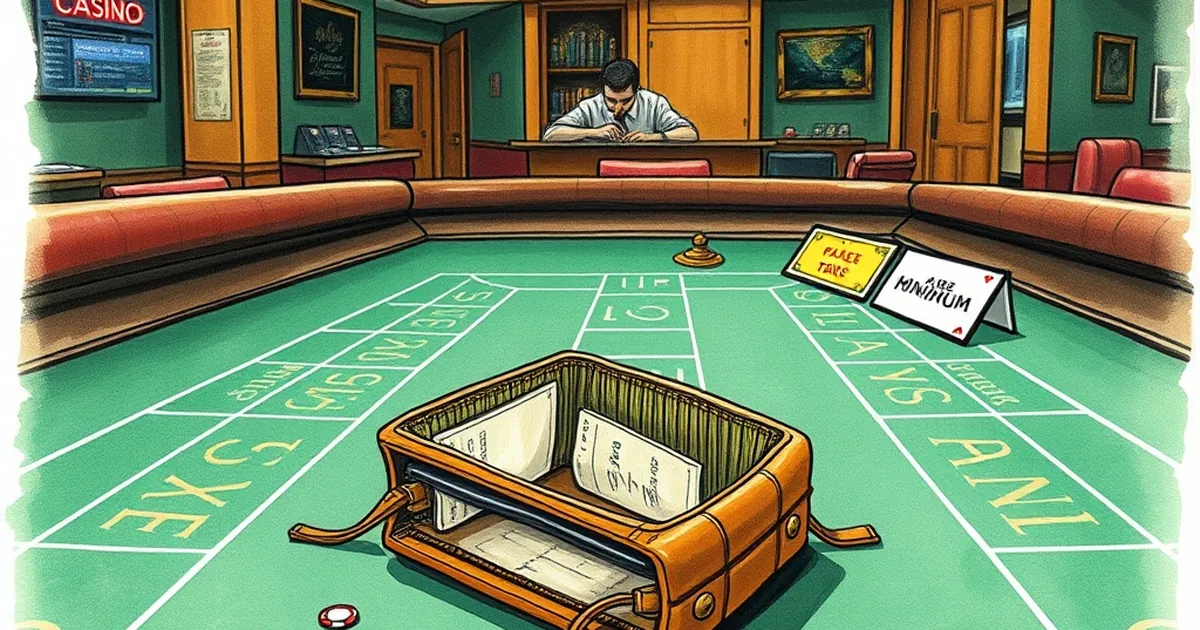
A $20 minimum on a blackjack table doesn't sound like much until you're sitting at one with $200 and a plan. That plan — flat-betting, maybe a mild progression, riding out a cold streak — assumes you can survive roughly ten losing hands before the math turns on you. On a $20 table, ten hands is your entire bankroll. On a $5 table, it's forty. Same game, same rules, radically different probability of walking away with anything left.
The minimum bet isn't a detail you optimize around. It's the parameter that decides whether your session has a shape at all.
The math the table minimum quietly does to you
Take a straightforward scenario. You've got $200. You're playing blackjack with basic strategy, house edge around 0.5% under decent rules, flat-betting $20 a hand. Your expected loss per hand is about 10 cents. Over 100 hands, that's roughly $10 in expected value — trivial. But expected value isn't what empties your pocket. Variance is.
With a $20 bet and a $200 stack, you're ten units deep. Blackjack hands swing roughly ±1.15 units per hand at flat betting, which means a standard deviation of about $23 per hand. Over 100 hands, your total standard deviation is around $230 — larger than your entire bankroll. That's the number that matters. You're not playing against the house edge over a session of this length. You're playing against a distribution wide enough to swallow your stack whole, and the house edge only decides how often you cross zero versus how often you double up.
Drop the bet to $5 and the same $200 becomes forty units. Standard deviation per 100 hands falls to about $57. Now you're operating inside a band your bankroll can actually absorb. The game didn't change. The minimum did.
This is why serious bankroll management advice keeps circling back to unit sizing — typically 1–2% of your roll per bet for a session you want to last. On a $20 minimum, that implies a bankroll of $1,000 to $2,000. If you're sitting down with $200, you're betting 10% of your roll per hand. That's not a session. That's a coin flip with extra steps.
Why $20 tables exist in the first place
Table minimums aren't arbitrary. They're set by the operator's cost structure and floor capacity. A live dealer table costs the same to staff whether it's dealing $5 hands or $500 hands, and the house needs a certain hourly theoretical win per seat to justify the space. Low-minimum tables fill up with players who generate less revenue per hour, so casinos cap how many they run and where they sit on the floor.
In practice, this means the $5 table is often the one tucked in the corner with a queue, while the $25 and $50 tables sit empty at prime hours. That's not a conspiracy — it's just throughput economics. But it has a real effect on players with smaller bankrolls: the game you can afford to play is the game you can't easily get a seat at, and the game with open seats is the one your bankroll can't sustain.
Online, the same logic plays out differently. Live dealer blackjack typically starts at $1–$5 on the lower tiers, but the streams with the best rules and lowest latency often sit behind $10–$25 minimums. RNG blackjack lets you bet $0.10 a hand, but you lose the social texture and the pace feels different. The tradeoff is real, and it's not always obvious which side you're on until you've played a few hundred hands.
The three failure modes of an over-minimum session
When the table minimum is too large relative to your bankroll, sessions tend to fail in one of three recognizable ways. None of them are about bad luck.
The short-stack spiral. You buy in for $100 at a $20 table. You lose four hands — entirely normal, happens about 6% of the time with flat betting — and you're at zero. You rebuy because the session "wasn't really over." Now you're $200 in on a table where your original plan assumed $100. The rebuy isn't irrational in isolation; it's irrational relative to the bankroll you actually allocated.
The bet-size creep. You start at $20 because that's the minimum. You lose a few, and the only way to get back to even within a reasonable number of hands is to press. So you go to $40, then $80. This is the Martingale instinct dressed up as "adjusting." It works often enough to feel like a strategy and fails catastrophically often enough to matter. On a $200 roll with a $20 minimum, you have three doublings before you're done. Three.
The grind that never recovers. You play tight, flat-bet, and survive. Two hours later you're down $60 — 30% of your roll — with no realistic path back because the minimum prevents you from making the small adjustments that would let variance work in your favor. You're paying rent on a seat you can't afford.
What to actually do about it
The cleanest fix is boring: match your bankroll to the minimum, not the other way around. If the lowest table you can find is $20 and your session bankroll is $200, you're playing the wrong game. Switch to a lower-variance variant, drop to RNG blackjack, or pick a different game entirely — baccarat banker bets at $1–$5 with a 1.06% house edge behave much better against a small roll than blackjack at a $20 minimum.
If you're set on live blackjack, the arithmetic is simple. Multiply the minimum by 50 to get the bankroll you'd want for a session where variance doesn't decide the outcome in the first twenty minutes. A $20 table implies $1,000. A $50 table implies $2,500. If that number feels unreasonable, the table is telling you something.
And if you're going to play anyway — because sometimes you are — set a hard stop before you sit down, not after the third rebuy. The stop-loss is the only mechanism that survives contact with a bad run. Everything else is a plan that assumes the cards cooperate.
What's less clear is whether the industry has any incentive to fix this. Low-minimum tables are unprofitable per square foot, and the players who need them most generate the least revenue. The $20 minimum isn't going anywhere. The question is whether players treat it as a floor to clear or a signal to walk.