What a $5 table minimum does to a 90-second decision
A $5 blackjack table changes more than the cost of entry, shaping how long you think and how sharp your decisions become under pressure
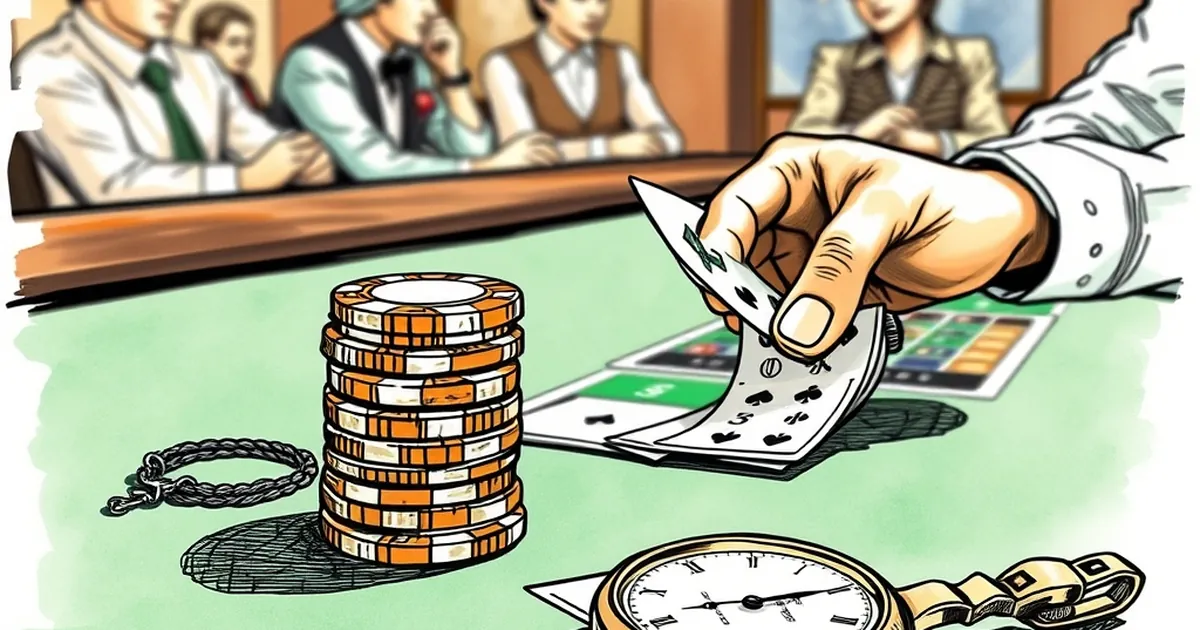
A $5 blackjack table doesn't just lower the cost of entry. It changes how long you have to think, and how much that thinking is worth. At a $25 table, the same 90-second decision carries five times the financial weight, which sounds like it should make you sharper — but the research on decision-making under pressure suggests the opposite. The stake level shapes the quality of the decision before you've even looked at your cards.
Walk into any casino with a mixed pit and you'll see it. The $5 table has five players crowded around it, some of them debating whether to hit a 16 against a dealer's 10 for longer than it takes the dealer to shuffle. The $50 table has two guys sitting quietly, betting in silence, deciding in under three seconds. Same game. Same 90-second window between hands. Completely different cognitive environments.
The 90-second window is a budget, not a pause
Between the moment the dealer pays out and the moment you place your next bet, you've got roughly a minute and a half. That's not dead time. It's where bankroll management actually happens, where you decide whether to press a win, pull back after three losses, or walk.
At a $5 minimum, your hourly expected loss on a standard 0.5% house edge game — say a decent basic-strategy blackjack table — comes out to something like $1.50 to $3 per hour at 60 hands. That's the price of a coffee. The decision to stay or leave feels costless, so players stay longer, drink more, and treat the 90 seconds as social time rather than a decision point.
At a $25 minimum, that same hourly expected loss jumps to $7.50 to $15. Still small in absolute terms, but the felt cost is different. Players at higher minimums report shorter sessions and more deliberate stop-loss behaviour. A 2019 study of Australian pokie players found that participants on lower-denomination machines played 40% longer per session than those on higher denominations, even when the total amount wagered was similar. The denomination didn't change the math. It changed the perception of the math.
Why the low minimum is a trap for the disciplined player
The $5 table is marketed as beginner-friendly, and it is — for learning rules. But it's hostile to the player who already knows basic strategy. The reason is simple: the variance-to-stake ratio is brutal.
On a $5 bet, a standard blackjack hand has a standard deviation of roughly $5.75. Your bankroll swings feel trivial. You can lose 20 hands in a row and be down $100, which is a rounding error for most people. So you keep playing. And every hand you play at a 0.5% edge is a small, certain loss dressed up as entertainment.
The player who would walk after a $200 loss at a $25 table will sit through a $200 loss at a $5 table without noticing, because the loss happened over four hours instead of forty minutes. Same money. Same edge. Different decision architecture.
The table minimum as a psychological anchor
Casinos understand this better than most players do. The $5 table isn't there to make money on the $5 bets. It's there to keep you in the building, in the chair, and in the habit loop.
A 2022 analysis of UK online casino session data found that players who chose the lowest available stake on a given game averaged 2.3 times the session length of players who chose mid-tier stakes, with a 15% higher total loss per session. The low-stake players weren't unlucky. They just had more hands to lose.
The 90-second window compounds this. At a $5 table, you're making roughly 60 decisions an hour. At a $50 table, you might make 40, because the game slows down — more deliberation, more counting, more table talk. Fewer decisions means fewer opportunities to make a mistake, but also fewer opportunities to notice you're making one.
The online equivalent
Online, the $5 minimum translates to a $0.50 or $1 spin on slots, or a $2/$5 no-limit hold'em table. The 90-second window shrinks to 3 seconds on a slot spin, which is a different problem entirely. But the principle holds: the lower the stake, the longer the session, and the more the house edge has time to work.
A $1 slot spin at 96% RTP loses $0.04 per spin on average. At 600 spins per hour — a realistic autoplay-adjacent pace — that's $24 an hour. A $5 spin at the same RTP loses $120 an hour. The $1 player feels virtuous. The $5 player feels reckless. But the $1 player is more likely to still be spinning three hours later, and the $5 player is more likely to have stopped after 45 minutes.
What the 90 seconds actually decide
The decision isn't whether to hit a 16. Basic strategy already answers that. The decision is whether to keep playing, and the table minimum is the single biggest input into that decision — bigger than the cards, bigger than the dealer's upcard, bigger than the count.
A $5 minimum makes the keep-playing decision feel free. It isn't. It's the most expensive decision at the table, because it's the one you make 60 times an hour without noticing.
The players who do best at low-minimum tables aren't the ones with the best strategy. They're the ones who set a hard stop — a loss limit, a time limit, or a hand count — before they sit down, and who treat the 90-second window as a checkpoint rather than a break.
The question the industry doesn't want to ask
If low table minimums reliably extend sessions and increase total losses, why do operators keep offering them? The obvious answer is volume: more players, more hands, more rake. But there's a less comfortable answer. The $5 table is a customer acquisition tool. It gets people in the door who wouldn't otherwise play, and it trains them to associate gambling with low-stakes, low-consequence fun.
That association is profitable right up until it isn't. The player who starts at $5 and moves to $25 after a good session is the ideal customer. The player who stays at $5 for four hours is the one the math depends on.
So the real question isn't whether a $5 minimum is good or bad for the player. It's whether the 90-second window is a feature of the game or a bug in the player's decision-making — and whether anyone sitting at that table has actually thought about it.