What 3am tilt does to a 1,400-spin session
Late-night tilt quietly inflates bet sizes mid-session, turning a fixed 1,400-spin count into a far more expensive night than planned
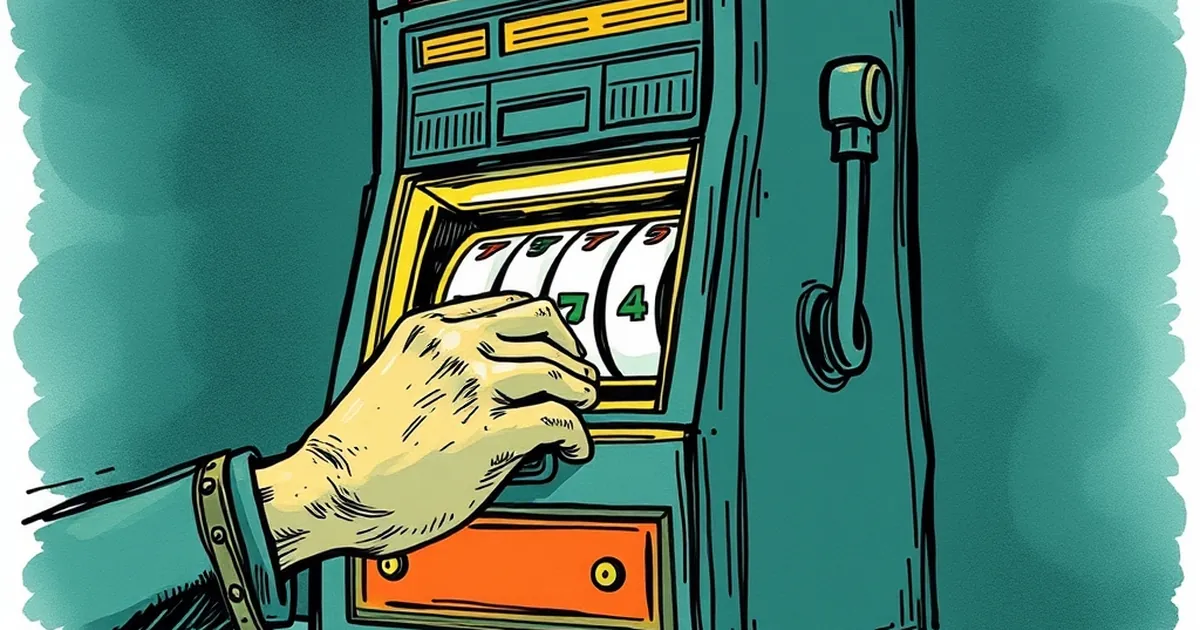
Most players who blow through a 1,400-spin session in one sitting don't lose because the slot was cold. They lose because somewhere past spin 900, with the clock edging toward 3am, their bet size creeps up, their session budget stops meaning anything, and the next 500 spins cost two or three times what the first 900 did. The spin count stays honest. The money doesn't. That gap between "I played 1,400 spins" and "I played 1,400 spins at wildly different stakes" is where tilt does its quiet damage.
The math of a session that changes shape
A 1,400-spin session sounds like a fixed thing. It isn't. Spins are units of time, not units of risk. If you open at €0.50 a spin, 1,400 spins is €700 of turnover. If you're still at €0.50 for the first 900 and then move to €1.50 for the last 500, your actual turnover is €450 plus €750 — €1,200, not €700. Same spin count. Seventy-one percent more money through the machine.
That matters more than it looks, because expected loss scales with turnover, not with spins. At a 96.2% RTP, the house edge is 3.8%. On €700 of turnover your expected loss is €26.60. On €1,200 it's €45.60. The session didn't get longer. It got more expensive per minute, and the player almost never notices the switch happening.
Why the last third is the expensive third
The pattern is consistent enough to be boring. Early spins are deliberate: you picked the stake, you know your budget, you're watching the balance. Around spin 600 to 900, depending on how the session is going, one of two things happens. If you're up, the stake feels like it's playing with house money. If you're down, the stake feels like the only lever that gets you back. Both roads lead to the same place — a bigger bet on a tired brain.
By 3am, decision quality is not what it was at 10pm. That's not a moral judgment; it's just what sleep pressure does to risk assessment. The bets that feel measured at midnight feel timid at 3am, and the ones that feel reckless at midnight feel reasonable. The slot's behaviour hasn't changed. Your calibration has.
What tilt actually looks like at 3am
Tilt gets described as rage, and sometimes it is. More often it's quieter: a kind of grim persistence. The signs in a 1,400-spin session tend to show up in this order.
Stake creep. The first move is usually small — €0.50 to €0.75, then €1.00. Each step is justifiable in isolation. Stacked, they're a 100% increase in cost per spin.
Spin speed. Tilt compresses time. Autoplay gets turned on, or the spacebar gets mashed, and the session that was running at 400 spins an hour starts running at 900. A 1,400-spin session that should have taken three and a half hours finishes in ninety minutes.
Loss reframing. The number you were down stops being a loss and becomes a target. "I need to get back to even" replaces "I set aside €200 for tonight." Those are different games.
Bonus blindness. At 3am, players accept bonus features or buy-feature offers without checking the cost against the stake. A €60 feature buy at €0.50 spins is a different decision than the same buy at €1.50 spins, and tilt rarely does that arithmetic.
The autoplay trap
Autoplay is the single biggest accelerant in a late session. It removes the small pause between spins where most players would otherwise reconsider. A 100-spin autoplay run at €1.00 is €100 of turnover in roughly four minutes at typical speeds. Chain three of those and you've done 300 spins and €300 of exposure while barely looking at the screen. The spin counter climbs; the sense of elapsed time doesn't.
Setting a session that survives 3am
You can't tilt-proof a session, but you can build in friction so tilt has to work harder.
Fix the stake for the whole session, not the spin count. Decide the per-spin cost before you open the game and treat any change as a new session with a new budget. If you want to move from €0.50 to €1.00, stop, log the loss or win, and start fresh.
Use a hard loss limit, not a soft one. "I'll stop at €200 down" is a soft limit and tilt will argue with it. A deposit limit or loss limit set in the account settings doesn't argue. Most licensed operators let you set these and enforce a cooling-off period before you can raise them — that delay is the whole point. If you can raise your limit at 3am and keep playing, it isn't a limit.
Set a clock, not just a budget. A 1,400-spin session at €0.50 is roughly three to four hours at normal pace. If you're an hour in and already past spin 700, the speed is the problem, not the stake. Autoplay off after 11pm is a blunt rule that works.
Bank the stake change. If you're going to move up, move up at the start of a session with money you've already decided is expendable — not at spin 1,100 with the balance you were trying to protect.
What the numbers say about late-session play
There's no clean public dataset on 3am tilt specifically, and anyone who claims otherwise is selling something. But the directional evidence is consistent: session length correlates with stake volatility, and stake volatility is where the real cost sits. A player who holds a flat €0.50 stake for 1,400 spins has a predictable, bounded session. A player who doubles the stake for the last third has roughly 40% more turnover and a correspondingly larger expected loss, with no extra entertainment to show for it. The spins were the same. The bill wasn't.
The question worth asking at 2:55am
The uncomfortable implication is that most "long session" losses aren't really about the game at all — they're about the last 500 spins being a different, more expensive game than the first 900, played by someone less equipped to make the call. So the useful question isn't "should I keep playing?" It's "am I still playing the session I sat down for?" If the stake has moved, the speed has moved, and the number you're chasing has replaced the number you set, the answer is probably no — and the spin counter won't tell you that. It just keeps counting.