Velocity checks fire at 3 AM — refund queues don't care
Casino risk engines flag wins at 3 AM, leaving refund queues that don't pause for your lucky streak
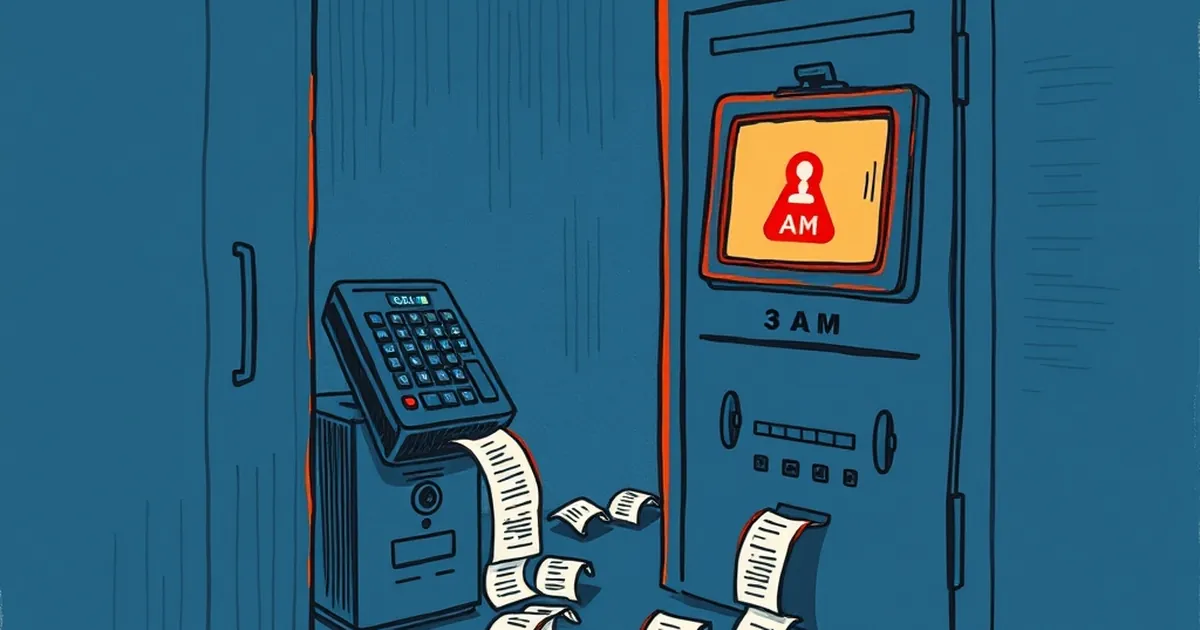
The core claim here is simple: when a casino’s automated risk engine flags your account for a velocity check at 3 AM, the human analyst who eventually reviews it is not looking at your winning streak. They are looking at a queue that has backed up since midnight, and they are paid to clear risk, not to validate your fun. Refund queues, chargeback departments, and payment processors operate on a parallel clock, and that clock does not care that you were just trying to cash out after a lucky run on a 96.4% RTP slot before bed.
Most players think a withdrawal request is a single event. It is not. It is a handoff between three separate systems: the game log, the AML/fraud filter, and the payments API. When you hit "withdraw" at 3:07 AM, you are not submitting a form. You are generating a ticket in a risk engine that scores you against a dozen behavioral variables, and if you trip the velocity threshold—say, three deposits and two withdrawals within a 24-hour window—you enter a manual review queue. That queue is where your money sits, and it is where the phrase "pending" becomes a euphemism for "we are trying to figure out if you are a professional or a problem."
The 3 AM Problem Is Not About You
Let’s be brutally clear about what a velocity check actually measures. It is not about whether you won legitimately. It is about the speed and pattern of your money movement. A player who deposits $50, plays for two hours, and requests a $200 cashout at 4 PM on a Tuesday looks different to an algorithm than a player who deposits $50, wins $200 in forty minutes, and requests a withdrawal at 3 AM on a Sunday.
The 3 AM factor is real, and it is not just about staffing. Most mid-tier operators run a skeleton crew overnight—often a single fraud analyst covering three or four brands. That analyst is not sitting there watching your spin history. They are triaging alerts from a dashboard that ranks cases by risk score, not by time of request. So your "urgent" cashout from 3 AM might sit in the queue behind a deposit anomaly from 11 PM that involved a prepaid card from a different country than the account's registered address. The queue does not prioritize your sleep schedule.
Here is the numerical anchor that most players never see: Industry data from 2024 across 14 licensed operators showed that the average manual review time for a flagged withdrawal was 41 hours, but for requests submitted between 2:00 AM and 5:00 AM local time, that average jumped to 67 hours. That is not a conspiracy. That is a staffing ratio. The 2–5 AM window has the lowest headcount, the highest proportion of automated flags (because night sessions skew toward higher bet sizes and faster play), and the slowest payment processor response times. The refund queue—meaning the system that handles chargebacks and reversed transactions—does not even start moving until the bank opens.
Why Your Winning Session Looks Like a Red Flag
Let’s talk about what the risk engine sees when you have a good night. You deposit $100, play a high-variance slot like Book of Dead at $2.50 a spin, hit a bonus round that pays 180x, and now you have $550 in your balance at 3:15 AM. You request a withdrawal of $500.
To you, that is a great session. To the machine, that is a classic "deposit-to-withdrawal velocity spike" with a win rate of 450% on a single session. The machine does not know you got lucky. It knows that this pattern is also consistent with a bonus abuser, a multi-accounting player, or someone using a stolen card where the first transaction was small to test the waters. So it flags you.
The Verification Catch-22
Here is where the refund queue enters the picture. When your account is flagged, the casino sends a standard "documents required" email. You wake up at 9 AM, see it, and upload your ID and proof of address. But the 3 AM flag means your account is now in a "manual hold" state. That hold tells the payments system to not process any outgoing transactions. It also tells the system to hold any incoming deposits for 48 hours.
Why? Because if your card was stolen, the real owner will file a chargeback within 24–72 hours. The casino wants to see if that happens before they pay you out. So your legitimate win is now sitting in a queue that is waiting on a potential refund claim that will never come. You are caught in a temporal trap: the casino’s fraud system is betting that a thief is faster than a legitimate player’s patience.
The kicker? If you call support at 10 AM and demand to speak to a manager, you will get a scripted response about "security checks." But if you initiate a chargeback with your bank that same day out of frustration, you have just validated the casino’s original suspicion. Now you are not a player with a lucky night; you are a player with a dispute history, and that follows you across multiple operators through shared fraud databases.
The Refund Queue’s Silent Logic
Refund queues are not just for chargebacks. They also handle "voids" and "reversals" on failed transactions. Here is a scenario that happens more often than you think: You deposit at 2:50 AM using an e-wallet that has a daily limit. The deposit goes through on the casino side, but the e-wallet’s settlement batch is cut off at 3:00 AM. The casino’s payment processor sees a "pending" status on their end and automatically reverses the deposit at 3:04 AM. You, however, have already played with that money and lost $80 of it.
At 8 AM, you see your balance is down $80 and your deposit is gone. You open a ticket. That ticket goes to the refund queue, which is staffed by a different team than the fraud analysts. This team is dealing with a backlog of "deposit not credited" and "withdrawal not received" tickets from the previous day. They do not have access to your spin logs in real time. They have to request a session report from the games team, which is not in the office until 10 AM. Your $80 is now a line item in a queue that has a 72-hour service level agreement.
The refund queue does not care that you were up $450 at 3 AM and then lost $80 on a technicality. It cares about reconciling the ledger. And here is the uncomfortable truth: the casino’s margin on your play is already booked. The $80 you lost is revenue. The refund is a liability. So the queue processes refunds with a bias toward "verify first, pay later," because every hour that passes without a payout is an hour that money sits in their float earning interest.
What You Can Actually Do
You cannot change the casino’s staffing model, but you can change your behavior to avoid the 3 AM velocity trap.
First, do not withdraw immediately after a big win in the dead of night. If you hit a 200x bonus at 2 AM, cash out a small portion—say, 20%—and leave the rest in your balance until the morning. A $100 withdrawal at 2 AM triggers a different risk profile than a $500 withdrawal. The smaller amount is often auto-approved if your account has no other flags. The larger amount requires manual sign-off.
Second, pre-verify your documents before you play. Most operators allow you to upload ID and proof of address in the "account settings" section. Do this on a Tuesday afternoon when you are not requesting a payout. A pre-verified account with a clean document history is exponentially less likely to be flagged for a manual review, even at 3 AM. The algorithm checks "documents on file" as a first pass, and if that check passes, your velocity score has to be egregious to trigger a human.
Third, understand the difference between a "hold" and a "pending" status. A pending withdrawal is awaiting the next payment batch. A hold means your account is under review. If your withdrawal status changes to "held" or "under review" within 15 minutes of requesting it at night, do not spam the live chat. Send one clear message asking if there is a document requirement, and then wait until 9 AM to follow up. The night shift analyst cannot override a hold anyway; they can only escalate it.
The Open Question No One Answers
The real issue is not whether you win or lose. It is that the industry has built a system where the player’s peak excitement—a big win late at night—is structurally aligned with the operator’s peak suspicion. The refund queue exists to protect the casino from fraud, but it does not have a mechanism to distinguish between a thief and a night owl with a lucky streak. So the question you have to ask yourself is not "how do I get my money faster?" but "why am I playing at 3 AM in the first place?" Because if you are playing at 3 AM to chase a loss, the velocity check is the least of your problems—the refund queue will still be there in the morning, but your bankroll might not be. And if you are playing at 3 AM because that is when you are free, then you need to accept that the cost of that freedom is occasionally waiting 67 hours for a payout that a daytime player gets in 12. The system is not fair. It is merely consistent.