Variable rewards hit at 3 pulls; the budget resets at 40
Why a $4 coffee feels free but a $40 fee stings: how reward timing and budget resets shape your spending decisions
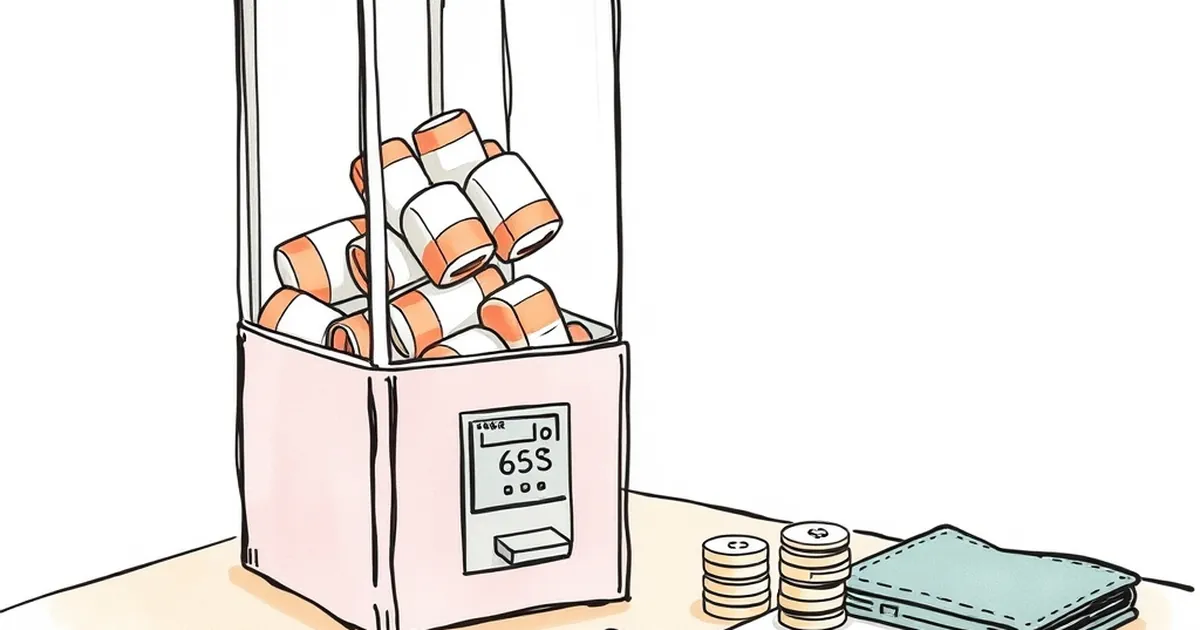
Why does a $4 coffee feel free on Friday, while a $40 annual fee feels like a personal insult? Both are small amounts of money. Both are, in the grand scheme of a household budget, rounding errors. Yet one produces a little glow of virtue and the other produces genuine irritation, sometimes enough to make someone close an account they've held for a decade. The difference isn't the amount. It's the shape of the moment the number arrives.
The pull and the reset are two different systems
Behavioral economists have spent decades documenting what B.F. Skinner found with pigeons: rewards delivered on an unpredictable schedule produce more persistent behavior than rewards delivered predictably. Variable-ratio reinforcement is the technical term, and it's the reason a notification you didn't expect lands harder than one you did. A cashback alert that shows up after an ordinary Tuesday purchase is, mechanically, a tiny unpredictable reward. Your brain files it differently than the scheduled statement credit you already knew was coming.
But there's a second system running in parallel, and it's the one that governs the $40 fee. This is where loss aversion enters — Kahneman and Tversky's central finding that losses loom roughly twice as large as equivalent gains. A fee isn't experienced as "$40 less in my account." It's experienced as "$40 taken." The framing does the damage, not the arithmetic.
So you have two forces pulling in opposite directions. Small unpredictable rewards build habit and affection. Small predictable charges build resentment out of all proportion to their size. Card issuers and payment platforms live or die on how well they manage both, and most manage one far better than the other.
Why the third pull feels different from the first
There's a detail buried in the reinforcement literature that matters enormously for product design: the anticipation of an uncertain reward is often more motivating than the reward itself. Dopamine signaling in the midbrain tracks prediction error — the gap between what you expected and what you got — not the reward's absolute value. A reward you didn't see coming generates a large prediction error. The same reward, expected, generates almost none.
This is why the third interaction with a rewards feature often feels qualitatively different from the first. The first time, you didn't know it was there. The second time, you were watching for it. By the third, your brain has built a model, and the model is either confirmed (mildly pleasant, now routine) or violated in an interesting way (a bonus category you didn't expect, a merchant offer that happens to match something you were already going to buy).
A concrete illustration: consider the difference between a card that offers "3% back on groceries" and one that offers "up to 5% back on rotating categories, announced quarterly." The first is a predictable gain — useful, easy to understand, and almost invisible emotionally after month two. The second is a variable reward with a calendar. It generates anticipation, conversation, and — crucially — a reason to check the app. Whether that's good for the customer is genuinely arguable. Whether it's good for engagement is not.
The $40 problem is a framing problem
Now the other side. Annual fees are, from a pure value standpoint, just a pricing structure. Pay $95, get $300 of lounge access and a $200 hotel credit, and the math works. But the fee arrives as a single line item, once, often on a statement you open while distracted. It's a discrete loss. The benefits, meanwhile, arrive as a diffuse stream of small gains spread across twelve months — each one individually too small to feel like it offsets anything.
This is a classic mental accounting failure, and it's well documented. People segregate gains and losses into separate mental buckets rather than netting them. Four small gains don't feel like they equal one medium loss, even when the arithmetic says they do. The result: a card that's objectively a good deal can feel like a bad one, purely because of the order and shape in which the numbers arrive.
Some issuers have figured this out. Reframing the fee as a monthly charge, or as a credit that gets "used up," changes the emotional texture entirely. A $10 monthly fee feels like a subscription. A $120 annual fee feels like a toll. Same money. Different nervous system response.
What payment products get wrong about decision-making under uncertainty
Here's where the two systems collide in a way that should worry anyone designing financial products. Variable rewards work best when the underlying value is real and the variance is small. They work badly — and eventually backfire — when the variance is large enough that the customer can't form a stable model of what they're getting.
A rotating cashback category that changes every quarter is a manageable uncertainty. A rewards program whose redemption value shifts unpredictably, or whose points-to-cash ratio quietly drifts, is a different animal. That's not a reward loop; that's a trust problem wearing a reward loop's clothes. The behavioral research on repeated games is fairly clear here: cooperation and loyalty survive when players can predict the other side's behavior well enough to plan around it. Break that, and people don't just disengage — they get angry, and anger is stickier than satisfaction.
There's also a competitive dimension worth naming. Payment networks compete partly on the generosity of their rewards and partly on the legibility of them. A program your customers can explain to a friend in one sentence has a structural advantage over one that requires a spreadsheet. Simplicity is a feature, and it's underrated precisely because it's hard to market.
Where this goes next
The interesting frontier isn't bigger rewards. It's better-timed ones. Real-time data on merchant category, location, and purchase history makes it possible to deliver a reward at the moment it's most surprising and most relevant — which is exactly the moment it generates the largest prediction error and the strongest memory. That's the "third pull" insight applied at scale.
The risk is obvious: get the timing wrong and you've built something that feels manipulative rather than delightful. The line between a pleasant surprise and a slot machine is mostly about whether the customer feels served or harvested. The products that get this right will be the ones where the variable reward is genuinely variable — tied to real behavior, not engineered to maximize checking frequency — and where the predictable costs are framed so they don't land like a slap.
For anyone building in this space, the practical question is worth sitting with: if you removed every unpredictable element from your rewards program tomorrow, would customers still feel like they were getting a good deal? If the answer is no, you don't have a rewards program. You have a habit loop with a fee attached, and the forty-dollar resentment is already forming somewhere in your customer base, waiting for a statement cycle to arrive.