Two-day settlement beats a 0.3-second tap
Instant card taps hide a two-day settlement gap that shapes cash flow for banks, merchants, and everyone caught in between
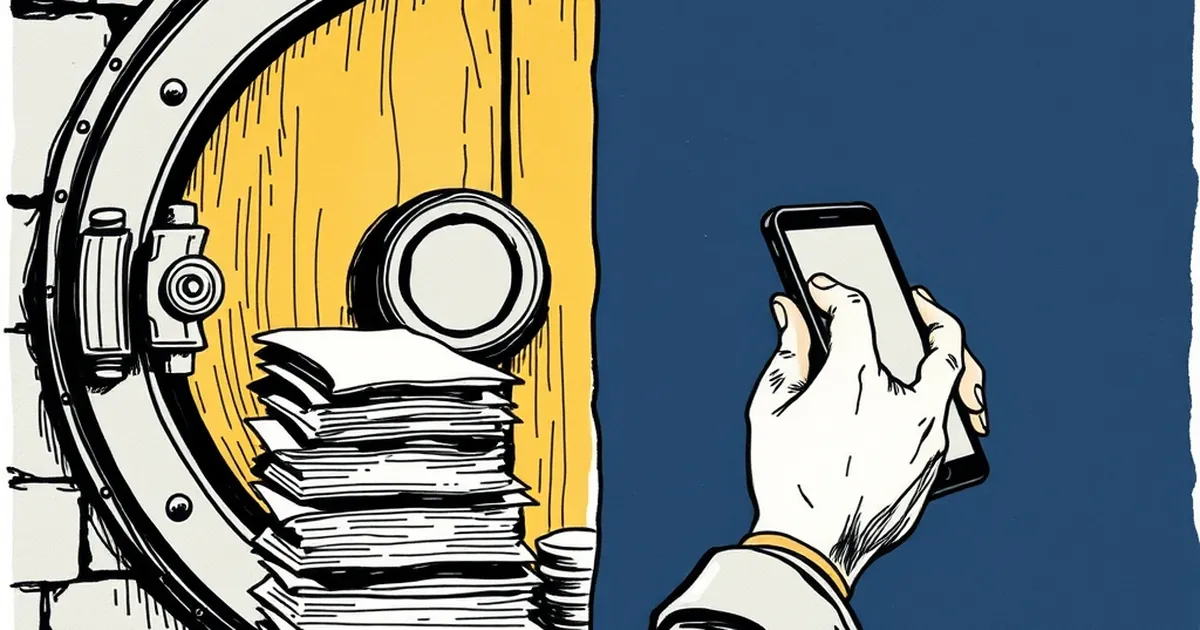
Every time you tap your card at a coffee shop, a chain of promises fires off across the financial system in under a third of a second. But the money behind that tap — the actual transfer of value between your bank and the merchant's — often takes a day or two to settle. That gap raises a question worth sitting with: if the customer-facing part of a payment has become nearly instantaneous, why does the plumbing underneath still run on a two-day clock? And what does that mismatch do to the people and businesses caught in the middle?
Speed at the edge, friction in the core
Card networks are remarkable at authorization. When you tap, the terminal sends a message through the acquirer to the network, the network checks with your issuer, and the issuer approves or declines. That round trip is measured in milliseconds. Visa and Mastercard have spent decades optimizing this layer, and it shows.
But authorization isn't settlement. Authorization is a promise. Settlement is the actual movement of funds between financial institutions. And settlement, for most card transactions, still runs through batch processing windows tied to legacy interbank systems — ACH in the US, SEPA in Europe, and various real-time rails that exist but aren't universally adopted.
This isn't a secret. The Federal Reserve has been building FedNow, its real-time payment rail, precisely because the gap between authorization speed and settlement speed has real consequences. The UK's Faster Payments system has been live since 2008. India's UPI moves money instantly at enormous scale. But the card networks, for all their consumer-facing polish, still largely settle on a T+1 or T+2 basis in many markets.
The question isn't whether faster settlement is technically possible. It clearly is. The question is why the gap persists — and what it does to behavior.
The psychology of the float
Here's where behavioral economics gets interesting. When you tap your card, your brain registers the transaction as complete. The coffee is yours. The payment is done. There's no cognitive space for the idea that the money hasn't actually moved yet.
This matters because the float — the time between authorization and settlement — is where a lot of hidden risk and hidden cost lives. For consumers, it's mostly invisible. For merchants, it's a cash-flow problem. For banks, it's a liquidity management exercise. For fraudsters, it's a window.
Consider a small business owner in Lagos or Manila or Detroit. She accepts card payments because her customers expect it. But the money doesn't hit her account for a day or two. In the meantime, she's already paid for the inventory, the staff, the rent. The authorization felt instant to her customer, but the settlement lag means she's effectively extending credit to the payment system — without being compensated for it.
This is a classic example of what Kahneman and Tversky called loss aversion operating at an institutional level. The pain of waiting for funds that are "yours" feels disproportionate to the actual delay. And because the delay is invisible at the point of sale, it's easy to ignore until cash flow gets tight.
Variable-ratio reinforcement and the illusion of instantaneity
There's another psychological layer here, and it's worth naming carefully. Variable-ratio reinforcement — the principle that behavior is strengthened when rewards arrive unpredictably — is well-documented in behavioral psychology. It's why notifications feel compelling, why email refreshes feel rewarding, why some payment experiences feel smoother than others.
Card networks understand this intuitively. The tap is designed to feel frictionless. The approval is immediate. The dopamine hit of "done" is real. But the settlement layer doesn't operate on the same schedule, and that mismatch creates a kind of cognitive dissonance.
I'm not suggesting anyone is deliberately exploiting this. But the design of the consumer-facing experience — instant, satisfying, complete — masks the reality of the back-end process. And when something goes wrong (a chargeback, a fraud hold, a settlement delay), the user is suddenly confronted with a system that feels archaic compared to the tap they just made.
This is where the bridge to decision-making under uncertainty gets interesting. Merchants and consumers both operate with incomplete information about when money actually moves. They make decisions — about spending, about inventory, about credit — based on the assumption that authorization equals settlement. When that assumption breaks down, the psychological cost is high.
What faster settlement actually changes
The move toward real-time settlement isn't just a technical upgrade. It changes behavior.
When settlement is instant, merchants can reinvest immediately. They can pay suppliers faster, reduce their reliance on short-term credit, and operate with thinner cash buffers. That's a meaningful shift for small businesses, which are disproportionately affected by settlement delays.
For consumers, instant settlement means fewer overdrafts caused by timing mismatches — the classic problem where a paycheck and a debit hit the same account on the same day but in the wrong order. The Fed has cited this as a key motivation for FedNow.
But there's a counterintuitive effect too. When settlement is instant, the float disappears. And the float, for all its problems, has been a source of implicit credit. Some businesses rely on the lag between authorization and settlement to manage their cash flow. Removing that lag doesn't just speed things up — it changes the financial planning calculus.
This is where the behavioral research on risk-taking becomes relevant. People don't just respond to incentives; they respond to the perceived speed of consequences. When feedback loops shorten, behavior changes. Instant settlement could make businesses more disciplined about cash management — or it could make them more vulnerable to timing shocks.
The competitive play
There's a competitive dimension here that's easy to overlook. Card networks have historically benefited from the settlement lag because it gives them a float — a pool of money that's in transit and can be managed for liquidity. Real-time settlement reduces that float.
But the networks aren't standing still. Visa and Mastercard have both invested in real-time payment infrastructure and faster settlement options. Visa Direct, Mastercard Send, and various push-to-card products are all attempts to close the gap. The competition isn't just between card networks and real-time rails — it's between different models of what a payment system should optimize for.
The interesting question is whether speed is actually the right metric. A two-day settlement that's predictable and cheap might be better for some use cases than a real-time settlement that's expensive and complex. The behavioral insight is that people don't just want speed — they want certainty. They want to know when the money will arrive, not just that it will arrive eventually.
Where this goes next
The practical implication for anyone building or using payment systems is that the consumer-facing experience and the back-end reality are drifting apart. That gap is a source of friction, and friction is where opportunity lives.
If you're a merchant, the forward-looking move is to understand your settlement timing and plan around it — not just assume that because the tap was instant, the money is too. If you're building payment products, the opportunity isn't just to make the tap faster. It's to make the settlement visible, predictable, and aligned with what the user actually experiences.
The next wave of payment innovation probably won't be about shaving milliseconds off the authorization. It'll be about closing the psychological gap between the tap and the transfer. That's a design problem as much as a technical one — and it's where behavioral psychology and payment infrastructure genuinely intersect.
The two-day settlement and the 0.3-second tap aren't just different speeds. They're different stories about what a payment is. And the businesses that understand both stories will be the ones that manage their money — and their customers' expectations — best.