The slot spins in 0.8s; the cooling-off period takes 24 hours
A video slot resolves in 0.8 seconds while a cooling-off request takes 24 hours, revealing the deliberate asymmetry between instant play and slow brakes
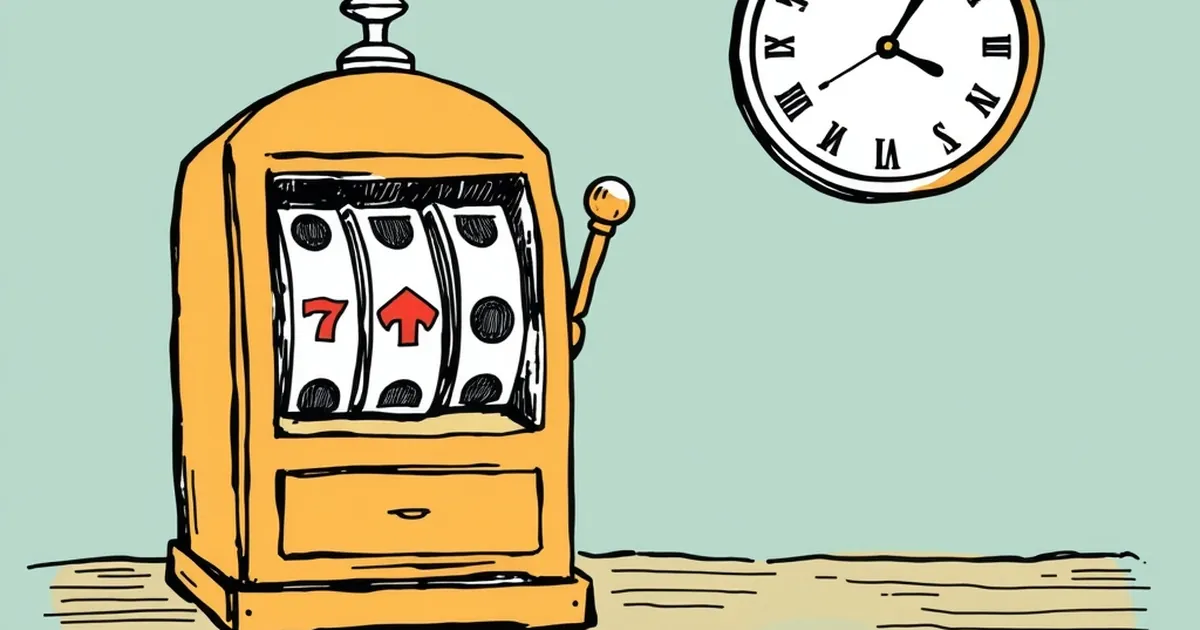
A modern video slot resolves a spin in roughly 800 milliseconds. The self-exclusion or cooling-off request that stops you from spinning again typically takes 24 hours to activate — sometimes 48, occasionally 72. That gap is not an accident of engineering. It is the single most telling asymmetry in online gambling: the product is built to be instant, and the brake is built to be slow.
Two clocks, one player
Think about what each number represents.
The 0.8-second spin is a design target. Studios benchmark it. If a slot takes 1.4 seconds to render a result on a mid-range Android phone, retention drops. Product teams know this. The animation has to feel like a lever pull, not a page load. Fast spins mean more spins per session, more chances to hit a feature, more time-on-device. At 0.8 seconds per spin with no breaks, that's 4,500 spins an hour. Nobody actually plays like that, but the ceiling tells you what the machine is optimized for.
The 24-hour cooling-off period is a different kind of number. It is a compliance artifact. Under the UK Gambling Commission's remote gambling rules, operators must offer a timeout of at least 24 hours, and the change must take effect "as soon as reasonably practicable." In practice, "reasonably practicable" has meant: at the next login, or after a manual review, or once the marketing team's automated email queue clears. The player who requests a cooling-off at 11pm on a Friday often finds the block live by Saturday evening — 18 to 24 hours later, if they're lucky.
Regulators have started naming this. In 2023, the UKGC wrote to operators about delays between a customer's self-exclusion request and the block taking effect, and several firms were required to tighten their processes. Australia's Interactive Gambling Act amendments, which took effect in stages through 2024 and 2025, pushed for near-immediate effect on certain self-exclusion tools. The direction of travel is clear: the delay is now treated as a defect, not a feature.
Why the brake is slow
There are legitimate reasons a cooling-off isn't instant, and it's worth separating them from the illegitimate ones.
The legitimate version: you want a human in the loop for irreversible, long-duration self-exclusions. If someone in a manic episode excludes themselves for five years and then regrets it, an instant, unappealable block is its own harm. Operators also have to reconcile the block across multiple systems — the casino wallet, the sportsbook, the poker client, any white-label skins, and the third-party game aggregators. That reconciliation genuinely takes time.
The illegitimate version: friction as a retention tool. A 24-hour delay means 24 more hours of marketing emails, push notifications, and "your favourite slot is paying out" texts. Some players will cool off during that window without needing the block. Others will reverse the request. The delay is not neutral — it is a soft attempt to keep the account active for one more cycle.
The tell is in the reversal flow. If a cooling-off takes 24 hours to activate but a reversal takes 30 seconds via live chat, the operator has revealed which direction it prefers.
What the 0.8-second spin does to a decision
The speed of the spin matters less than the speed of the decision it invites.
A single spin is trivial. A hundred spins in 80 seconds is not a hundred decisions — it's one decision repeated with diminishing reflection. Behavioral researchers call this "automaticity": the point at which an action stops being deliberated and starts being executed. Slot design, with its near-instant resolution, short animation, and autoplay-style features, is engineered to get you there quickly.
Now put that next to a 24-hour cooling-off. The player who wants to stop is asking the system to interrupt an automatic process. The system responds with a bureaucratic process that requires them to stay in the automatic state for another day, receiving prompts, feeling the pull, and hoping the block lands before they do something they'll regret.
There's a number that captures the mismatch better than either figure alone: the average online slot session in regulated markets runs 20 to 40 minutes. That's 1,500 to 3,000 spins. The cooling-off period is 1,440 minutes. The brake is roughly 40 to 70 times longer than the behaviour it's meant to interrupt.
The operators getting it right
A handful of operators have closed the gap, and it's worth knowing what to look for.
The best implementations activate a cooling-off immediately on confirmation — you click, you confirm, you're blocked, and the only way back is to wait out the period. Some use a "panic button" that locks the account for a fixed window with no reversal option. A few publish their activation times: "self-exclusion takes effect within 60 seconds."
If your operator doesn't publish that number, ask. The support agent's answer tells you more than any responsible gambling page.
The asymmetry is the product
Here's the part that rarely gets said plainly: the 0.8-second spin and the 24-hour brake are not two separate features that happen to coexist. They are the same feature. A product that resolves outcomes instantly and blocks access slowly is a product optimized for one thing — continued play — with a compliance layer bolted on afterward.
That's not a conspiracy. It's an incentive structure. The operator's revenue comes from spins, not from successful cooling-offs. Every hour of delay is, on average, revenue-positive. No individual employee has to decide to exploit that; the system does it by default.
Which is why the fix has to come from outside the operator. Regulators setting maximum activation times — not "as soon as reasonably practicable" but "within X minutes" — would collapse the asymmetry overnight. A few jurisdictions are moving that way. Most aren't.
The question worth asking
If a slot can resolve a spin in 0.8 seconds, why does a cooling-off take 24 hours?
The honest answer is that it doesn't have to. It takes 24 hours because the systems that make money fast are allowed to move fast, and the systems that protect players are allowed to move slowly. The technology is not the constraint. The incentive is.
So the next time you see a "Play responsibly" banner sitting above a 0.8-second spin counter, ask which clock the operator is actually watching. And if you're setting your own limits, set them before you need them — because the brake you'll want in the moment is the one that takes a day to arrive.