The goal gradient makes 80% done feel closer than 20% left
The goal gradient effect explains why being 80% done feels closer than having 20% left, and how perceived progress quietly shapes everyday decisions
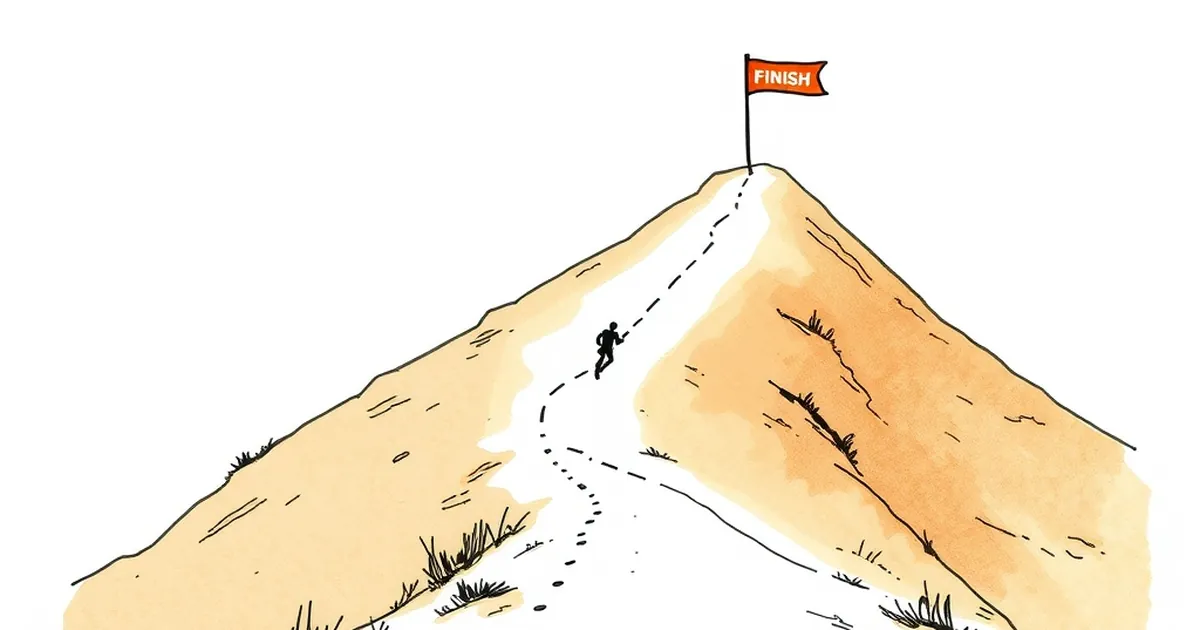
Picture two credit card offers sitting in front of you. The first needs $200 more in spending to hit a sign-up bonus; the second needs $800. Both are worth the same $150 in cash back. If you're like most people, the first one feels like a quick errand and the second feels like a project you'll get to eventually — even though the gap between them is pure arithmetic. Why does the mind treat identical rewards so differently depending on how far along we already are?
The mind counts progress, not distance
Behavioral economists have a name for this: the goal gradient effect. The closer you get to a goal, the harder you push toward it. It sounds obvious until you notice the asymmetry hiding inside it. Being 80% of the way to a bonus doesn't feel like "20% left." It feels like a nearly finished thing, and the brain assigns it a completely different motivation weight than a goal you've barely started.
The classic demonstration comes from a 1934 study by Clark Hull, who watched rats run mazes and noticed they sped up as they neared the food at the end. Hull's finding was so durable that researchers replicated it in humans across dozens of settings. In one widely cited field experiment, coffee shop customers were given loyalty cards — some with ten stamps needed, others with twelve stamps but two already filled in. Both groups needed to buy ten coffees. The group with the head start was nearly twice as likely to complete the card. The work felt smaller because it looked smaller.
That head start is doing something sneaky. It isn't changing the number of coffees you need. It's changing the story you tell yourself about how much is left.
Why a head start changes the math in your head
Kahneman and Tversky's work on loss aversion gives us part of the explanation. We don't evaluate outcomes in absolute terms; we evaluate them relative to a reference point. A prepopulated loyalty card moves the reference point. You're no longer starting from zero — you're protecting something you already have. Losing those two stamps feels like a loss, and losses sting roughly twice as much as equivalent gains feel good.
This is why banks and card issuers have quietly engineered progress into their products. A spending tracker that shows "62% of your bonus complete" is not neutral information. It reframes a spending requirement as a partially owned asset. You start to feel like the bonus is already yours and the only question is whether you'll let it slip away — which, behaviorally speaking, is a much stronger motivator than the promise of something new.
The goal gradient also explains why the last stretch of a goal feels disproportionately urgent. Near the finish line, the perceived value of completing the goal spikes. This is the same mechanism that makes a nearly full punch card feel precious and a nearly empty one feel disposable, even though the reward is identical.
Variable rewards and the pull of the next tier
There's a second layer worth noticing: variable-ratio reinforcement. B.F. Skinner's research showed that unpredictable rewards produce more persistent behavior than predictable ones. Credit card reward programs have absorbed this lesson thoroughly. Rotating bonus categories, limited-time multipliers, surprise cash-back offers — none of these are accidental. They keep the reward schedule uncertain, which keeps cardholders checking, spending, and upgrading.
But here's the part that matters more for a global audience: the goal gradient and variable rewards interact. When the reward is uncertain and you're already 80% of the way there, the combination is potent. You're not just chasing a bonus; you're chasing a bonus that might be bigger than expected. The ambiguity amplifies the pull of the near-finish.
This isn't a moral failing. It's a documented feature of how humans process uncertain payoffs, and it shows up everywhere from frequent flyer status tiers to the "you're $12 away from free shipping" banner. The mechanism is the same whether you're in Lagos, London, or Lima.
The risk side: when near-finish pressure goes wrong
The goal gradient has a shadow. Near-finish pressure can push people into decisions they wouldn't otherwise make. A cardholder who is $300 from a bonus might put a purchase on credit they can't pay off that month, trading a $150 reward for $40 in interest and a ding to their credit utilization. The math is bad, but the psychology is loud.
Loss aversion makes this worse. Once you've mentally banked the bonus, abandoning it feels like losing money you already had. That's the reference point doing its work. The rational move — walk away, skip the bonus, avoid the interest — requires you to accept a loss that your brain has already priced as real.
There's also a competitive dimension. Card issuers know that status tiers and progress bars create a kind of private competition with yourself. "Silver status" isn't valuable in any absolute sense; it's valuable because you're close to it. The goal gradient turns loyalty programs into a game where the opponent is your own sense of unfinished business.
Designing your own finish lines
The practical takeaway isn't to avoid rewards programs — it's to notice when the goal gradient is doing your thinking for you. A few habits help.
First, convert percentages back into absolute terms. "80% complete" sounds much better than "$200 left." Ask yourself which framing you'd use if you were advising a friend. The number that matters is the one you'd say out loud.
Second, separate the reward from the spending decision. If you were going to make the purchase anyway, the bonus is a genuine win. If the bonus is the reason for the purchase, run the interest math before you swipe. A $150 bonus that costs $200 in carried balance is a loss dressed as a gain.
Third, watch for reference-point creep. The moment you start feeling like a bonus is "yours," you've been moved. That feeling is useful information — it tells you the goal gradient is active and you should slow down.
What to watch next
The next frontier is personalization. Card issuers are getting better at timing progress nudges to moments when you're most responsive — right after a purchase, right before a statement closes. The goal gradient is about to get a lot more precise. That makes your own awareness the more valuable skill. The finish line will always feel closer than it is; the trick is knowing which finish lines are worth crossing and which ones were drawn to move you.