The 0.3-Second Pause That Makes You Rethink a Purchase
Discover the science behind the 0.3-second pause that can change your spending habits and help you make wiser purchases
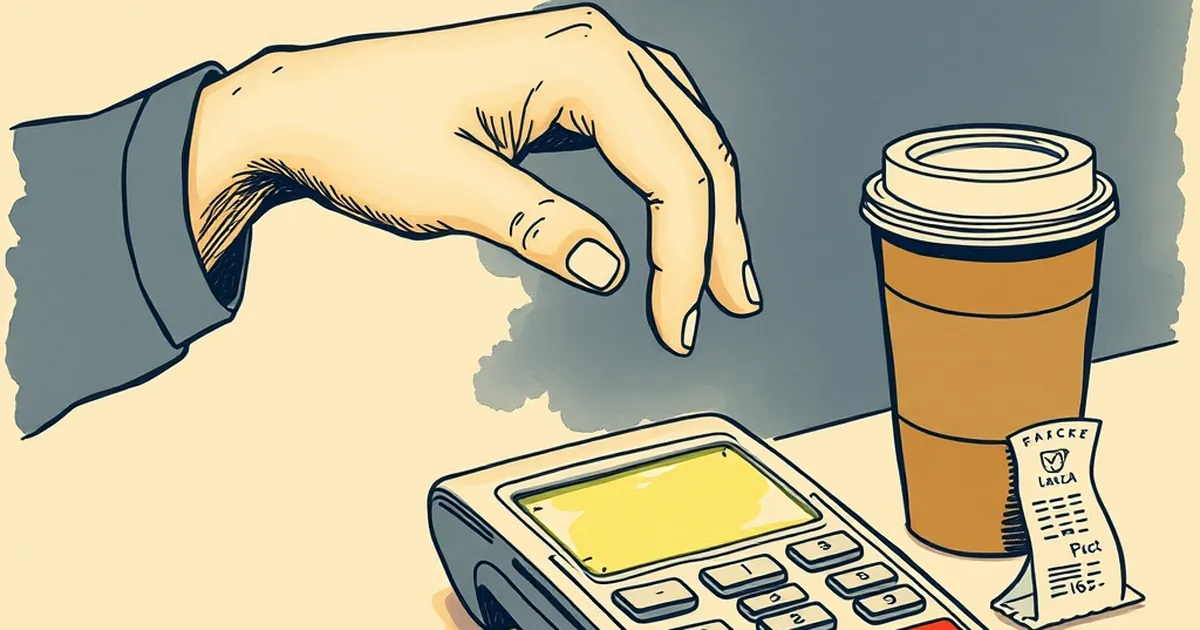
There is a specific moment, a fraction of a second, that happens right before you tap your card or click "Pay Now," where the entire architecture of your financial life hangs in the balance. It isn't the moment of decision itself—that's already been made—but the tiny window of hesitation where your brain registers the weight of the transaction. For years, I’ve written about the rails that move money, but I’ve become obsessed with what happens on the rail, in that 0.3-second pause. Why do some purchases sail through without a thought, while others trigger a physiological flinch? And more importantly, can we train ourselves to use that pause as a tool rather than a speed bump?
The answer lies not in your bank account, but in the intersection of payment mechanics and behavioral economics. We are, all of us, walking around with a payment system that has been engineered for frictionlessness, while our brains are still running on a system designed for scarcity. Understanding that mismatch is the first step toward financial agency.
The Physics of Frictionless Spending
Let’s talk about the elephant in the room: the contactless tap. It was designed to be fast, and it is. But the speed isn't just a convenience; it's a behavioral intervention. When you insert a chip and wait for the prompt, you have roughly 5-7 seconds of "dead time." That’s an eternity for your prefrontal cortex to kick in and ask, "Wait, was that $80 or $800?"
The 0.3-second tap removes that cognitive window almost entirely. Visa and Mastercard have spent billions optimizing for throughput—reducing the time it takes for the authorization to travel from the terminal to the bank and back. But from a psychological standpoint, they are effectively compressing the space where loss aversion is supposed to live.
Daniel Kahneman’s work on System 1 (fast, automatic) and System 2 (slow, deliberate) thinking is crucial here. The tap is pure System 1. It’s reflexive. It feels like no money is leaving your account because the physical act of handing over cash—which activates the pain centers of the brain—is absent. The 0.3-second pause is the only remaining vestige of a system that used to force you to look at the numbers. It’s not a bug; it’s the last guardrail you have left.
The Variable-Ratio Trap in Your Wallet
Here is where the bridge gets genuinely interesting. The credit card rewards ecosystem—the points, the miles, the cash-back percentages—operates on a psychological principle that was first mapped in pigeons and rats: variable-ratio reinforcement.
B.F. Skinner discovered that if you reward a behavior on an unpredictable schedule, the behavior becomes almost impossible to extinguish. You never know if the next tap will yield 1% or 5% back. You never know if the "bonus category" this quarter is groceries or gas. That uncertainty is more compelling than a guaranteed reward.
Now, apply this to the 0.3-second pause. The pause isn't just about the cost; it's about the potential reward. When you hesitate, your brain is doing a rapid cost-benefit analysis that is heavily skewed by the possibility of a reward, not the certainty of the expense. This is why you’ll happily buy a $4 latte that earns 40 points, but you’ll agonize over a $40 purchase on a non-bonus category. The reward circuitry is hijacking the loss aversion circuitry.
The practical takeaway here isn't to ditch your points card—that’s financially irrational if you pay your balance in full. The takeaway is to recognize that when you feel that 0.3-second hesitation, you are not evaluating the price. You are evaluating the odds. And the odds are always rigged in favor of the transaction, because the potential upside (points) feels more tangible than the downside (a smaller bank balance).
The "Pain of Paying" and the Invisibility of Digital Money
We often talk about "forgetting" a subscription charge or "not noticing" a small transaction. But the reality is more nuanced. The 0.3-second pause is the last gasp of what researchers call the "pain of paying." This is the negative emotional arousal we experience when we part with our resources.
Cash is the most painful. Debit cards are moderately painful. Credit cards are less painful. And digital wallets (Apple Pay, Google Pay) are the least painful of all. Why? Because the medium of exchange has become abstracted to the point of invisibility.
Here’s a study that always stops me in my tracks: Researchers at MIT and Carnegie Mellon looked at the "coupon effect" and how we value goods. But more relevantly, a study from Duke University found that when people pay with a credit card, they are willing to pay significantly more for the same item than if they were paying with cash. The willingness-to-pay premium isn't because they're stupid; it's because the friction of the payment method dictates the perceived value.
The 0.3-second pause is your brain’s last-ditch effort to re-introduce friction. It’s saying, "Hey, this feels a little too easy. Are you sure?" If you ignore it, you’re signaling to your brain that the transaction is as trivial as a tap. If you honor it—even for just a fraction of a second—you re-introduce the concept of "loss" into the equation.
Reclaiming the Pause as a Strategic Asset
So, how do we turn this neurological glitch into a forward-looking strategy? It’s not about going back to cash—that’s a Luddite fantasy. It’s about hacking the timing.
Think of the 0.3-second pause as a "decision interrupt." In high-stakes trading, there is a concept called the "post-trade analysis." You don't just execute; you review. We need to do the same for micro-transactions, but we need to do it during the pause, not after.
Here is a practical, three-step framework I use when I feel that hesitation:
Name the Trigger: Don't just feel the pause. Verbally (or internally) label it. Say, "This is a $60 transaction at a hardware store." Naming the specific number re-activates your System 2 thinking. It pulls the transaction out of the abstract ether and places it in the concrete realm of your checking account.
Ask the "Reverse Points" Question: Instead of asking "How many points do I get?", ask "How many hours of my life did I spend earning this money?" This is a crude heuristic, but it works. If you make $30/hour net, a $30 purchase is one hour of your life. When you frame it that way, the variable-ratio reward loop loses its power. You aren't gambling for points; you're spending time.
Deploy the "24-Hour Rule" Only for Digital: The pause is most dangerous when you're buying physical goods online. The 0.3-second pause is too short. For anything over a certain threshold (say, $50), force a physical separation. Close the app. Wait 24 hours. If you still want it, the pain of paying has been recalibrated. You're no longer buying on impulse; you're buying on intention.
The Future of the Flinch
As we move toward biometric payments—fingerprint scans, facial recognition, maybe even heart-rate detection—the 0.3-second pause will shrink even further. The payment rails are heading toward a state of "ambient commerce" where you simply walk out of the store and the money is gone. There will be no pause at all.
This is why it is so critical to understand the psychology now. The infrastructure is designed to eliminate friction, but your financial health depends on selective friction. The goal isn't to slow down every transaction; that would be exhausting. The goal is to become hyper-aware of the specific transactions that trigger that flinch.
That flinch is your brain telling you that you've hit a mismatch between your values and your spending. It’s not a signal to stop; it’s a signal to look. The 0.3-second pause is the only honest feedback loop you have left in a system built to keep you oblivious. Don't let the banks engineer it away. Savor it, use it, and make it count. The future of your financial agency depends on your ability to hold that pause, just long enough to ask the one question that matters: "Is this worth the weight?"