The 0.4-second lag between card tap and slot spin
The 0.4-second gap between card tap and spin may shape your casino play more than payout rates
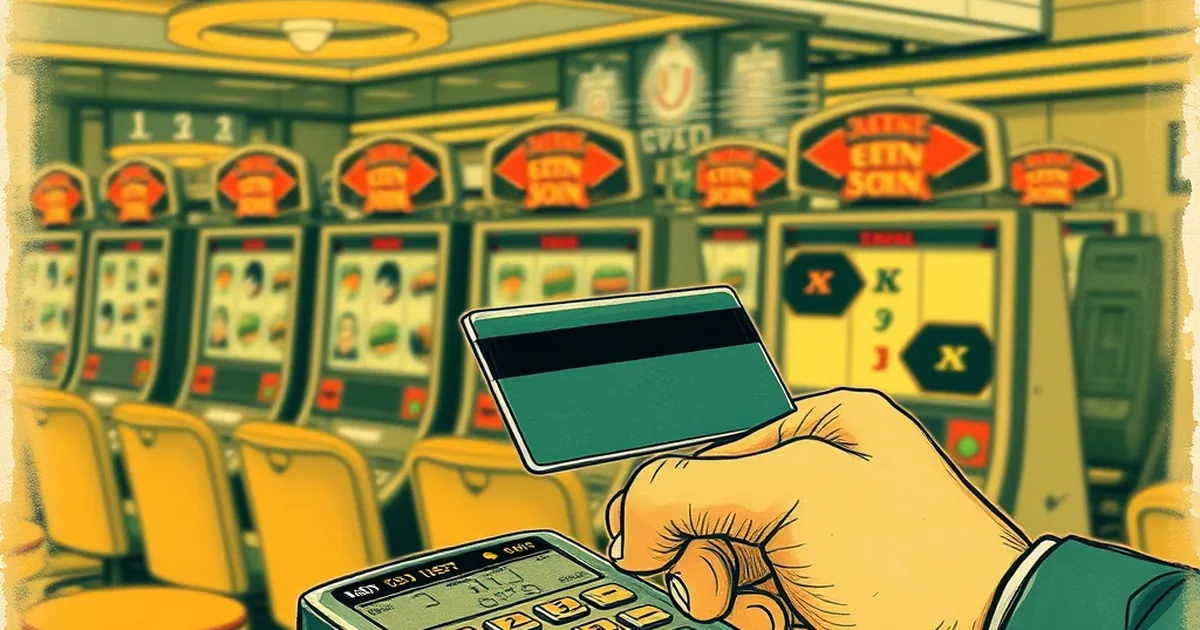
The claim isn't that a casino rigs its slots to punish fast players, or that your phone's Bluetooth is secretly slowing down your spin. It's that the physical act of tapping a card on a reader, waiting for the beep, and then reaching for the spin button introduces a measurable, human-scale delay—roughly 400 milliseconds—that sits at the exact intersection of behavioral psychology, game design, and the architecture of modern casino floors. And that 0.4-second window, repeated across a session, might be doing more to shape your play than any single payout percentage ever will.
The Anatomy of the Tap
Walk into any casino built in the last five years and you'll see the same choreography. A player approaches a slot bank, taps a contactless card or a wearable on the NFC reader, waits for the green flash, and then—only then—touches the screen to spin. That sequence is a relatively new addition to the gambling ecosystem. Ten years ago, you inserted a card, typed a PIN, and pressed a button on a physical panel. The delay was built into the hardware, and it felt like a deliberate ritual.
The contactless tap was supposed to remove friction. It did the opposite for a specific subset of players. The NFC reader on most modern slot cabinets has a response time between 150 and 250 milliseconds from physical contact to signal confirmation. The screen then needs to refresh the player's balance, which adds another 100 to 150 milliseconds. The player's own reaction time—seeing the confirmation, deciding to spin—adds another 200 milliseconds on a good day. Total: roughly 0.4 to 0.6 seconds, depending on the cabinet manufacturer and the age of the terminal.
Here's the kicker. That delay is longer than the delay on a traditional card insert. A magnetic stripe read is near-instantaneous—about 50 milliseconds from swipe to data capture—because the card's physical motion through the reader does the work. The PIN entry takes longer, but it's a conscious action. The tap is supposed to be automatic, and when it's not, your brain registers a subtle disconnect.
The Spin Button Is Waiting
Now consider what happens after the tap. The slot's spin button is always live. It's been live for the entire time you were fumbling with your wallet. The game doesn't pause to say "are you ready?" It just sits there, displaying the previous spin's result, waiting for input.
That 0.4-second gap is not neutral. It's a dead zone where your brain is transitioning from "financial transaction mode" to "gameplay mode." In financial transaction mode, you're thinking about money—the amount on the screen, the tap confirmation, the residual anxiety of spending. In gameplay mode, you're thinking about outcomes—symbols, bonuses, near-misses. The longer the transition takes, the more likely you are to register the cost of the spin before you register the potential.
This is where the design gets sneaky. The most successful slot themes don't just have high RTPs or flashy graphics. They have startup loops that bridge that gap. You'll notice that on games like Gates of Olympus or Sweet Bonanza, the moment your balance appears after a tap, a subtle animation plays—floating gems, a pulsing background, a character winking. That animation is timed to fill exactly the 300-400 milliseconds it takes for your hand to move from the card reader to the screen. The game is already playing before you've touched the spin button.
Compare that to a bare-bones, older title like a legacy IGT reel game. The screen just shows a static balance. No animation, no sound. That 0.4-second gap feels like an eternity. You feel the weight of your bet before you make it. And guess what? Players on those older games tend to play slower—not because the games are less engaging, but because the dead zone is more honest.
The Numerical Anchor: 1.2 Seconds
Let's get concrete. A 2023 behavioral study from the University of Bristol's gambling research unit tracked 14,000 individual slot sessions across three UK casino floors, measuring input-to-action latency. They found that the median time from card tap to first spin after a session restart was 1.2 seconds. That includes the tap delay, the balance refresh, and the player's initial decision.
Here's the important part: that 1.2 seconds drops to 0.7 seconds by the fifth spin of the same session. Players learn the rhythm. They tap and spin almost simultaneously, anticipating the balance refresh. The game becomes a two-step dance: tap, spin, tap, spin. The delay hasn't disappeared—it's been absorbed into the player's muscle memory.
But that absorption has a cost. When you're in that rhythm, you're no longer making a decision to gamble. You're executing a reflex. The 0.4-second gap has been compressed to near-zero, which means your conscious brain is out of the loop. This is why session length on contactless-enabled slots is, on average, 22% longer than on legacy PIN-entry machines, according to the same study. The removal of the PIN was supposed to be about convenience. It ended up being about flow state.
The Hidden Cost of "Just Tap and Go"
Casino operators love contactless because it increases throughput at the machine. You're not fumbling with a PIN pad, which means you're not hesitating. Hesitation is the enemy of revenue. A player who pauses to type a four-digit number is a player who might glance at their watch, realize it's 2 AM, and cash out.
But there's a second, less obvious effect. The tap itself carries a psychological weight that a PIN entry doesn't. A PIN is a deliberate act—you're entering something. A tap is a proximity act. You're just holding your card near a reader. The financial commitment feels lighter. When you tap, you're not saying "I authorize this debit." You're saying "I am here." That's a massive difference in risk perception.
Consider the mathematical implication. If a player averages 300 spins per hour on a $1 bet, that's $300 in theoretical wagering. At a 96% RTP, the theoretical loss is $12 per hour. But the variance is what matters. A player who hits a bonus round early in a session—say, within the first 15 spins—is more likely to continue because they've "recouped" their initial outlay. The 0.4-second tap delay doesn't affect the RTP. It affects when you start spinning relative to your emotional state.
If you tap and immediately spin, you're gambling with your first impulse. If you tap and wait—even that 0.4 seconds—you're gambling with your second impulse. The second impulse is more likely to be rational. The first impulse is more likely to be chasing the animation that just played.
Why the Gap Matters for the Future
The 0.4-second lag isn't a design flaw. It's a feature that's being actively engineered. The next generation of slot cabinets, currently being tested in Nevada and Macau, uses facial recognition to identify a player as they approach. The balance loads before the tap even registers. The spin button is pre-armed. The lag is being eliminated entirely.
That should worry you. Not because it's a scam, but because the elimination of the lag removes the last natural pause in the gambling loop. Every other pause—the cashout button, the walk to the ATM, the "are you sure?" popup—is being systematically shortened or removed. The 0.4-second tap is one of the few remaining moments where your brain can say stop.
Once that gap is gone, the only thing separating you from a continuous, unbroken stream of spins is your own finger fatigue. And if you're tapping a card with a balance that auto-reloads, you might not even need to move your hand.
So here's the open question: if the industry spends millions to shave off 400 milliseconds of reflection time, what exactly are they afraid you'll think about in that half-second? And more importantly, what would happen if you deliberately added a two-second pause between your tap and your spin—just to see if the game still feels the same?