Tax forms post in 3 weeks; the win feed in 4 seconds
The three-week gap between a jackpot tweet and its tax form reveals how iGaming marketing shapes what players believe about their winnings
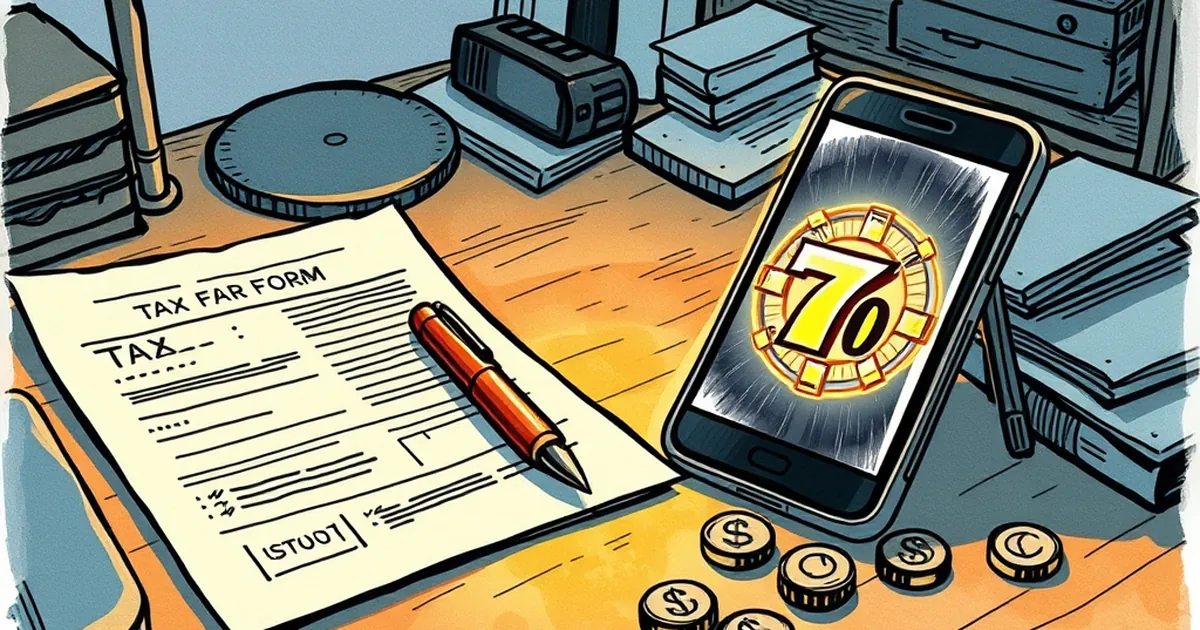
The 1099-MISC for your $4,200 jackpot arrives in late January, printed on paper, mailed by a processor in Ohio. The tweet announcing that same jackpot — screenshot, casino logo, "WE PAID OUT AGAIN" — went live four seconds after your spin resolved. One of these is a legal document with your Social Security number on it. The other is marketing. Only one of them is designed to make you feel like the money is already yours.
That gap, somewhere between three weeks and four seconds, is where most of the confusion around modern iGaming actually lives. Not in the math of the games, which is published and auditable, but in the paperwork and the performance that surrounds the money after it leaves the reels.
The 4-second win feed is not a public record
Casino Twitter accounts and Telegram channels post wins constantly. A $12,000 slot hit on a streamer's account, a $340,000 progressive on a random Tuesday, a screenshot of a $9.87 balance turning into $2,100 on a single hand of blackjack. The posts are real in the sense that the money was real. They are not real in the sense that they represent anything about your expected outcome.
The math here is boring and worth stating anyway. If a slot has a 96.2% RTP and you spin it 500 times at $1, your expected loss is $19. The variance around that number is enormous — you might be up $800 or down $400 — but the feed never shows you the 40,000 losing sessions that funded the 12 winners it posted that week. This is not a conspiracy. It's selection bias with a social media manager attached.
The reason it matters is that the feed compresses time. A jackpot that took someone 11 years of play to hit looks, in a four-second clip, like it took one spin. Your brain files it under "this happens." It doesn't, at least not to you, at least not on a schedule you can plan around.
The tax forms arrive on a schedule you can't compress
Here's where the two timelines really diverge. In the United States, a casino operator (or the slot machine itself, for certain hand-pay thresholds) has to issue a W-2G for slot winnings of $1,200 or more, or 300 times the bet for certain other games, and withhold 24% if the win is over $5,000 and the payer has your taxpayer ID. That form is due to you by January 31. If you're playing on a cruise ship in international waters, the rules shift. If you're playing on an offshore site that accepts US players, the operator may not issue anything at all — and that's not the same as tax-free, it's just unreported.
Outside the US, the picture is patchier. The UK doesn't tax gambling winnings at all, which is why a British streamer can post a £40,000 win and mean it literally. Germany taxes certain gambling income under specific conditions. Australia doesn't tax winnings but does tax professional gamblers. Canada is generally tax-free for casual players. A global audience reading the same win feed is looking at wildly different post-win realities, and the feed never mentions which one applies.
That's the second compression: the feed shows the win, not the 1099-MISC, not the 24% withholding, not the currency conversion, not the three-week wait for a form that will eventually require you to reconcile a number you may have already spent.
Why the timing mismatch is the actual product
Casino marketing departments understand something that tax authorities don't have to: attention decays fast. A win that gets posted four seconds after it happens captures the dopamine of everyone watching. A tax form that arrives 21 days later captures nothing, because by then you've moved on.
There's a rough industry figure worth holding onto: player acquisition costs in regulated markets frequently run $200–$400 per depositing customer, and retention spend is a fraction of that. The win feed is cheap retention. It costs nothing to post a screenshot and it does more work than a $50 bonus with a 35x wagering requirement, because it doesn't ask the viewer to do anything except feel something.
The tax form, by contrast, is the only part of the transaction that asks you to do math. It asks you to add up wins, subtract losses (if you're itemizing in the US, and only up to the extent of your winnings), and confront the net number. That's an unpleasant ask, and no operator is going to volunteer it in a tweet.
What this means if you're playing across borders
If you're in a jurisdiction that taxes winnings, the practical move is unglamorous: keep your own log. Date, operator, amount, currency, game. Not because the operator won't send you a form — they will, if they're regulated and the threshold is met — but because operators don't always send forms for amounts below the threshold, and "below the threshold" is not the same as "not taxable" in every jurisdiction. In the US, $1,199 in slot winnings is still reportable income even though no W-2G is generated. The form is a reporting requirement for the payer, not a definition of what you owe.
If you're in a jurisdiction that doesn't tax winnings, the log is still useful, because the moment you cross a border — literally or in terms of where your account is registered — the rules can change. A Canadian player with a US-facing account is playing in a different tax regime than a Canadian player on a Canadian-licensed site, even if the games are identical and the RTP is the same 96.2%.
The open question
The win feed and the tax form are two halves of the same transaction, and the industry has gotten very good at promoting one while treating the other as an administrative afterthought. That's not going to change, because the feed sells and the form doesn't.
What might change is player behavior, if enough people start asking a simple question before they deposit: not "what's the RTP" or "what's the bonus," but "what does this look like on February 1st?" The operators who answer that question honestly — with a page that says, plainly, "here's what we report, here's what we don't, here's what you'll owe" — will lose some signups to the ones who don't. Whether that trade is worth it is a business decision. Whether players should care is not.