Slots pause 6s on a win; the loss limit never does
Slot machines stretch a win into a 6-second show while loss limit increases clear in 400 milliseconds, and that design gap shapes how players spend
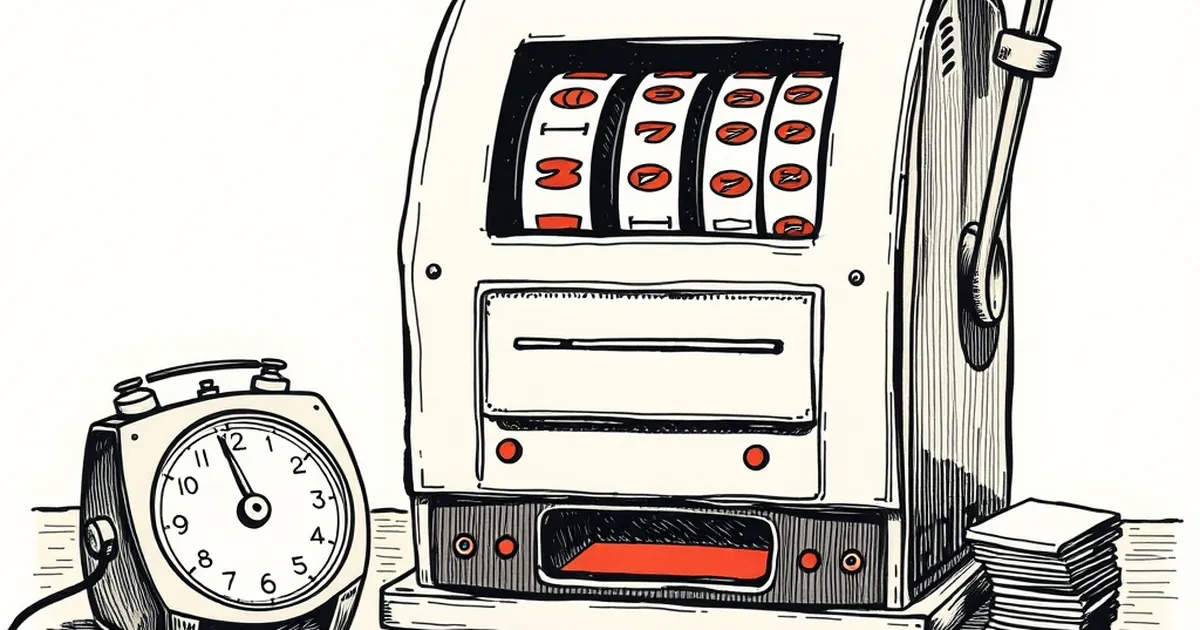
A modern video slot celebrates a €2 win with a 6-second animation, a coin shower, and a rising synth arpeggio. It processes your request to raise the loss limit in about 400 milliseconds, and it does not celebrate that at all. The asymmetry is the product. One of those events is designed to feel like it takes time; the other is designed to feel like it didn't happen.
That gap matters more than any RTP figure on the paytable.
The celebration is a feature, not a bug
Six seconds is not an arbitrary number. Slot studios A/B test win presentation the way streaming services test thumbnails. A "big win" tier in a 2024-era release typically triggers at 15x–20x stake, and the animation scales with the multiplier: a 20x hit might run 6–8 seconds, a 100x hit 12–15 seconds, and anything above 500x can lock the screen for the better part of half a minute. Nobody is hiding this. Producers talk about it openly as "juice" — the audiovisual feedback that makes a small return feel like an event.
The problem is what the juice is attached to. On a slot with 96.2% RTP, the house keeps €3.80 of every €100 staked over a long enough run. A 6-second celebration on a €2 win, multiplied across a session, adds up to minutes of positive reinforcement for money you already had. The animation isn't lying — you did win that spin — but it's editorializing. It's choosing which moments of a statistically flat session deserve a soundtrack.
Compare that to the mechanics that actually change your session length. Loss limits, deposit limits, and reality checks are usually buried two taps deep in an account menu, phrased in the language of compliance ("Set your limits"), and confirmed with a grey toast notification. Some operators have started adding cooldowns — a 24-hour wait to increase a deposit limit, but an instant effect when you lower it. That's the right instinct. It's also the only place in the entire product where the friction runs in your favor.
What the friction tells you
Think about where a platform puts its delays. It's a reliable map of what it wants you to do.
- Deposits: instant, saved card, one tap, sometimes pre-filled.
- Withdrawals: "pending" for 24–72 hours at many brands, faster only after KYC and sometimes only via specific rails.
- Win animations: 6 seconds, unskippable by default.
- Loss limit increases: 24-hour cooling-off period at the better-regulated operators.
- Loss limit decreases: immediate.
If you read that list as a UX designer, it's incoherent. If you read it as a business, it's a funnel. The 6-second win animation exists to extend session time. The 72-hour withdrawal window exists to extend the float. Neither is illegal, and both are disclosed somewhere in the terms. But they shape behaviour in ways that the RTP number — the stat everyone quotes — never touches.
This is why "96.5% RTP" is a nearly useless way to compare two slots for a real player. RTP is measured over millions of spins, assumes flat staking, and says nothing about hit frequency, volatility clustering, or how the game feels during a 200-spin cold streak. A 96.5% slot with a 1-in-4 hit rate and short animations will drain a €50 bankroll very differently from a 96.5% slot with a 1-in-6 hit rate and theatrical wins. Same number. Different night.
The volatility multiplier nobody mentions
Volatility does more to your session than RTP does. A high-volatility slot can run 300+ spins without a meaningful hit and then return 200x in one go. That's the design. The 6-second animation on the recovery spin is what convinces you the drought was worth it — and, critically, what convinces you to keep the session open for the next drought. The animation is the bridge between a statistically normal losing run and your decision to fund another one.
The loss limit has no animation because it doesn't need one
Here's the thing about a loss limit: it works whether or not you feel good about it. Set a €100 weekly loss limit and the platform will stop accepting your bets once you're down €100, regardless of whether you're chasing, bored, or convinced the bonus round is "due." No soundtrack required. No 6-second pause to let the decision sink in.
The reason the limit feels like nothing — a dropdown, a number, a save button — is that it's the only setting on the entire platform designed to reduce your engagement. Every other control is tuned to increase it. There is no commercial incentive to make a loss limit delightful, and pretending otherwise would be naive. What there is is a regulatory incentive in a growing number of markets: the UK, several EU jurisdictions, and parts of Australia and Canada now require operators to offer deposit limits, and some require periodic reality checks or loss-limit prompts at defined intervals. That's the mechanism doing the work. Not the game design.
So the practical move is to treat the loss limit as the one piece of the product you configure before you're having fun. Set it on a good day, at a number that wouldn't ruin a bad week, and don't touch it. If your operator makes you wait 24 hours to raise it, that's a feature — that 24-hour window is the only 6-second pause the industry will ever give you for free, and it's 14,400 times longer.
A quick test
Next session, watch the clock. Note how long the win animations run in total versus how long it takes you to find, set, and confirm a loss limit on your operator's site. Most people will find a ratio somewhere between 20:1 and 50:1 in favour of the animation. That ratio is the actual product design. The RTP is just the price tag.
Where this leaves the spin button
None of this makes slots unfair. The math is the math, it's regulated, and a 96% RTP game returns 96% over a long enough horizon whether the wins come with fireworks or a silent number change. What it makes is asymmetric — a product where the emotional feedback is engineered and the risk controls are merely permitted. You can play around that, and most experienced players do: fixed stake, pre-set loss limit, no chasing, and a healthy suspicion of anything on screen that's trying to hold your attention for six seconds.
The open question is whether regulators will ever mandate the same design energy on the boring side of the ledger. A 6-second pause before a loss limit increase. A confirmation screen that shows your last 30 days of net position before you top up. A win animation that, once per session, displays what you've actually staked versus what you've actually withdrawn. None of that is technically hard. All of it is commercially unappealing. Which is exactly why the loss limit will keep sitting quietly in a settings menu while the reels keep throwing confetti at a €2 win — and why the only person reliably adding friction to your session is you.