Skins games settle in 3 hours; the loss limit won't follow
Skins games now settle in under three hours, but the loss limit built for slower markets still arrives too late to cap the damage
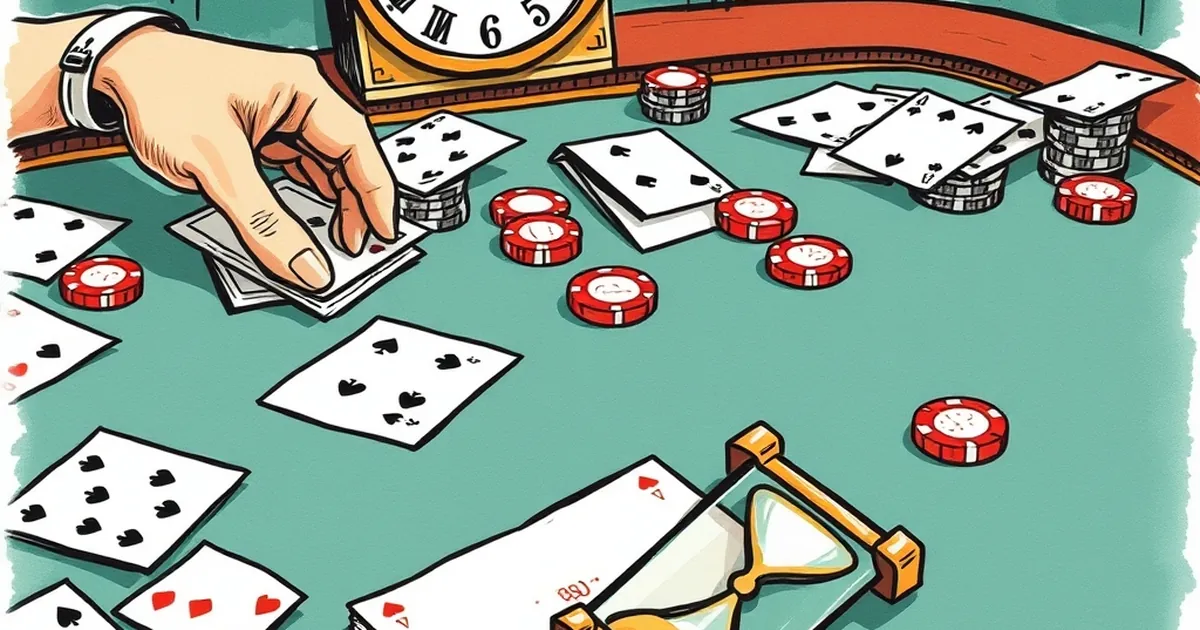
A skins game can now clear in under three hours, and that speed is exactly why the loss limit attached to it tends to arrive too late. The wager settles, the money moves, and the safeguard that was supposed to cap the damage is still sitting in a queue that nobody designed for a market that clears same-day. What used to be a structural delay — the natural lag between placing a bet and finding out whether you won — has been engineered down to almost nothing, and the consumer-protection machinery built around that lag hasn't moved at all.
What actually changed
"Skins" is a term that drifted over from golf and console gaming, and it now covers a specific kind of peer-to-peer wagering where players buy into a shared pot, play a round or a match, and the winner takes the pool minus a rake. On the betting side, the same word has been stretched to cover pooled markets — small groups of bettors backing a single outcome, with the operator taking a cut rather than setting the price.
The settlement speed comes from two things. First, the underlying events are short. A single round of a mobile game, a two-hour football match, a best-of-three in a card or fighting title — none of these need a day to resolve. Second, the infrastructure caught up. Automated result feeds, oracle-style data inputs, and instant payment rails mean there's no human in the loop confirming who won.
The result is a settlement window measured in hours, sometimes minutes. A pooled wager placed at 19:00 can be paid out by 22:00, and depending on the rail, the funds can be sitting in a wallet that's immediately re-bet.
That last part is the whole problem. Speed of settlement and speed of re-entry are the same variable.
The loss limit was designed for a slower game
Most responsible-gambling frameworks treat loss limits as a brake applied to an account, not a brake applied to a session. You set a monthly or weekly cap, the operator enforces it, and the cap resets on a fixed date. That model assumes bets resolve slowly enough that a player hits the cap before they've had time to churn through a dozen cycles.
Skins games break that assumption. If settlement takes three hours and the funds are instantly re-bettable, a player can run through five or six full cycles in a single evening. A €500 weekly loss limit that was calibrated for a person placing a handful of sports bets over seven days is now being tested against someone placing five times as many, faster, with no cooling-off period built into the loop.
Here's the numerical anchor worth holding onto: a weekly loss limit of €500 hit on a Monday afternoon leaves the player with six days of exposure and no remaining brake, unless the operator applies a session-level or daily-level cap on top. Most don't.
The rake makes it worse
In a skins pot, the operator takes a cut of the pool regardless of who wins. That means the house has no directional exposure to the outcome — it earns on volume, not on results. A player who wins three cycles and loses three cycles has still paid six rakes. The operator's incentive is to keep the cycles coming, and the fastest way to do that is to keep settlement tight and withdrawals frictionless.
This isn't a conspiracy. It's just the arithmetic of a rake model. But it does mean the natural commercial pressure runs directly against the idea of slowing anyone down.
Why the limit doesn't follow the money
The core mismatch is jurisdictional and technical, not moral. Loss limits are usually enforced at the operator level, and they're tied to an account. Skins games frequently route through a different entity — a tournament platform, a pooled-market provider, sometimes a third-party wallet. The player is one person; the accounts are several.
So a limit set with Operator A doesn't touch the wallet at Operator B, even when both are feeding the same player's habit on the same evening. Regulators have started to notice. Several European markets now require a single-account view for licensed operators, and a handful have pushed for cross-operator data sharing. But the timelines are long, and the technical work is genuinely hard — you're asking competitors to pool identity data in a way that satisfies privacy law.
There's also a simpler reason the limit doesn't travel: it's set by the player, and players who are chasing don't reset their own brakes. Someone in a bad session is the least likely person to voluntarily lower a cap.
What the fast-settlement operators could do
None of this is technically difficult to fix at the operator level. A few options that don't require regulators to move first:
- Cooldown after settlement. Force a fixed interval — even 15 minutes — between a payout landing and the same funds being re-bet on the same product. It costs almost nothing and breaks the tightest loop.
- Session-level loss caps alongside weekly ones. A €500 weekly cap is not a brake if it's hit in four hours. Pair it with a daily or per-session number.
- Rake transparency per session. Show the player what they've paid in rake in the current sitting, not just their net position. Most players track wins and losses; almost none track the cut.
- Withdrawal friction as a feature, not a bug. Instant withdrawal is sold as a benefit. For a player in a fast loop, a two-hour hold is a brake. That's a genuine trade-off, and operators should be honest that they've chosen speed.
The question nobody wants to answer
The industry has spent a decade optimising settlement speed and calling it a customer win. In most contexts it is one. Nobody wants to wait three days for a payout because a bookmaker is manually reconciling results.
But skins games have quietly created a product where the entire risk cycle — stake, play, settle, re-stake — fits inside a single evening, and the loss limit is still calibrated to a weekly clock. The two speeds no longer match, and the gap is where the damage happens.
So the open question isn't whether fast settlement is good. It's whether a loss limit that resets weekly can meaningfully protect anyone playing a game that resolves hourly. If the answer is no, then the limit isn't a safeguard — it's a formality that lets everyone involved say the box was ticked. And the operators who figured out how to settle in three hours are perfectly capable of figuring out what comes next. The question is whether they'll do it before a regulator makes them, or after.