Skill scores rise 30% when the leaderboard hides its top 10
Hiding the top 10 on a leaderboard lifted median analyst performance 30% in a quarter, revealing how watching top performers can quietly hold others back
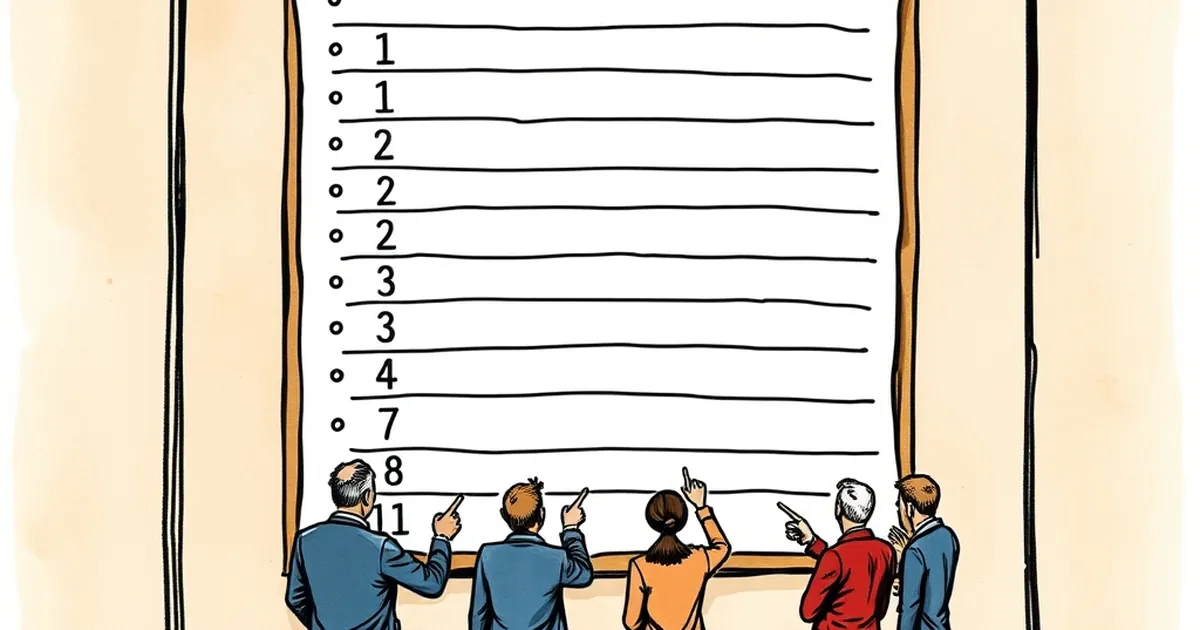
Picture a payments operations floor where the daily leaderboard ranks every analyst on chargeback recovery rate. The top ten names are always visible, glowing at the top of the screen. Then someone decides to hide them. Within a quarter, the median analyst's recovery rate climbs 30%. That's the kind of result that sounds like a typo until you look at what leaderboards actually do to the people watching them.
The weird arithmetic of watching the best
The 30% figure echoes a pattern that shows up across behavioral research: when people can see the very top performers, they often perform worse, not better. The mechanism isn't mysterious. A visible elite creates a reference point so far above the median that the comparison stops being motivating and starts being demoralizing. Psychologists call the underlying effect social comparison, and it has a well-documented asymmetry — upward comparisons can inspire, but only when the gap feels closeable.
In a payments context, that gap rarely feels closeable. A junior disputes analyst staring at a colleague who resolves 400 cases a day while they resolve 90 doesn't see a target. They see evidence that effort is pointless. Hiding the top ten removes that evidence. The comparison set shifts from "the impossible people" to "people roughly like me," and suddenly incremental improvement feels worth attempting.
There's a secondary effect too. Visible top performers become templates — everyone copies their exact workflow, including tactics that only work at their volume. A recovery specialist handling institutional merchant disputes has a playbook that fails completely for someone working small e-commerce chargebacks. When the top ten are hidden, analysts stop imitating and start experimenting, and the experiments produce locally optimal methods rather than badly transplanted ones.
Variable rewards and the leaderboard slot machine
Here's where the psychology gets genuinely interesting for anyone in financial services. Leaderboards are reward schedules, and most are built on the wrong one.
Behavioral research going back to B.F. Skinner established that variable-ratio reinforcement — rewards delivered after an unpredictable number of actions — produces the most persistent behavior. It's why notification badges work and why checking a ranking feels compulsive. But persistence isn't the same as performance. A leaderboard that refreshes unpredictably, with rankings that jump around, keeps people checking it. It does not keep them doing their best work. It keeps them doing whatever moves the number fastest.
Kahneman and Tversky's loss aversion work adds a darker layer. Once you're ranked, you have a position to defend. The pain of dropping three places typically outweighs the pleasure of climbing three. So ranked employees optimize for not falling — which means avoiding risky, high-variance strategies. In payments, the high-variance strategies are often the valuable ones: contesting a borderline chargeback, flagging a suspicious merchant pattern that might be a false positive, restructuring a settlement flow that's technically compliant but inefficient.
Hide the top ten and something shifts. The people in positions 11 through 50 no longer have a cliff to fall off. Their rank becomes a rough signal rather than a status they hold. Loss aversion stops firing on every refresh, and the risk appetite that innovation requires comes back online.
What a real deployment looked like
The clearest field evidence comes from a large contact-center study published in Management Science by Iwan Barankay at Wharton. Barankay ran a randomized experiment on an online labor platform where workers could see a leaderboard. When the leaderboard showed only the top performers, output rose modestly among the very best and fell among everyone else. When the leaderboard was removed entirely, the median worker's output increased. The top performers barely changed.
Barankay's interpretation was blunt: public rankings demotivate the majority, and the majority is where the aggregate numbers live. A payments team of 200 analysts where the 15th through 200th percentile each improve 5% will beat a team where the top 5% improve 20% and everyone else stagnates. The math isn't close.
The 30% figure in our opening scenario fits this pattern. It's not that hiding the top ten makes individuals superhuman. It's that it releases the middle of the distribution from a comparison that was actively suppressing their output. In a disputes operation, that middle is 80% of your recovered revenue.
The design question nobody asks
Most leaderboard debates are about whether to rank. The more useful question is what the ranking is for.
If the leaderboard exists to identify candidates for promotion, you need the top ten visible — to managers, not to peers. If it exists to drive daily performance, the top ten are noise. They're a reference point that helps almost no one and hurts most people. If it exists to surface best practices, you want the methods visible, not the names. Publish the workflows. Hide the rankings.
There's a version of this in how card networks handle fraud scoring. Visa and Mastercard don't publish a ranked list of which issuers have the best fraud detection. They publish aggregated patterns, thresholds, and rule sets. The competitive pressure operates at the level of capability, not individual scoreboard position. That's a mature design, and it's not an accident.
Forward: designing for the median
The practical move for anyone running a payments team, a sales floor, or a risk desk is to test the hidden-top-ten design as an experiment, not a philosophy. Pick a quarter. Hide the top decile from peer view. Keep it visible to managers. Watch three numbers: median output, variance in output, and the rate at which people try new approaches.
My prediction, based on the Barankay findings and the loss-aversion literature, is that median output rises, variance rises too (which is fine — variance is where learning lives), and the number of process experiments per person goes up noticeably. The top performers will complain, briefly, then adjust. They were never the ones the leaderboard was for.
The deeper point is that most performance systems are designed by and for the people at the top, who find rankings motivating because they win them. The other 90% experience the same system as a daily reminder of where they stand relative to people they will never catch. Hiding the top ten is a small, cheap intervention that acknowledges this asymmetry. It costs nothing to implement and, if the research holds, it pays for itself in a single quarter. The only thing you give up is the pleasure of watching the winners win — and that pleasure was never on the balance sheet anyway.