Round-up apps save $4.80 but feel like $40 at checkout
Round-up apps turn spare change into savings, but behavioral psychology makes those tiny transfers feel far more rewarding than the amount suggests
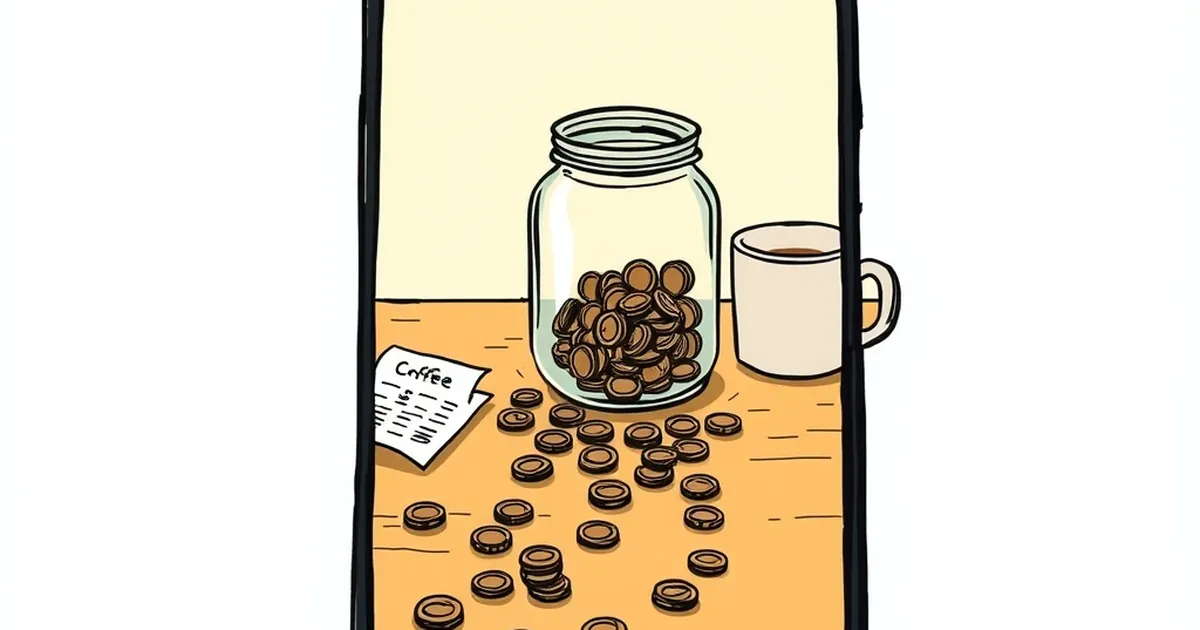
Why does moving $4.80 into a savings bucket feel so much more satisfying than finding the same amount already sitting in your checking account? The answer sits somewhere between behavioral psychology and the way fintech products are engineered to make small transfers feel consequential. And it matters more than you'd think, because round-up apps have quietly become one of the most widely used consumer finance tools of the past decade.
The mechanic is boring. The feeling isn't.
If you've used a round-up feature — Acorns, Chime, Monzo, Revolut, or the dozens of bank-native versions that followed — you already know how it works. You spend $4.20 on coffee. The app rounds the transaction to $5.00 and sweeps $0.80 into savings or an investment account. Repeat that a few hundred times a year and you've moved a few hundred dollars without noticing.
On paper, this is a trivial cash-flow rearrangement. The money was always yours. Moving it from one pocket to another doesn't create value. And yet the psychological payoff is real, measurable, and almost comically out of proportion to the amount.
The average round-up transfer in most consumer apps lands somewhere between $0.30 and $1.20. Over a month of normal spending, that's often $15 to $40. But users consistently describe the experience as though they've saved far more. There's a reason.
Why $4.80 registers as $40
Behavioral economists have known for decades that people don't evaluate money in absolute terms. They evaluate it relative to a reference point, and they weight gains and losses asymmetrically. Kahneman and Tversky's prospect theory — the work that eventually earned Kahneman the Nobel — showed that losses feel roughly twice as painful as equivalent gains feel pleasurable. The corollary is just as important: small, unexpected gains feel disproportionately good because they arrive without a matching sense of sacrifice.
A round-up hits both notes at once.
First, the amount is small enough that it never triggers loss aversion. You don't experience the $0.80 as money taken away, because it was never psychologically "yours" in the first place. It was change. It was rounding error. It existed in the same mental category as the pennies in a jar on your dresser.
Second, the transfer arrives as a gain you didn't consciously choose. You didn't sit down and decide to save $0.80. The app decided. That automaticity matters. Research on default effects — most famously the 401(k) auto-enrollment studies by Madrian and Shea — shows that people save dramatically more when the decision is made for them, even when opting out is trivial. Round-ups are auto-enrollment at the transaction level.
Third, and this is the part that fintech designers understood earlier than most, the app shows you the number. A growing balance. A little animation. A monthly summary. That's a feedback loop, and feedback loops are what convert a passive behavior into a habit.
The variable-ratio thing nobody wants to name
There's a less comfortable parallel here, and it's worth being honest about.
Variable-ratio reinforcement — the schedule where a reward arrives after an unpredictable number of actions — produces the most persistent behavior of any reinforcement pattern B.F. Skinner studied. It's the same mechanism that makes social media feeds sticky and email inboxes compulsive. It's also, structurally, what a round-up app delivers.
You don't know how much you'll round up on any given purchase. Sometimes it's $0.03. Sometimes it's $0.97. The unpredictability is tiny, but it's there, and the app surfaces it in a satisfying way. Over a week, the accumulated total feels like a small windfall rather than an arithmetic inevitability.
I'm not suggesting a savings app is equivalent to a social media slot machine. The stakes are inverted — you're building a balance, not draining one. But the engagement mechanics are cousins, and pretending otherwise makes it harder to design these products responsibly.
The responsible version is straightforward: show the user what's actually happening. Don't obscure the fact that round-ups are your own money. Don't dress up a $4.80 monthly total as a $40 feeling without also showing the real number. The apps that do this well — Monzo's round-up pots, for instance, which display both the round-up and the underlying transaction — tend to retain users longer than the ones that lean hard into gamification. Trust compounds faster than delight.
The checkout moment is where the illusion breaks
Here's where it gets interesting. The same user who feels great about accumulating $30 in round-ups over a month will often hesitate at checkout when asked to spend that $30.
This is mental accounting, a concept Richard Thaler developed and which is now one of the most robust findings in behavioral finance. People don't treat money as fungible. They put it in buckets — "savings," "fun money," "bills" — and they protect the buckets differently. Once round-ups land in the savings bucket, spending them feels like a loss, even though it's the same dollars.
You can watch this play out in real user behavior. Someone will happily spend $4.80 on a coffee without a second thought, then agonize over whether to withdraw $4.80 from their round-up account to cover a parking meter. The dollar amount is identical. The psychological cost is not.
Fintechs have learned to exploit this gently. Some apps now let you "spend your round-ups" on specific goals — a vacation fund, a gadget, a gift — which reframes the withdrawal as a reward rather than a loss. Others lock round-ups into investment accounts, adding friction that makes withdrawal feel like breaking a commitment. Both approaches work because they respect the mental accounting that's already happening.
What the next generation of these products gets right
The most interesting shift in the past two years isn't the round-up itself. It's the bundling.
Apps are increasingly combining round-ups with other micro-savings triggers — recurring transfers on payday, "save the difference" features that sweep the gap between a budgeted amount and an actual spend, and rules-based savings that respond to spending patterns. The behavioral logic is the same in each case: reduce the decision cost to zero, keep the amount small enough to avoid loss aversion, and make the accumulated result visible.
What's changing is the sophistication of the feedback. Instead of a single balance, users now see projections, streaks, and goal progress bars. That's Kahneman's reference point doing useful work — a moving target that keeps the gain feeling fresh.
The next frontier is likely interest and yield. As more round-up products connect to high-yield savings or money market accounts, the $4.80 stops being purely psychological and starts earning. That's a genuinely better story than the feeling. It's also harder to fake, which is probably good for everyone.
If you're building or choosing one of these products, the question worth asking isn't "how big does this feel?" It's "what does this look like in twelve months, and does the user still trust the number they see?" The apps that answer that honestly will still be around when the novelty of rounding up wears off.